Longtime North Carolina Congresswoman Virginia Foxx Concedes House Seat to Democrat Chuck Hubbard Following Historic Midterm Recount

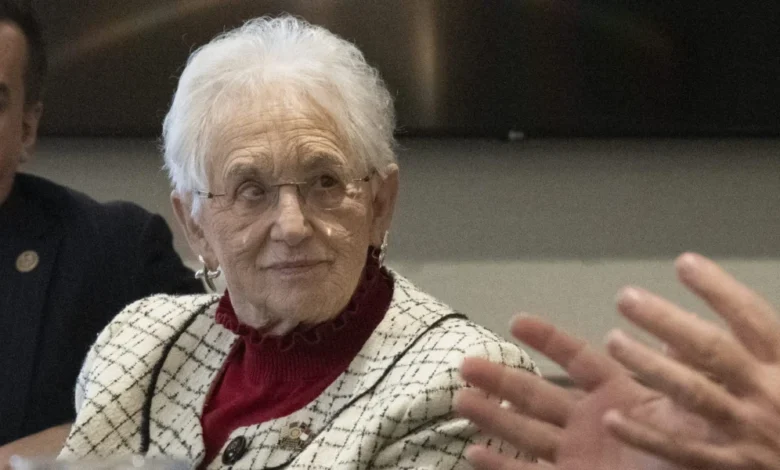
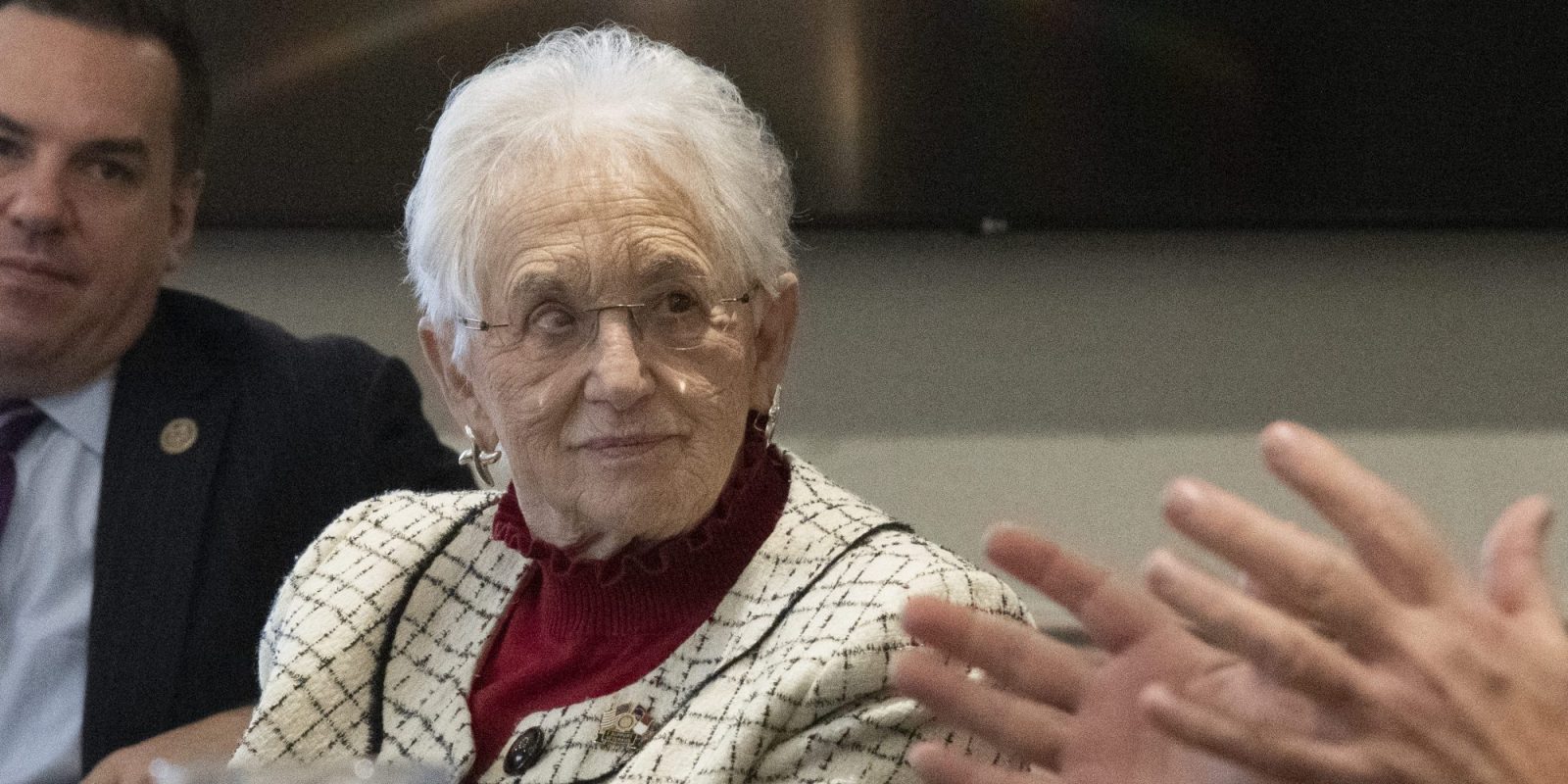
An 83-year-old veteran lawmaker has lost her seat in the United States House of Representatives following a razor-thin recount that concluded a tumultuous 2026 midterm election cycle. Representative Virginia Foxx, an 11-term Republican representing North Carolina’s 5th Congressional District, conceded the race to Democratic challenger Chuck Hubbard after a mandatory recount established a 330-vote margin. The defeat punctuates a dramatic electoral shift that saw widespread Democratic gains nationwide, turning what was once considered a secure Republican stronghold into a historic pickup.
The conclusion of the NC-5 contest marks the final unresolved race of the 2026 midterms, cementing a 258-seat Democratic majority in the House—the party’s largest representation in the chamber since 1992. The outcome also brings closure to a bizarre political controversy that erupted earlier in the year involving the veteran congresswoman, a 10-year-old constituent, and a contentious policy debate over electric vehicles and climate change.
The Origins of a Constituent Controversy
The political friction that ultimately shadowed Foxx’s reelection bid began as a standard elementary school civics assignment. Christian Mango, a 10-year-old student living in North Carolina, was encouraged by his educators to research a public policy issue of his choice and correspond with an elected official. Christian elected to write to his congressional representative, Virginia Foxx, focusing his correspondence on the merits of electric vehicles (EVs) and broader environmental action.
In his handwritten letter, Christian articulated several arguments supporting zero-emission transportation, noting that electric vehicles produce zero tailpipe emissions, require less maintenance, and eliminate the need for gasoline purchases. He proposed that the federal government incentivize EV adoption through a $5,000 consumer tax rebate. Furthermore, Christian touched upon climate change mitigation, expressing concern over glacial melting and global air quality.
While the young student’s letter contained minor colloquial conflations between weather and climate, his mother, Emily Mango, emphasized that the essay was thoroughly researched and rooted in civic engagement. However, the response received from Representative Foxx’s congressional office sharply escalated the situation.
A Controversial Official Response Sparks Public Outrage
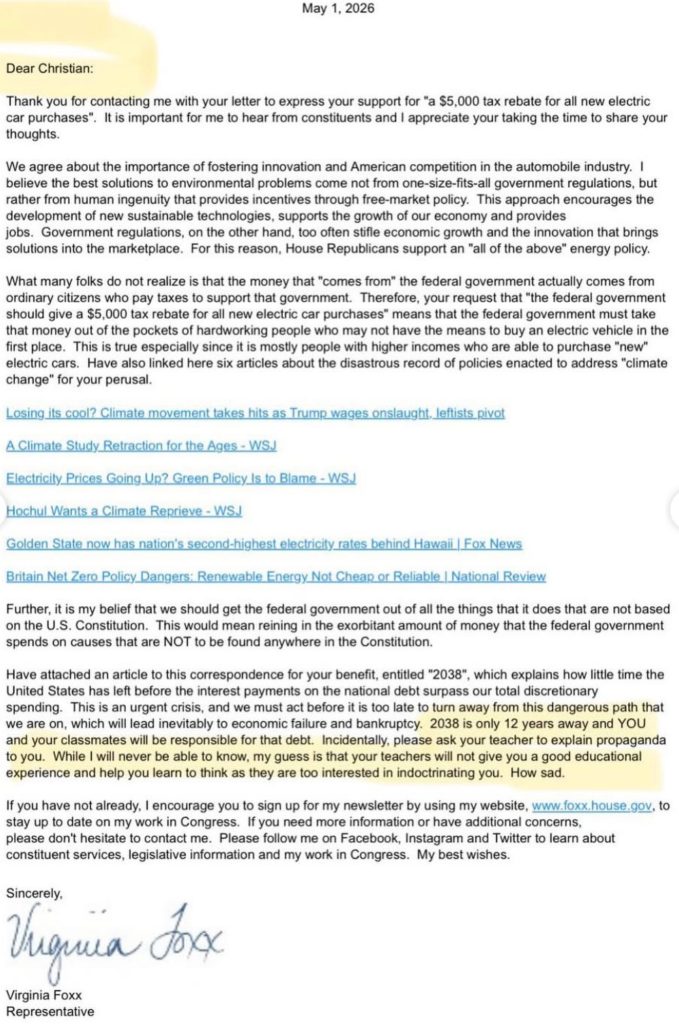
Rather than offering a standard, encouraging boilerplate response designed to foster civic participation in youth, Foxx’s office issued a pointed critique. The letter dismissed the student’s assertions, questioned the validity of climate science by citing various conservative publication editorials and opinion columns, and admonished the child regarding national debt and the role of educators.
In the correspondence, Foxx asserted that federal EV tax credits primarily benefit higher-income demographics purchasing new vehicles. She criticized federal spending initiatives and explicitly warned the 10-year-old that his generation would bear the financial burden of current national debt obligations. Additionally, the congresswoman’s letter contained disparaging remarks directed at the public education system, cautioning the student against academic "indoctrination."
Emily Mango publicized the response on social media, describing the congresswoman’s tone as hostile, demoralizing, and inappropriate for a communication directed at a minor. The post quickly circulated across digital platforms, drawing sharp criticism from constituents, education advocates, and environmental groups who viewed the response as a failure of constituent service and basic decorum.
Policy Paradoxes: EVs, Energy Policy, and National Debt
The policy positions articulated in Foxx’s response invited substantial scrutiny from political analysts and energy sector observers, particularly regarding the dichotomy between her stated rhetoric and her legislative voting record.
While Foxx’s letter championed an "all-of-the-energy-above" approach, her legislative actions consistently opposed policies supporting clean energy infrastructure and zero-emission vehicle manufacturing. Critics noted that electric vehicles are uniquely suited to an all-sources energy grid, as they can draw electricity generated from nuclear, wind, solar, hydroelectric, or fossil fuel generation. Conversely, internal combustion engine vehicles remain exclusively reliant on petroleum derivatives.
Furthermore, Foxx’s critique of national debt regarding federal clean energy incentives contrasted sharply with her support for broader fiscal legislation. The congresswoman had previously voted in favor of major tax and expenditure packages that independent economic scoring organizations, such as the Committee for Responsible Federal Budget and the Congressional Budget Office, projected would add trillions of dollars to the national deficit. By contrast, revenue-positive measures like the prior Inflation Reduction Act had introduced deficit-reduction provisions alongside clean energy investments.
A Historic Midterm Wave and the North Carolina Context
When the constituent controversy initially gained public attention in May, political forecasters viewed North Carolina’s 5th District as overwhelmingly safe for the incumbent. Foxx, who had maintained a commanding presence in state politics for decades, was heavily favored to secure a 12th term in a district traditionally insulated by conservative voting patterns.
However, the political landscape shifted dramatically as the November 2026 midterms approached. Voter sentiment nationwide was heavily influenced by broader economic pressures, global energy price fluctuations, and voter fatigue surrounding congressional leadership. Across the country, traditionally secure Republican seats experienced unprecedented voter erosion, leading to a sweeping "blue wave" that handed control of both chambers of Congress to the Democratic Party.
In North Carolina, these national headwinds collided with state-level redistricting dynamics. Following strategic mid-decade map redraws designed to secure legislative majorities, Republicans engineered district lines across several states to maximize partisan advantage. However, the sheer magnitude of voter turnout and anti-incumbent sentiment caused these efforts to backfire—a phenomenon political analysts describe as a "dummymander"—where excessively narrow victory margins left multiple seats vulnerable to unexpected Democratic swings.
The Recount and Concession
The race in North Carolina’s 5th Congressional District proved to be the ultimate embodiment of this electoral volatility. Following initial election night tallies, the contest between Foxx and Democratic challenger Chuck Hubbard—a former journalist and regional native—was too close to call.
As provisional and absentee ballots were tabulated, the lead shifted by razor-thin margins. When unofficial totals placed Hubbard ahead by a mere 0.12 percentage point—a difference of 330 votes out of hundreds of thousands cast—Foxx officially petitioned the North Carolina State Board of Elections for a statewide recount.
State election officials conducted the rigorous vote verification process over subsequent weeks. As precincts reported certified totals, the 330-vote margin held firm. Facing the mathematically confirmed defeat, Foxx formally conceded the election, bringing an end to her lengthy tenure in the House of Representatives and finalizing the roster of the 110th Congress.

Broader Implications and Future Outlook
The defeat of Representative Foxx carries significant symbolic and practical weight. Capitol Hill observers note that the unseating of such a senior and entrenched member underscores the potency of grassroots mobilization, constituent communication accountability, and the unpredictable nature of modern electoral maps.
For the constituents of North Carolina’s 5th District, the transition to Representative-elect Chuck Hubbard signals a shift in congressional representation focused on regional economic development, infrastructure modernization, and public education support. Meanwhile, the incident involving young Christian Mango remains a prominent case study in the intersection of civic education, digital accountability, and the direct impact of constituent correspondence in the digital age.
As political analysts evaluate the fallout of the 2026 midterms, the North Carolina race stands out as a testament to the volatility of contemporary American politics, where local interactions and macroeconomic pressures can converge to reshape the halls of power.
Related posts: