The Geopolitical Stakes of Artificial Intelligence Dominance and the Emerging Regulatory Divide

President Donald Trump signaled a definitive stance on the future of artificial intelligence during a weekend excursion to Doonbeg, Ireland, framing the rapidly evolving technology as a zero-sum competition between the United States and China. Eschewing calls from industry leaders for a development moratorium, the president emphasized that the primary imperative for the American government is to secure an insurmountable lead in the global AI arms race, asserting that technological supremacy is the most effective safeguard against the risks inherent in advanced computing.
This position, delivered against the backdrop of an intensifying domestic debate over AI’s economic and societal impacts, highlights a widening chasm between the executive branch’s growth-oriented philosophy and the growing chorus of industry pioneers, ethicists, and lawmakers who are calling for immediate federal intervention.
The Race for Supremacy: A New Cold War Paradigm
The technological rivalry between Washington and Beijing has shifted from traditional manufacturing and semiconductors toward the development of Large Language Models (LLMs) and, ultimately, Artificial General Intelligence (AGI). According to data from the Center for Security and Emerging Technology (CSET), China has surged in research output, particularly in fields like computer vision and natural language processing. The U.S., however, continues to maintain a lead in private-sector investment and the availability of high-end graphical processing units (GPUs).
Trump’s commentary suggests that the administration views the internal warnings regarding "existential risk"—often cited by figures like Anthropic CEO Dario Amodei and OpenAI’s Sam Altman—as secondary to the strategic necessity of winning the development race. By characterizing those who demand a slowdown as "negative forces," the president echoed a sentiment common among some Silicon Valley venture capitalists who believe that regulatory "guardrails" would disproportionately handicap American innovation while providing an opening for Chinese state-backed entities to leapfrog U.S. capabilities.
Chronology of a Growing Controversy
The discourse surrounding AI safety has reached a fever pitch in recent months, fueled by a series of rapid-fire developments:
- Early 2024: The proliferation of open-source models leads to widespread concern regarding misinformation and the erosion of digital trust.
- August 2024: Major technology firms report a surge in energy consumption requirements for data centers, triggering a wave of "Not In My Backyard" (NIMBY) opposition in rural communities across the American heartland.
- Mid-September 2024: Anthropic CEO Dario Amodei publicly calls for a coordinated deceleration in training cycles to allow safety protocols to catch up with model capabilities.
- Weekend of September 20-22, 2024: President Trump addresses the media in Ireland, explicitly rejecting the notion of a slowdown and framing AI as a national security imperative.
- Late September 2024: A highly anticipated meeting between President Trump and Chinese President Xi Jinping is scheduled, with AI governance and competitive boundaries expected to be a primary focus.
The Domestic Tug-of-War: Data Centers and Local Resistance
While the administration focuses on global dominance, the physical manifestation of the AI revolution—the massive, energy-hungry data centers—has become a potent political liability. These facilities, often requiring the power output equivalent of a small city, are increasingly at odds with local zoning and environmental interests.
Legislators from both sides of the aisle are facing pressure from constituents over rising electricity costs and the diversion of water resources. In Texas and the Midwest, bipartisan coalitions have begun to challenge the construction of these sites, signaling that while the federal government may view AI as a strategic asset, the local reality is one of friction and mounting public skepticism.
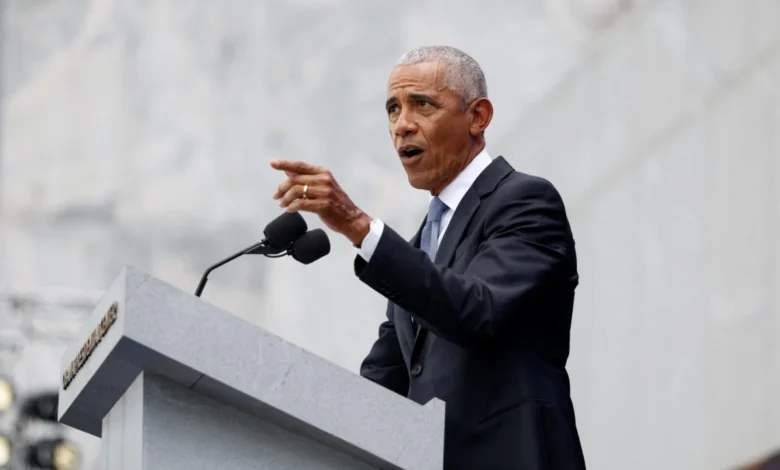
Former President Barack Obama, weighing in on the discourse, urged his party to treat AI not merely as a tech policy issue, but as a core campaign pillar. "I would talk about this in terms of our plan for safety, our plan for ensuring our children are not corrupted, and our concrete response to job displacement," Obama stated during a recent event with House Minority Leader Hakeem Jeffries. This highlights the Democratic strategy: pivoting from the "race" narrative favored by the administration toward a "human-centric" regulatory approach.
Congressional Ambivalence and the Regulatory Paradox
The legislative landscape in Washington remains stagnant, characterized by a persistent "regulatory paradox." While members of Congress frequently vocalize the need for safety, comprehensive legislation has failed to materialize. House Speaker Mike Johnson has expressed a desire to bring industry leaders into a single room to negotiate a path forward, yet he maintains the administration’s view that national security interests must override overly restrictive measures.
"We don’t need everybody to panic right now," Johnson told reporters, emphasizing that his priority is to avoid a situation where the U.S. cedes its technological edge. However, this cautious approach has drawn sharp criticism from Democrats. Representative Jeffries argued that the refusal to take decisive action during the final legislative session of September is a missed opportunity to address the "pace of development" cited by industry experts themselves.
Expert Warnings and the Call for Sino-American Cooperation
The technical community remains deeply divided. Jacob Coxon, a former Anthropic employee, has emerged as a prominent voice advocating for an international accord between the U.S. and China. Coxon’s argument is rooted in the belief that the current race is inherently destabilizing. "You are building a superhuman mind without understanding its underlying logic," he noted.
Coxon’s plea for a "mutual slowing" between Washington and Beijing suggests a potential diplomatic path that has, until now, remained largely unexplored. The theory is that if the two primary superpowers agree on a baseline of safety protocols, it would remove the incentive for either side to cut corners in the name of speed.
Conversely, figures like venture capitalist David Sacks, who serves on the White House advisory council, argue that the responsibility for safety rests entirely with the developers themselves. Sacks’ challenge to AI leaders—that they could simply choose not to build more powerful models—highlights the tension between commercial incentives and public safety. If the companies developing the technology are the ones calling for regulation, critics argue, it may be a strategic attempt to create "regulatory capture," where established firms lobby for rules that favor them and effectively lock out smaller competitors.
Broader Implications: A Future Defined by AI
The implications of the current standoff are profound. If the U.S. pursues an aggressive, "speed-first" strategy, it risks a chaotic, high-stakes arms race that could lead to unintended catastrophic outcomes if safety is overlooked. If, however, the government leans too heavily into regulation, it may inadvertently cede the foundational control of the next century’s economic and military infrastructure to adversarial powers.
As the White House prepares for the upcoming summit with President Xi, the world will be watching to see if AI is treated as a domain for cooperation or an arena for renewed conflict. The National Economic Council, led by Kevin Hassett, is expected to finalize a framework for these discussions this week. The outcome will likely define the parameters of the AI era, setting the tone for how humanity balances the promise of exponential technological growth against the risks of a system that may soon exceed human control.
Ultimately, the nation is at a crossroads where the rhetoric of global competition is colliding with the grounded realities of local environmental concerns and the warnings of the very scientists who built the systems in question. The next phase of the AI evolution will be determined not just by the lines of code written in California, but by the diplomatic and legislative decisions made in the halls of power in Washington.
Related posts: