James Webb Space Telescope Reveals Ancient Galaxies Emerging From the Cosmic Dark Ages

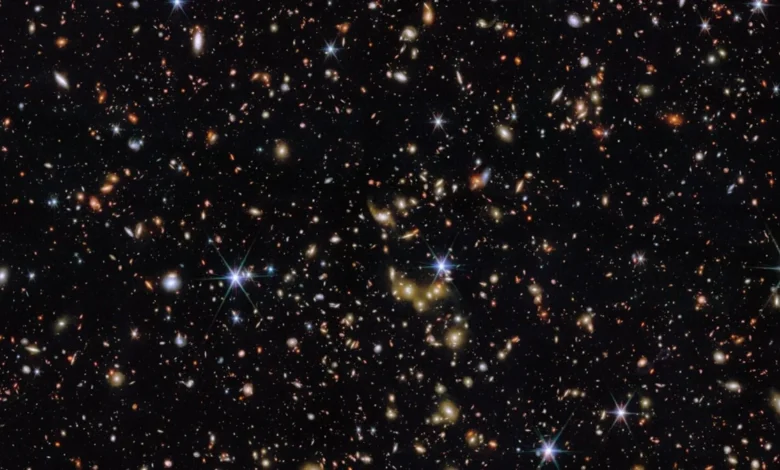
The James Webb Space Telescope (JWST) has once again recalibrated our understanding of the early universe, capturing unprecedented imagery of distant, primordial galaxies that emerged during the final stages of the Cosmic Dark Ages. This latest deep-field observation, coordinated by the international COSMOS-Web team, provides a window into an epoch when the universe was less than 500 million years old. By peering through the thick veil of interstellar dust and gas that previously obscured our view, astronomers are now able to analyze the structural evolution of these infant galaxies, offering critical insights into how the first stars and structures in the cosmos were forged from the remnants of the Big Bang.
The Chronology of the Early Universe
To understand the significance of these observations, one must first look at the timeline of the universe’s infancy. Following the Big Bang, approximately 13.8 billion years ago, the universe entered a period of rapid expansion and cooling. Roughly 380,000 years after the initial event, the universe became transparent as neutral hydrogen formed, a stage known as recombination. Following this, the universe entered the "Cosmic Dark Ages," a period lasting several hundred million years where no stars or galaxies existed to emit light.
The "Cosmic Dawn" marks the transition from this period of darkness to the formation of the first luminous structures. Scientists have long theorized that gravity began pulling clumps of matter together, eventually triggering nuclear fusion within the first gas clouds. The images recently transmitted by the JWST capture this specific, transformative era. By analyzing the light from these galaxies—which has been stretched into the infrared spectrum by the expansion of the universe—the JWST acts as a time machine, allowing researchers to study the formative years of the cosmos in greater detail than ever before.
Technical Prowess: Why JWST Excels
The reason for this leap in discovery lies in the technological design of the James Webb Space Telescope. Unlike the Hubble Space Telescope, which primarily operates in the visible and ultraviolet light spectrums, the JWST is optimized for infrared observation. This is crucial because, as light travels across the vast distances of the expanding universe, its wavelength is stretched—a phenomenon known as cosmological redshift. Light that started as ultraviolet or visible light from young, hot stars billions of years ago arrives at our detectors today as infrared light.
The telescope’s primary mirror, a gold-coated hexagonal array spanning 6.5 meters, provides the sensitivity required to detect the faint, ancient glow of these galaxies. Furthermore, its location at the second Lagrange point (L2), roughly 1.5 million kilometers from Earth, ensures that the telescope remains in a stable, cold environment, shielded from the heat of the Sun, Earth, and Moon. This thermal stability is essential for maintaining the high-precision measurements needed to map the distribution of galaxies in the deep field.
Supporting Data and Scientific Observations
The data released by the COSMOS-Web team comprises a massive survey of the sky, intended to map the distribution of dark matter and the evolution of galaxies over cosmic time. Preliminary analysis of these deep-field images indicates that galaxies in the early universe were significantly more organized and structurally complex than previous models had predicted.

Current data suggests:
- Rapid Assembly: Many of the observed galaxies exhibit well-defined disks and structures, suggesting that star formation occurred at a much faster rate in the early universe than previously modeled.
- Galaxy Density: The number of luminous galaxies detected at these extreme distances challenges existing theories regarding the hierarchical assembly of the universe, implying that dark matter halos may have facilitated faster structure formation.
- Redshift Extremes: Some of the objects identified are characterized by redshifts (z) exceeding 10, placing them at an age where the universe was only a tiny fraction of its current size.
Perspectives from the Scientific Community
Dr. A. Koekemoer and the international team involved in the project have noted that these findings are not merely snapshots but are foundational to the next generation of cosmological modeling. "The level of detail we are seeing is transformative," noted one researcher associated with the project. "We are no longer looking at smudges of light; we are looking at the architecture of the early universe."
The collaboration between NASA, the European Space Agency (ESA), and the Canadian Space Agency (CSA) has ensured that the data is processed with a focus on both aesthetic clarity and scientific utility. By combining infrared imaging with spectroscopic data, the team is working to determine the chemical composition of these galaxies. Identifying elements such as oxygen and carbon in these early systems will provide evidence of previous generations of stars, further refining our understanding of the universe’s chemical enrichment history.
Broader Implications and Future Research
The implications of these deep-field observations extend beyond simple galactic surveys. By studying how these early structures interacted, astronomers hope to solve the "missing satellite" problem—the discrepancy between the predicted number of small satellite galaxies around major galaxies and the actual number observed. Additionally, the role of supermassive black holes in the centers of these early galaxies remains a subject of intense scrutiny. If these black holes formed early, they likely played a significant role in "quenching" star formation, effectively regulating the growth of their host galaxies.
Looking forward, the COSMOS-Web survey is only the beginning. As the JWST continues its mission, it will provide deeper insights into the "Epoch of Reionization," the period when radiation from the first stars stripped electrons from neutral hydrogen gas, fundamentally changing the physical state of the universe.
Conclusion: A New Era of Cosmology
The images produced by the James Webb Space Telescope represent a pivotal moment in human history. We are witnessing, for the first time, the transition from a dark, chaotic expanse to a structured, illuminated cosmos. This era of observation is forcing theorists to reconsider the pace of galactic evolution and the nature of the dark matter that serves as the cosmic scaffolding for these structures.
As data continues to be disseminated through the scientific community, the focus will shift toward identifying the "first light" sources—the very first stars that ended the Dark Ages. While we have yet to isolate a single Population III star (the hypothetical first generation of stars consisting only of hydrogen and helium), the current deep-field data provides the best map we have ever possessed to guide that search. The story of our universe is being rewritten in real-time, and the James Webb Space Telescope stands as the primary instrument for this monumental endeavor. With every new observation, the veil of the past is pulled back further, revealing the intricate processes that eventually led to the formation of our own galaxy, our solar system, and ultimately, life on Earth.
Related posts: