New Research Suggests Earth Forged Hundreds of Oceans of Water in Its Own Atmosphere

For generations, humanity has looked to the vast, star-strewn canvas of the cosmos and wondered about the ultimate origin of its most precious resource: water. The prevailing scientific consensus long pointed outward, dictating that Earth was once a dry, desolate rock that only acquired its shimmering blue oceans through a fierce, prolonged bombardment of icy comets, volatile-rich meteorites, and distant asteroids crashing down from the outer reaches of the solar system. However, a groundbreaking study published in the journal Nature Geoscience has fundamentally upended this celestial narrative. Researchers at The University of New Mexico have discovered that Earth may have manufactured a substantial portion—potentially hundreds of oceans’ worth—of its own water internally, through violent chemical reactions occurring within its primordial, hellish atmosphere over 4.5 billion years ago.
This paradigm-shifting revelation not only reshapes our understanding of terrestrial history but also breathes new life into the search for extraterrestrial habitability. If rocky planets can independently forge vast quantities of water simply by accumulating material through standard planetary accretion processes, then life-supporting worlds may not be cosmic anomalies reliant on improbable luck. Instead, water could be a routine, baked-in feature of planetary formation across the universe.
The Historical Debate: Looking Outward for the Wet and Wild
To fully comprehend the significance of the recent findings, one must examine the decades of scientific inquiry that preceded them. When the solar system coalesced approximately 4.5 billion years ago from a rotating disc of gas and dust, the inner region—where Mercury, Venus, Earth, and Mars would eventually form—was intensely hot. This thermal hostility meant that volatile compounds like water could not easily condense into ice or remain on the surface of these newborn rocky bodies.
Consequently, conventional planetary formation models argued that the inner planets were born bone-dry. To account for Earth’s current hydrosphere—which covers roughly 71 percent of the surface—scientists hypothesized that an external delivery system was mandatory. This classic hypothesis centered on the Late Heavy Bombardment or continuous impacts from carbonaceous chondrite meteorites and icy comets originating beyond the snow line, the frigid boundary in the solar system where volatile ices can survive.
Yet, this delivery-from-space model has always wrestled with significant hurdles. Planetary scientists have struggled to reconcile isotopic ratios—such as the deuterium-to-hydrogen (D/H) ratios—found in terrestrial oceans with those measured in ancient comets, which often do not match cleanly. Furthermore, calculating the sheer volume of material required to supply Earth’s massive oceans through meteorite impacts alone left researchers debating whether the math truly added up.
The New Mechanism: Rocky Pebbles and a Reducing Atmosphere
Enter a radical alternative: internal manufacturing. The new study, spearheaded by graduate student Susmita Garai under the mentorship of Professor and Director of Earth and Planetary Sciences Zachary Sharp, alongside Professor Peter Olson, investigates an entirely different route to ocean genesis. Rather than waiting for water to arrive pre-packaged from the outer solar system, the researchers investigated whether water could be synthesized locally from the very building blocks that constructed the planet.
During the earliest epochs of planetary growth, Earth expanded via a process known as pebble accretion. Countless millimeter- to centimeter-sized fragments of rock—silicate pebbles—swirled around the young Sun and rained down onto the growing protoplanet. As Earth steadily gained mass, its gravitational pull became strong enough to capture and hold onto a dense, primordial envelope of gas, dominated overwhelmingly by hydrogen.
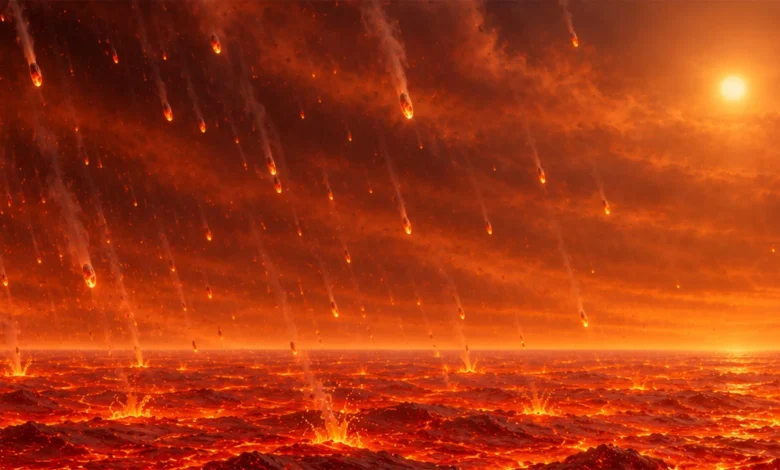
This infant atmosphere bore little resemblance to the oxygen-rich blanket of air that sustains life today. It was a crushing, hyper-thermal environment characterized by extreme pressures and temperatures far exceeding anything experienced on Earth’s modern surface.
In this volatile crucible, a remarkable chemical transformation took place. As rocky pebbles rained down through the hydrogen-rich atmosphere, the hydrogen gas interacted chemically with the iron oxide (rust-like compounds) contained within the silicate rocks. Under blistering heat, the hydrogen stripped oxygen away from the iron oxide, reducing the iron into its metallic state while simultaneously forging water vapor. This newly synthesized water was then released directly into the burgeoning atmosphere, eventually cooling, condensing, and raining down to form the planet’s first primitive pools.
Rigorous Experimentation Under Extreme Conditions
To test the viability of this theoretical pathway, the research team designed a series of high-temperature experiments designed to replicate the hellish conditions of the early Earth. Dr. Garai and her colleagues exposed carefully measured samples of silicate rock to blistering temperatures ranging from 1,200 to 1,400 degrees Celsius (approximately 2,192 to 2,552 degrees Fahrenheit).
The experiments utilized flowing hydrogen gas to mimic the primitive atmosphere, while parallel control tests were conducted using inert helium gas for comparison. Each experimental run lasted anywhere from 15 minutes to three hours, putting the materials under intense thermal stress.
The results were both immediate and striking. Within minutes of exposure to the high-temperature hydrogen environment, the chemical reactions ignited. The experiments revealed that nearly 80 percent of the iron oxide present within the silicate rocks was successfully transformed into metallic iron, with substantial quantities of water vapor generated as a direct byproduct.
Conversely, when the rocks were subjected to identical thermal conditions in the presence of helium rather than hydrogen, the water-producing reaction failed to occur. This stark contrast provided definitive proof that hydrogen was the critical catalyst driving the transformation.
Scaling Up: Hundreds of Oceans in the Crucible
While the researchers initially hypothesized that reduction reactions would yield iron metal and water, the sheer velocity and scale of the output caught them entirely off guard. The chemical conversion occurred within minutes in the laboratory settings. When the team mathematically extrapolated these experimental findings to account for the massive scale of early Earth—factering in the continuous influx of pebble accretion and the sheer volume of hydrogen-rich gas available—the implications proved staggering.
Calculations indicated that this atmospheric-rock interaction could have generated not just a modest dampening, but hundreds of oceans’ worth of water.
"We had suspected and hoped that we would produce iron metal and water in our reduction experiments, but we really had no way of knowing how fast and how much," Professor Sharp remarked. "We were quite surprised to find that extrapolation of our work suggests that hundreds of oceans’ worth of water were likely produced in this way. Looking out over a large body of water, it is hard to imagine that that water may have been produced 4.5 billion years ago in a hell-like atmosphere, but it very well may have."
Implications for Planetary Science and Exoplanet Habitability
The ramifications of this study extend far beyond the geological history of our own home world. By demonstrating that water can be an inherent byproduct of standard rocky planet accretion, the research alters the calculus of astrobiology and the search for life in the universe.
For years, the astrobiological community operated under the assumption that habitable exoplanets—rocky worlds orbiting distant stars within their systems’ Goldilocks zones—required a delicate, statistically improbable chain of events. Specifically, they needed not only to form at the right distance from their host star but also to be struck by just the right number of icy comets to deliver life-giving hydration.
If, however, water production is a natural thermodynamic consequence of a rocky planet accumulating matter beneath a hydrogen-rich atmosphere, then wet, habitable worlds may be a standard evolutionary outcome rather than a cosmic lottery win.
"The idea of pebble accretion is still relatively new. It’s only been around for the last decade. But it seems to solve many problems that exist with the existing paradigm for planet formation," noted Sharp. "And now we see that it also can explain why our planet is habitable. By extension, it is reasonable to expect that other Earth-sized bodies circling other stars would also have water and possibly life."
A New Frontier in Understanding Earth’s Genesis
Despite the compelling nature of the laboratory results, the scientific community emphasizes that this study represents a new chapter in an ongoing investigation rather than the closing argument on Earth’s hydrologic origins. Important uncertainties remain to be resolved.
While the experiments firmly establish that silicate rocks and hydrogen gas can react to produce copious amounts of water under primitive atmospheric conditions, quantifying the exact percentage of modern Earth’s water attributable to this internal manufacturing process—versus external delivery by comets and meteorites—requires further interdisciplinary research. Scientists will need to combine geochemical modeling, isotopic analysis, and advanced astrophysical simulations to trace the precise contribution of pebble-atmosphere reactions through the eons.
Nevertheless, the findings published in Nature Geoscience provide a compelling new framework for viewing our planet’s fiery beginnings. They remind us that Earth was not merely a passive recipient of cosmic benevolence, waiting for stray comets to quench its thirst. Instead, the very forces that tore our world apart and melted its crust during its tumultuous infancy may have simultaneously equipped it with the vital elixir necessary to foster life, transforming a hellish primordial landscape into a blue, life-sustaining cradle.