Northern Ireland’s UEFA Nations League campaign hit a minor speed bump on Tuesday evening as Michael O’Neill’s side were held to a 0-0 draw by a technically proficient but ultimately toothless Hungary team at Windsor Park. Despite a dominant first-half display that saw the hosts dictate the tempo and carve out the game’s clearest opportunities, Northern Ireland were unable to break the deadlock, leaving the Belfast faithful with a sense of what might have been against higher-ranked opposition.
The result serves as both a testament to the continued defensive stability of O’Neill’s evolving squad and a reminder of the clinical edge required to compete at the upper echelons of international football. For Northern Ireland, the match represented a successful return to home soil after 315 days, building on the momentum of their recent victory in Tbilisi. However, the inability to convert pressure into points leaves them in a precarious position as they look to navigate the complexities of Group B2.
A Tactical Masterclass in the First Half
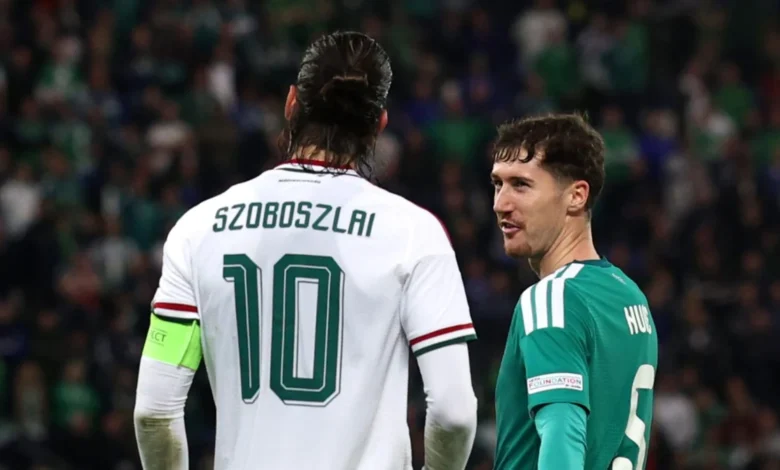
From the opening whistle, Northern Ireland signaled their intent. Bolstered by the atmospheric return to Windsor Park, the home side employed a high-intensity press that unsettled the Hungarian defensive line. The visitors, led by the high-profile presence of Liverpool playmaker Dominik Szoboszlai, found themselves forced into hurried clearances and uncharacteristic errors in possession.
The tactical battle was clearly won by O’Neill in the opening 45 minutes. By utilizing a physical approach and crowding the midfield, Northern Ireland prevented Hungary from establishing any rhythm. The visitors, despite being the higher-ranked side, struggled to bridge the gap between their midfield and attack, with Szoboszlai often forced to drop deep just to receive the ball, his most visible impact being limited to efforts to animate the traveling Hungarian support rather than creative output on the pitch.
Patrick Kelly emerged as the protagonist of the first half. The Barnsley midfielder, growing in stature within the international setup, provided a constant threat. His first significant opportunity arrived shortly after the half-hour mark when an incisive pass from Isaac Price split the Hungarian defense. Kelly’s attempt to chip the onrushing Balazs Toth lacked the necessary elevation, allowing the Blackburn goalkeeper to smother the danger. Moments later, Kelly was agonisingly close again; a long throw from Ciaron Brown caused chaos in the penalty area, and after Shea Charles engaged in a physical tussle with Milos Kerkez, the ball fell to Kelly, whose looped effort kissed the top of the crossbar before drifting over.
Discipline and Defensive Fortitude
As the match progressed, the physical intensity of the contest began to manifest in a flurry of disciplinary action. Referee Ricardo De Burgos found himself at the center of a tense standoff, issuing yellow cards to Shea Charles, Jamie Donley, Isaac Price, and Ethan Galbraith. Even manager Michael O’Neill found himself cautioned for vocal protests, highlighting the palpable frustration on the touchline as the game threatened to boil over.
The second half shifted in dynamic, with Hungary finally finding some attacking impetus. As Northern Ireland’s energy levels dipped, the visitors began to exploit the space between the lines. Schafer, one of Hungary’s more energetic performers, saw a snapshot drift wide before failing to hit the target from a set-piece situation. Donat Barany also went close, heading over the bar from a corner kick as the pressure began to mount on the Northern Irish backline.
However, the defensive unit—anchored by the composed Pierce Charles—remained largely unbreached. Charles, who has now secured five clean sheets in seven competitive appearances, was called into action late in the game to deny Alex Toth. The pivotal moment of the closing stages, however, belonged to Ruairi McConville, whose last-ditch block on a fierce strike from Willi Orban preserved the point. By the final whistle, Hungary had managed only a single shot on target, a statistic that underscores the disciplined, if at times conservative, defensive structure O’Neill has fostered.
Statistical Context and Group Dynamics
The stalemate leaves Northern Ireland with a solid, if unspectacular, start to their Nations League journey. Having secured a late 1-0 victory in Tbilisi just days prior, the four-point haul from the opening fixtures provides a stable platform for the remainder of the group stage.
Historically, Windsor Park has remained a fortress under O’Neill’s stewardship. The team has now lost only one of their last 10 competitive fixtures in Belfast, a record that reflects the distinct advantage of playing in front of their own supporters. This defensive resilience is not a new development; it is a continuation of a project that prioritizes collective structure over individual flair.
In terms of group standings, the draw keeps Northern Ireland in the mix, though the missed opportunity against Hungary may prove costly should the group remain tight. The objective for O’Neill remains clear: transition the current defensive solidity into a more fluid attacking system capable of unlocking defenses that sit deep or frustrate the play.
Post-Match Analysis and Implications
The post-match reaction from the camp was one of measured disappointment. While there was a recognition that the performance warranted a victory, the coaching staff remained pleased with the application of the game plan. The decision to employ a physical, pressing style clearly rattled the Hungarians, and for long periods, it appeared as though Northern Ireland were the side competing at a higher level.
For O’Neill, the challenge remains the development of his young squad. With the likes of Kelly, Price, and Charles gaining invaluable minutes against top-tier European talent, the experience of managing a game against a team of Hungary’s caliber is vital. The disciplinary issues, while a point of contention, also highlight a team that is not afraid to engage in the "dark arts" of the game to secure a result—a necessary trait for any side looking to punch above its weight in international football.
The implications for the remainder of the group are significant. With Hungary expected to be the main rivals for top spot, dropping points at home is a setback. However, the clean sheet and the ability to nullify a playmaker of Szoboszlai’s quality suggests that Northern Ireland have the tools to remain competitive in every fixture.
Future Outlook
As the squad disperses for their respective club duties, the focus will shift to refining the attacking transitions. The lack of clinical finishing in the final third was the only major flaw in an otherwise disciplined display. Whether it is a matter of confidence or a need for more tactical variation in the final third, O’Neill will be looking to address these issues before the next international window.
Looking ahead, the resilience shown in these opening matches provides a blueprint for the campaign. If Northern Ireland can marry this defensive iron with a sharper edge in front of goal, they remain a formidable prospect in Group B2. The journey is long, and while the result against Hungary was a draw, the performance itself suggests that this Northern Ireland side is far from a finished product—and that is a prospect that will likely encourage their supporters as they look toward the next set of fixtures.
Related posts: