Ancient fragment of the Odyssey discovered in Utrecht University library reveals new insights into classical literature preservation

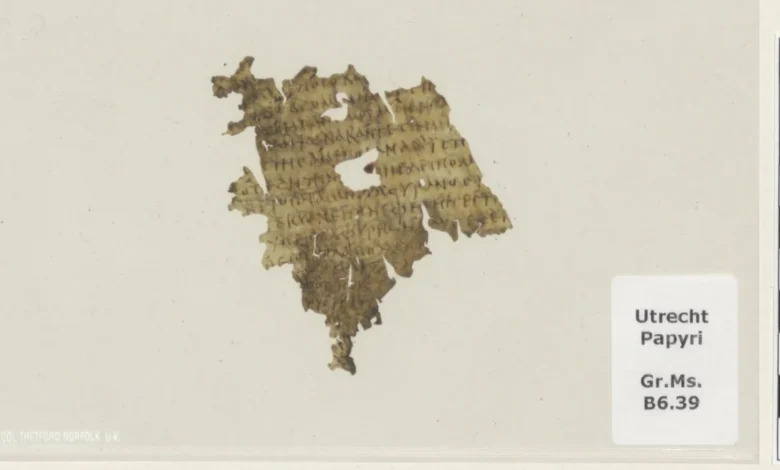
In a remarkable convergence of modern archival research and classical scholarship, a long-overlooked piece of parchment housed within the Utrecht University library has been identified as a significant fragment of Homer’s Odyssey. The discovery, which sheds light on the circulation of Greek literature in late antiquity, was made by Mark de Kreij, a specialist in Greek literature and professor at Radboud University. The fragment, dated to approximately A.D. 300, provides a rare glimpse into the material culture of reading in Roman-era Egypt, suggesting that epic poetry was not merely the domain of high-status libraries but was also accessible through portable, "pocket-sized" editions.
The Discovery: A Chance Encounter in the Archives
The identification of the fragment occurred during a systematic review of early Christian manuscripts. Utrecht University had acquired the collection in the mid-20th century, but the vast majority of these documents—many of which are written on papyrus or parchment—remained cataloged under broader, less descriptive headings. While examining these items for his own research, de Kreij encountered a small, weathered scrap of parchment that stood out from the surrounding theological texts.
Upon closer inspection, the text on the parchment revealed distinct hexameter lines that de Kreij immediately recognized as passages from the Odyssey. The realization that he was holding a 1,700-year-old copy of Homer’s epic within a university collection highlights the potential for "hidden" discoveries within existing institutional archives. The parchment is believed to be a remnant of a codex, a precursor to the modern book, which was gaining popularity over the traditional scroll format during the transition from the third to the fourth century.
Chronology of the Fragment and Its Journey
The history of the fragment is characterized by long periods of obscurity followed by this recent academic revelation. To understand the significance of the find, one must look at the timeline of the artifact’s existence:
- Circa A.D. 300: The fragment is produced in Egypt. At this time, Egypt was a province of the Roman Empire, and Greek remained the primary language of administration, literature, and intellectual discourse. The format—a pocket edition—suggests the text was intended for personal use, likely by a student or a traveler.
- Early 20th Century: The collection containing the fragment is assembled, likely by antiquities dealers in Egypt, and eventually finds its way into the European market.
- Mid-20th Century: Utrecht University acquires the collection as part of a broader effort to expand its holdings in ancient manuscripts, specifically focusing on early Christian texts.
- Late 20th Century to 2024: The fragment remains in the library archives, largely unexamined in its specific context, until the recent research initiative led by de Kreij.
- September 2024: Utrecht University and Radboud University formally announce the identification of the fragment, marking its transition from an anonymous scrap to a recognized piece of Homeric history.
Material Analysis and Historical Context
The Odyssey fragment is noteworthy not only for its content but for its physical form. In the third and fourth centuries, the transition from papyrus scrolls to parchment codices was well underway. Parchment—treated animal skin—was more durable than papyrus, making it ideal for texts that were handled frequently.
The fact that this was a "pocket edition" is a significant detail for classical historians. Most surviving fragments of Homer from this period are either grand, expensive scrolls intended for public performance or highly formal editions for the elite. A pocket-sized copy indicates that Homer was being read privately and potentially during travel. This suggests a broader democratization of classical literature in the Roman provinces, where even modest households or individual scholars might possess their own copies of the foundational Greek epics.
The paleography—the study of ancient handwriting—also aligns with the A.D. 300 dating. The script exhibits features consistent with the "Roman cursive" or "book hand" styles common in the Egyptian provinces during the late third and early fourth centuries.
Institutional Responses and Academic Significance
The discovery has been met with enthusiasm from the global archaeological and philological community. In an official statement, Utrecht University emphasized the collaborative nature of the research, noting that the intersection of theology and classical literature in their archives often leads to unexpected outcomes.
"This fragment is a testament to the enduring presence of Homer in the ancient world," a university spokesperson stated. "It serves as a reminder that the canon of Greek literature was deeply integrated into the daily lives of people living in Roman Egypt, bridging the gap between high culture and the practical reality of literacy."
Mark de Kreij’s work on the fragment is expected to be part of a larger publication that will analyze the textual variations between this fragment and the standard versions of the Odyssey used today. Scholars are particularly interested in whether the fragment contains unique "variants"—slight changes in wording or structure—that might reveal how the Odyssey was edited or remembered by scribes in late antiquity.
Implications for Classical Studies
The identification of this fragment carries several broader implications for the field of classical studies:
- Archival Re-evaluation: This discovery underscores the necessity of re-examining institutional collections. Many libraries and museums across Europe hold "unidentified" fragments that were cataloged decades ago with limited information. Modern technology, combined with the expertise of scholars like de Kreij, offers a path to identifying these "lost" texts.
- Mapping Literacy in Antiquity: The existence of a portable Odyssey suggests that literacy was not limited to the administrative elite. It reinforces the theory that Greek epic poetry remained the cornerstone of education and personal enrichment for centuries after its composition.
- Transmission of Texts: By comparing this fragment to other known papyri and parchments, researchers can map the transmission of the Odyssey. This helps determine how stable the text was as it moved through time and geography, providing clues about the accuracy of the copies that eventually became the basis for modern printed editions.
- Material Culture: The shift to codices, as evidenced by this fragment, represents a pivot point in human communication. The transition from the scroll to the codex allowed for easier indexing, faster searching, and greater longevity for books, fundamentally changing how humans interacted with long-form literature.
Data and Comparative Analysis
While the fragment itself is small, its scientific value is measured in the information it yields about the broader Homeric tradition. Current data on Homeric papyri and parchment finds, as compiled by the Advanced Papyrological Information System (APIS), shows that Homer is the most frequently represented author in the Egyptian finds, far outnumbering other poets such as Hesiod or Euripides.
However, the majority of these finds date to the second and third centuries. A fourth-century fragment is increasingly rare, as it marks the end of the traditional pagan literary tradition’s dominance as Christianity began to assert its cultural influence. The presence of a Homeric text in a collection otherwise dominated by early Christian manuscripts is a fascinating juxtaposition. It suggests that the owner of this collection likely valued both the classical tradition and the emerging Christian faith—a common reality for the intellectual class in Roman Egypt.
Future Research Directions
Following the public announcement, the fragment is expected to undergo further non-invasive analysis. Multispectral imaging may be employed to reveal faint or damaged ink strokes, allowing for a more complete transcription of the text. Furthermore, the library plans to digitize the fragment as part of an open-access project, ensuring that scholars worldwide can study the high-resolution images of the manuscript.
The case of the Utrecht Odyssey fragment is a poignant reminder of how history is not always found in the grand monuments of the past, but often in the overlooked scraps of parchment stored in quiet university corridors. As the academic community turns its attention to this finding, it reinforces the value of meticulous archival research. The Odyssey, a story about the long and arduous journey home, has itself found a small, significant way back into the light of modern scholarship.
For now, the fragment remains in the specialized climate-controlled environment of the Utrecht University library, where it is being preserved for future generations. Its discovery has reignited discussions on the necessity of funding the digitization and study of ancient archives, proving that even the smallest piece of parchment can hold a monumental place in our understanding of the human story. As de Kreij continues his work, the literary world awaits the full analysis of what this 1,700-year-old pocket edition might tell us about the readers who held it, the scribes who copied it, and the enduring power of Homer’s narrative.