Spain Secures 2026 FIFA World Cup Title as Frosted Tips and Generational Narratives Dominate the Global Stage at MetLife Stadium

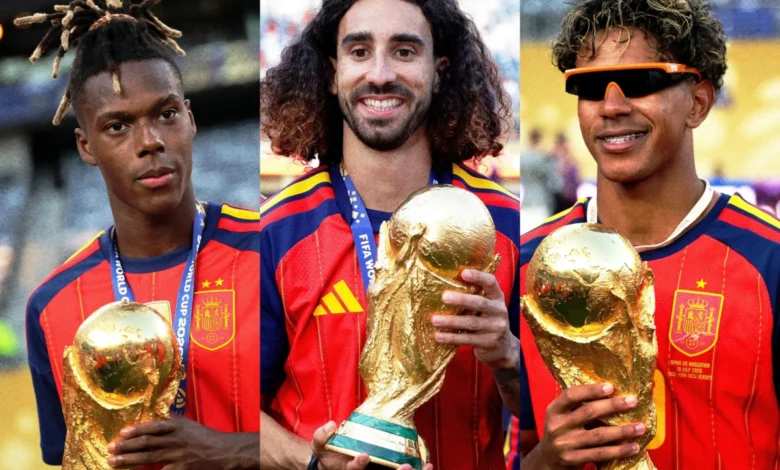
Spain has officially ascended to the pinnacle of international football, securing the 2026 FIFA World Cup trophy after a grueling month-long tournament that culminated in a 1-0 victory over Argentina at MetLife Stadium in East Rutherford, New Jersey. In a match defined by tactical rigidity, high-stakes drama, and a singular moment of brilliance, the Spanish national team claimed their second world title, ending Argentina’s hopes of a back-to-back championship. Beyond the tactical masterclass displayed on the pitch, the tournament will be remembered for its distinct cultural footprints, most notably a widespread revival of the "frosted tips" hairstyle among the world’s elite athletes and a poignant passing of the torch between the game’s greatest legend and its brightest young star.
The final, held before a capacity crowd of over 82,000 spectators, served as the centerpiece of the first-ever 48-team World Cup hosted across the United States, Mexico, and Canada. The decisive goal arrived in the second half, orchestrated by the explosive Nico Williams and finished by Ferran Torres. While the scoreboard remained narrow, the narrative surrounding the match was expansive, touching on everything from grooming trends to the sociological evolution of the modern footballer’s personal brand.
The Tactical Breakdown: Spain’s Path to Glory
The final match was a clash of philosophies. Argentina, led by the venerable Lionel Messi in what many assume to be his final international appearance, relied on a structured mid-block and counter-attacking surges. Spain, conversely, utilized a high-pressing system that prioritized ball retention and width. The first half remained a stalemate, with both goalkeepers—Spain’s Unai Simón and Argentina’s Emiliano Martínez—called into action to deny long-range efforts.
The breakthrough occurred in the 74th minute. Nico Williams, operating on the left flank, utilized his pace to bypass the Argentine wing-back before delivering a precise, driven cross into the box. A physical challenge involving Williams and an Argentine defender—which some characterized as a strategic "headbutt" or aggressive aerial duel—teed up the ball perfectly for Ferran Torres. Torres’ clinical finish into the bottom right corner silenced the massive contingent of Albiceleste supporters and provided the margin of victory Spain needed to secure the trophy.
Defensively, Spain was anchored by Marc Cucurella, whose tenacity on the left side of the defense neutralized several Argentine forays. Despite a late-game surge by Argentina, including a series of corner kicks in stoppage time, the Spanish backline held firm. The victory marks a significant achievement for Spanish head coach Luis de la Fuente, who successfully integrated a younger generation of talent with veteran leadership.
The Aesthetic of the 2026 World Cup: The Return of Frosted Tips
While the football was world-class, the visual identity of the 2026 World Cup was unexpectedly dominated by a 1990s-era grooming trend: frosted tips. Throughout the tournament, players from various nations embraced lightened hair ends, creating a cohesive visual theme across the pitch. This trend was most visible within the champion Spanish squad, where three key figures—Lamine Yamal, Nico Williams, and Marc Cucurella—carried the style to the podium.
Lamine Yamal, the 19-year-old sensation, opted for a burst fade with his natural curls accented by light yellow tips. Nico Williams sported a high fade with dip-dyed dreadlocks, often tied back during play. Marc Cucurella, perhaps the most recognizable figure on the pitch due to his voluminous hair, featured shoulder-length curls with ends dyed in an orangey-yellow hue.
According to celebrity hairstylist TerraRose Puncerelli, the revival of this look is more than just nostalgia. "On curls, coils, and textured hair, lightened tips emphasize shape and movement differently than they do on straight hair, giving the trend a distinctly modern, global feel rather than evoking a single early-2000s archetype," Puncerelli noted in an interview with GQ. She further explained that such bold aesthetic choices are integral to modern sports marketing. "It helps build a personal brand that extends beyond the game."
The trend was not limited to the finalists. Earlier in the tournament, players like Curaçao’s Tahith Chong, Canada’s Derek Cornelius, and Tunisia’s Hannibal Mejbri were seen sporting variations of the look. Much like the prevalence of striking pink cleats throughout the competition, the frosted tips served as a unifying stylistic thread in a tournament that spanned an entire continent.
A Generational Transition: Messi and Yamal
One of the most compelling subplots of the 2026 final was the relationship between the legendary Lionel Messi and the teenage prodigy Lamine Yamal. Prior to the match, a photograph from 2007 resurfaced on social media via UNICEF, showing a young Messi meeting a then-infant Yamal and his mother during a fundraising photoshoot. The image, which went viral globally, underscored the immense longevity of Messi’s career and the rapid ascent of Yamal.
At 19, Yamal has already established himself as a cornerstone of the Spanish offense. His performance throughout the tournament was characterized by a maturity that belies his age, leading many analysts to designate him as the heir apparent to the "Global Icon" status long held by Messi. The final represented a "full circle" moment for the sport—the infant from the charity photo facing off against the legend on the world’s biggest stage.
The match was not without its friction between the two eras. A notable incident occurred when Messi, captaining Argentina, aggressively lobbied the referee to have Marc Cucurella ejected from the game. The request followed a brief exchange where Cucurella appeared to graze his own mouth while speaking—a common habit among players to prevent lip-reading by cameras. Messi’s insistence on a card for the defender was viewed by many fans and commentators as a sign of frustration, a rare moment of gamesmanship from a player typically known for his composure. The referee ultimately dismissed the appeal, and the incident became a talking point regarding the high emotional stakes of the final.
Chronology of the 2026 World Cup Final
- 0’: Kickoff at MetLife Stadium. Temperature at pitch level recorded at 88°F (31°C).
- 12’: Spain’s Lamine Yamal registers the first shot on target, a low drive saved by Martínez.
- 34’: Argentina’s Lionel Messi strikes a free kick that hits the side netting.
- 45+2’: Halftime. Score remains 0-0. Spain leads in possession (58%), while Argentina leads in successful tackles.
- 61’: Tactical substitution for Spain; Ferran Torres enters the match.
- 74’: GOAL. Nico Williams beats his marker on the wing and sends a cross into the box. After a chaotic aerial challenge, the ball falls to Ferran Torres, who scores. Spain 1-0 Argentina.
- 82’: Controversy erupts as Messi argues for a Cucurella ejection; play resumes after a brief VAR check for a separate foul.
- 90+5’: Final whistle. Spain is crowned World Cup Champion.
Data and Tournament Statistics
The 2026 FIFA World Cup was a record-breaking event in several metrics. As the first tournament to feature 48 teams (up from 32), the total number of matches increased to 104, providing a massive boost to viewership and revenue.
- Total Attendance: Estimated at over 6.5 million across all venues, surpassing the previous record set during the 1994 World Cup in the United States.
- Economic Impact: Early estimates suggest a combined economic injection of over $5 billion into the host cities in the U.S., Mexico, and Canada.
- Broadcast Reach: FIFA reported a projected global reach of 5 billion viewers for the final match, aided by optimized kickoff times for European and South American markets.
- Goal Average: The tournament saw an average of 2.8 goals per game, one of the highest in recent history, attributed to the expanded format and the inclusion of emerging footballing nations.
Official Reactions and Global Impact
Following the trophy presentation, Spanish manager Luis de la Fuente praised his team’s resilience. "This group has shown that football is evolving. We have technical skill, but we also have the personality to win on the biggest stage. Players like Lamine and Nico represent the future of Spanish football, and today, that future arrived," he stated in the post-match press conference.
Argentine coach Lionel Scaloni offered a somber reflection: "It is a difficult result to accept because we fought until the last second. Spain played a great game. Regarding Leo [Messi], we are proud of everything he has given to this jersey. Today was not our day, but our legacy remains."
The victory has immediate implications for the FIFA World Rankings, where Spain is expected to reclaim the number one spot. Furthermore, the success of the tournament in North America has bolstered the region’s standing as a hub for major international sporting events, with several U.S. cities now looking toward the 2028 Los Angeles Olympics with increased logistical confidence.
As the "frosted tips" World Cup comes to a close, the narrative of the sport has shifted. The 2026 tournament served as a bridge between the legends of the 21st century’s first two decades and a new, stylistically bold generation. Spain’s triumph is a testament to their developmental system, while the cultural trends observed on the pitch reflect a sport that is increasingly comfortable with individual expression and the intersection of fashion and athletics. For Spain, the celebration will continue in Madrid, but for the rest of the world, the 2026 World Cup will be remembered as the moment the game’s aesthetic and competitive landscapes underwent a vibrant transformation.