Kia Unveils the PV7: A Spacious New Electric Van Aiming to Dominate the Global Light Commercial Vehicle Market

The global light commercial vehicle sector is experiencing a profound transformation as traditional internal combustion engine fleets give way to modular, highly versatile all-electric alternatives. Marking a significant step forward in this transition, South Korean automaker Kia officially unveiled its largest electric van to date, the PV7, at the prestigious IAA Transportation 2026 exhibition in Hanover, Germany. Serving as the second major product from Kia’s dedicated Platform Beyond Vehicle (PBV) business division—following the successful introduction of the smaller PV5—the PV7 is engineered to address the rigorous demands of modern commercial enterprises, logistics providers, passenger shuttle operators, and private families alike.
By combining an expansive flat-floor architecture, state-of-the-art battery technology, and an extensive ecosystem of customizable body styles, Kia is positioning the PV7 to aggressively challenge established commercial competitors across international markets. The debut in Hanover highlights the brand’s ambitious strategy to capture a dominant share of the light commercial vehicle (LCV) segment, building upon the early momentum generated by its smaller stablemate across European and Asian territories.
Engineering Foundations and Platform Architecture
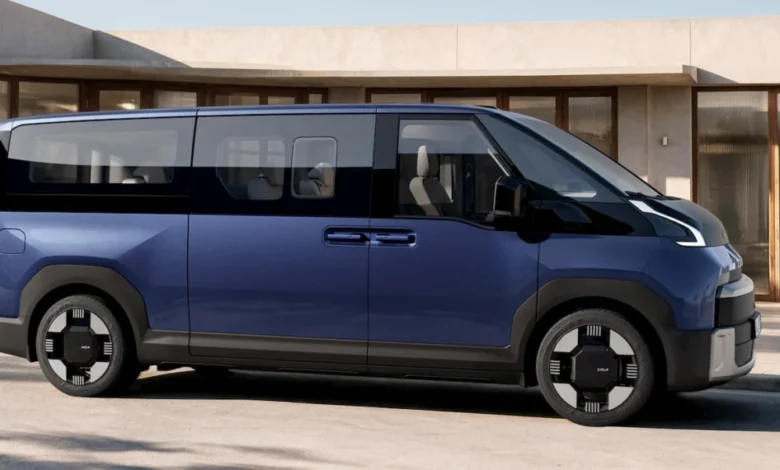
At the structural core of the Kia PV7 lies the advanced E-GMP.S dedicated electric vehicle platform, sharing its foundational DNA with the smaller PV5 model. However, the PV7 scales these engineering principles up to accommodate substantially larger footprints and higher-capacity payloads. Measuring 5,350 millimeters (17.55 feet) in length, 1,995 millimeters in width, and 1,990 millimeters in height, with a substantial wheelbase of 3,500 millimeters, the PV7 easily eclipses its predecessor. To put its scale into perspective, the vehicle is noticeably longer and more accommodating than the long-wheelbase Volkswagen ID. Buzz, which measures 4,962 millimeters with a 3,239-millimeter wheelbase.
![Kia’s new EV van is over 17.5 ft long and can haul 9 people or lots of cargo [Images]](https://electrek.co/wp-content/uploads/sites/3/2026/09/Kia-PV7-EV-van-images.jpeg?quality=82&strip=all&w=1400)
This generous sizing allows the PV7 to provide an exceptionally versatile interior layout facilitated by its flat-floor design. The modular architecture enables Kia to implement an array of distinct "top hats"—customizable upper body configurations tailored to specific commercial or passenger-oriented applications. Over the coming years, Kia intends to roll out an impressive portfolio of 23 unique PV7 variants, encompassing dedicated Cargo configurations, Passenger models, a specialized Chassis Cab, and various tailored conversion options designed for specialized industrial and municipal uses.
Performance Specifications, Battery Range, and Charging Infrastructure
To ensure that commercial operators can maintain rigorous operational schedules without experiencing range anxiety, Kia has equipped the PV7 with high-performance nickel-cobalt-manganese (NCM) battery packs. Buyers will be able to select between a 71.5 kWh unit and a larger 96.2 kWh battery pack. When configured with the Long Range Cargo setup and the maximum battery capacity, the vehicle achieves an all-electric driving range exceeding 460 kilometers (approximately 285 miles) under the stringent Worldwide Harmonized Light Vehicles Test Procedure (WLTP) cycle.
Power is transmitted primarily to the front wheels via a front electric powertrain that delivers up to 268 horsepower (200 kW) and 309 lb-ft (420 Nm) of torque, depending on the chosen specification. Furthermore, Kia has confirmed plans to introduce an all-wheel-drive (AWD) variant in future updates to cater to operators requiring enhanced traction in adverse weather conditions or challenging off-road worksite environments.
Charging efficiency remains a critical metric for commercial fleet managers who rely on high vehicle uptime. Leveraging an advanced 800-volt electrical architecture, the Kia PV7 supports ultra-fast DC charging capabilities. When connected to a 350 kW DC fast charger, the vehicle’s battery can be replenished from 10% to 80% capacity in approximately 25 minutes, minimizing downtime during long-haul logistics operations. Additionally, the PV7 incorporates Kia’s signature Vehicle-to-Load (V2L) technology, transforming the van into a mobile power source capable of running heavy-duty power tools, construction equipment, campsite electronics, or emergency apparatus directly from the vehicle’s high-capacity battery.
![Kia’s new EV van is over 17.5 ft long and can haul 9 people or lots of cargo [Images]](https://electrek.co/wp-content/uploads/sites/3/2026/09/Kia-PV7-EV-debut.jpeg?quality=82&strip=all)
Cargo Capacity and Passenger Versatility
The PV7 lineup is divided into two primary operational categories at launch: the Cargo variant and the Passenger variant, both engineered to maximize space utility.
The PV7 Cargo is offered in flexible two- and three-seat configurations, providing a standard cargo volume of up to 6.1 cubic meters. For businesses requiring maximum vertical clearance, a High Roof variant expands the internal volume to an impressive 8 cubic meters. Payload capacities are equally robust, reaching up to 1,165 kilograms (2,568 pounds) for the Long version and up to 1,200 kilograms (2,645 pounds) for the compact model. Operational efficiency is further enhanced by a low 550-millimeter loading height on the PV7 Long, which has been thoughtfully designed to accommodate up to three standard Euro pallets (measuring 800 x 1,200 mm). Drivers can also utilize a dedicated heavy-loading driving mode designed to optimize powertrain performance and suspension response when carrying maximum weight. Depending on operational preferences, buyers can select between full-open twin-swing tailgate doors or a conventional lift-up tailgate.
In contrast, the PV7 Passenger variant is optimized for corporate shuttles, hospitality rentals, and large families. In international markets, the vehicle accommodates up to nine occupants across flexible seating rows. In its domestic South Korean market, configurations will scale up to accommodate up to 11 passengers. The seven-seat variant features Long-Rail Easy Remove Seats, allowing fleet operators and private owners to dynamically adjust interior arrangements. The nine-seat model is similarly flexible, offering options with or without a fourth row to balance passenger comfort with luggage capacity.
High-Tech Cabin and Intelligent Connectivity
Inside the cabin, the PV7 bridges the gap between rugged commercial utility and consumer-grade luxury. The dashboard features Hyundai Motor Group’s state-of-the-art Pleos Connect infotainment system, anchored by dual 12.9-inch and 14.6-inch high-resolution displays. Developed on the Android Automotive OS framework, the interface operates much like a modern smartphone, offering intuitive navigation, downloadable productivity applications, and highly customizable home screens.
![Kia’s new EV van is over 17.5 ft long and can haul 9 people or lots of cargo [Images]](https://electrek.co/wp-content/themes/ninetofive/dist/images/google-preferred-source-badge-dark.png)
A standout technological inclusion is Gleo AI, an advanced artificial intelligence-driven in-car companion. Gleo AI is designed to assist drivers by processing complex voice commands, managing multi-stop navigation routes, controlling vehicle climate and auxiliary functions, and providing real-time diagnostic insights. This level of digital integration aims to reduce driver fatigue and streamline daily route planning for logistics professionals.
Chronology, Market Rollout, and Economic Projections
The debut of the PV7 at IAA Transportation 2026 represents the continuation of a meticulously planned commercial vehicle roadmap established by Kia. The journey began in earnest with the conceptualization of the PBV strategy at consumer technology and automotive expos, leading to the rapid commercialization and market success of the smaller PV5, which quickly established itself as Europe’s top-selling small electric van following its rollout.
Following its public unveiling in Hanover, Kia has scheduled the official market launch of the PV7 Passenger and Cargo variants for the second half of 2027. Sales will initially commence in domestic South Korean and European markets, where stringent emissions regulations and expanding urban low-emission zones have accelerated the demand for commercial electrification. Subsequent expansions will introduce the vehicle to new global territories alongside the phased rollout of specialized derivatives, chassis cabs, and custom conversion models.
While official pricing for the PV7 will be announced closer to the commercial launch window, market analysts anticipate competitive positioning in line with Kia’s broader pricing strategy. For context, the smaller PV5 Passenger and Cargo Compact models start at approximately 45.9 million won ($34,000 USD) and 41 million won ($30,300 USD) respectively in Korea, while the PV5 Passenger five-seater starts at roughly €38,390 ($44,200 USD) in Germany.
![Kia’s new EV van is over 17.5 ft long and can haul 9 people or lots of cargo [Images]](https://electrek.co/wp-content/themes/ninetofive/dist/images/google-preferred-source-badge-light.png)
Broader Industry Implications
The introduction of the Kia PV7 carries significant implications for the light commercial vehicle landscape. As multinational corporations and municipal authorities face mounting regulatory pressures to decarbonize their fleets, the demand for reliable, high-capacity commercial electric vehicles has outpaced supply. Traditional commercial van manufacturers have historically struggled to balance driving range, payload capacity, and interior flexibility within a cost-effective electric architecture.
By utilizing a dedicated modular platform (E-GMP.S) that can spawn 23 distinct variants, Kia is demonstrating an industrial agility that traditional legacy automakers are racing to replicate. The ability to pivot seamlessly from a high-roof logistics van capable of hauling Euro pallets to a nine-passenger VIP shuttle—all utilizing the same underlying skateboard chassis—significantly reduces manufacturing overhead and maintenance complexity for fleet operators.
Furthermore, the integration of advanced 800V charging architecture addresses one of the primary operational bottlenecks associated with commercial EVs: extended charging times. By enabling a 10% to 80% charge in just 25 minutes, the PV7 ensures that delivery drivers and transit operators can complete multi-shift operations with minimal disruption.
As the commercial vehicle sector looks toward a zero-emission future, the success of the PV7 will likely serve as a bellwether for the broader adoption of dedicated commercial EV platforms. Backed by the proven market reception of its smaller PV5 sibling, Kia’s expanded PBV offensive signals that the brand is no longer merely a participant in the passenger car market, but a serious, highly competitive force poised to reshape global commercial logistics and transportation.
Related posts: