The Chevrolet Camaro occupies a storied position in the pantheon of American automotive history, representing a legacy of competition, innovation, and cultural endurance. Since its inception in 1966 as a direct riposte to the Ford Mustang, the Camaro underwent multiple stylistic and engineering iterations. While the first-generation models established the platform’s identity, the second generation—produced from 1970 to 1981—marked a pivot toward a more European, grand-touring aesthetic characterized by smoother lines and a lower stance. It is within this specific era that a particularly aggressive restomod has emerged, currently listed on the auction platform Bring a Trailer, challenging the notion that a 1978 Type LT should remain a relic of the late-seventies malaise era.
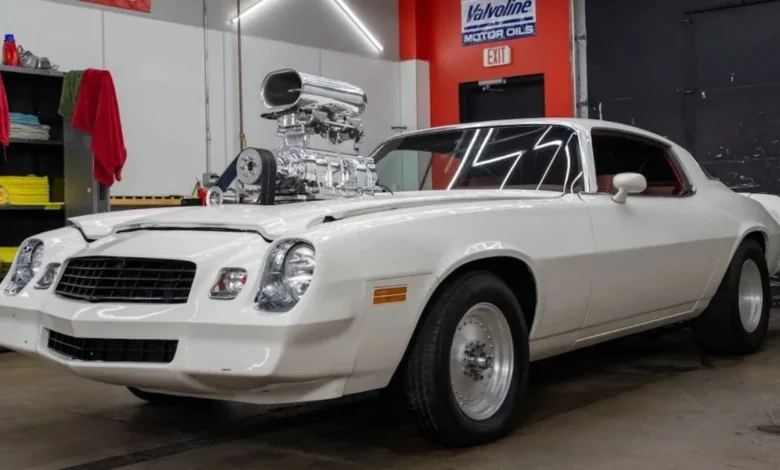
This specific build represents a radical departure from the original factory specifications. Where a standard 1978 Type LT would have left the Norwood, Ohio, assembly plant equipped with a modest 350-cubic-inch small-block V8 producing roughly 170 horsepower, this example has been transformed into a high-displacement exhibition of mechanical excess. The vehicle is currently centered around a 543-cubic-inch big-block V8 engine, a powerplant that occupies the entire engine bay and physically protrudes through the hood via a polished 8-71 Roots-style supercharger.
Technical Specifications and Engineering Modifications
The transformation of this vehicle began in 2005, when the current owner acquired the coupe and initiated a multi-year project to overhaul its performance capabilities. The engine architecture centers on a big-block displacement, augmented by Brodix RFD aluminum cylinder heads that facilitate improved airflow and combustion efficiency. The integration of Holley Sniper EFI throttle bodies suggests an attempt to balance the raw, forced-induction power of the 8-71 blower with the modern reliability of electronic fuel injection.
The powertrain is managed by a GM Turbo Hydra-Matic 400 three-speed automatic transmission, a legendary heavy-duty unit frequently chosen by drag racers for its ability to withstand massive torque loads. Gear selection is facilitated by a Hurst Quarter Stick shifter, a hallmark of stripped-down, performance-oriented cabins. Power is transferred to the rear wheels via a Positraction limited-slip differential, ensuring that the engine’s output—though not officially dyno-verified—is distributed across the massive Mickey Thompson drag slicks fitted to the rear.
The chassis has undergone a series of reinforcements to handle the power surge. The front suspension features lowering springs to sharpen turn-in response, while CalTracs traction bars have been installed to mitigate axle hop during high-torque launches. Braking, a critical oversight in many vintage builds, has been addressed through the installation of disc brakes on all four corners, providing the necessary stopping power for a vehicle of this weight and output.
Chronology of the Second-Generation Camaro
To understand the context of this build, one must look at the trajectory of the second-generation Camaro. Introduced for the 1970 model year, the car was initially praised for its handling, which outperformed many of its contemporaries. However, the mid-to-late 1970s presented a difficult environment for American muscle. The 1973 oil crisis and the implementation of increasingly stringent emissions regulations by the Environmental Protection Agency (EPA) forced manufacturers to detune their engines. By 1978, the Camaro was less of a performance icon and more of a personal luxury coupe.
This specific 1978 Type LT serves as a historical corrective. By utilizing a post-emissions-era chassis, the builder has effectively bypassed the regulatory constraints that stifled the original model’s performance. The move from the original 350-cubic-inch engine to the current 543-cubic-inch powerhouse is a testament to the "pro-street" trend that gained traction in the late 1980s and 1990s—a movement defined by taking street-legal vehicles and modifying them to resemble Pro Stock drag cars.
Safety Implications and Performance Realities
One of the most notable aspects of this build is the dichotomy between its extreme power and its lack of contemporary safety infrastructure. While the engine and drivetrain are prepared for the drag strip, the interior lacks a roll cage or a multi-point racing harness. In the world of high-performance automotive building, this creates a significant delta between the car’s capability and its occupant protection.
Industry experts often emphasize that vehicles of this caliber, when exceeding 500 cubic inches of displacement with forced induction, operate in a realm where chassis rigidity and safety are paramount. The presence of a fire extinguisher in the passenger footwell is a concession to the inherent risks of a high-compression, supercharged engine, yet it serves as the only defensive measure in a vehicle that is clearly designed for high-acceleration scenarios.
Market analysts observing the Bring a Trailer auction have noted that the lack of official dyno sheets or quarter-mile times is a common, if frustrating, feature of such private sales. Potential buyers are left to infer the vehicle’s capability based on the hardware installed rather than verifiable data. The current bidding, which has reached the $10,000 threshold at the time of writing, reflects a market that values the "character" of the build—the "movie-quality" bug catcher and the aesthetic of the blower—as much as the mechanical performance.
Broader Impact on the Restomod Market
The auction of this 1978 Camaro highlights the current state of the collector car market. There is a distinct bifurcation between "numbers-matching" factory restorations and radical restomods. The former appeals to purists, while the latter, like this Camaro, appeals to a demographic that views the original vehicle as a canvas for creative engineering.
This build also underscores the evolving valuation of the second-generation Camaro. Once overshadowed by the first-gen models, the 1970–1981 platform has seen a resurgence in popularity, driven by the relative affordability of the chassis compared to the early "pony car" variants. As more enthusiasts seek out these platforms for high-horsepower builds, the scarcity of clean, unmodified examples may increase, potentially driving up the price of "survivor" cars while creating a secondary market for specialized, high-performance modifications.
Conclusion
The 1978 Chevrolet Camaro Type LT, as presented in this auction, serves as a quintessential example of the American hot-rodding spirit. It rejects the constraints of its era, opting instead for a "more is better" philosophy regarding displacement and forced induction. While it lacks the refined handling or the modern safety systems of contemporary high-performance vehicles, it captures a specific moment in automotive culture where the primary goal was to create the most visually and audibly striking machine possible.
As the auction progresses, the final sale price will offer further insight into the demand for mid-tier, big-block-swapped coupes. For the buyer, the car represents an opportunity to own a piece of engineering that is intentionally over-the-top, a vehicle that ignores the concept of subtlety in favor of raw mechanical presence. Whether it sees a drag strip or remains a fixture at local car shows, this Camaro remains a testament to the builder’s commitment to the classic American muscle car ethos—a philosophy that prioritizes power, displacement, and the unadulterated aesthetic of the supercharged V8 above all else.
In the broader context of Chevrolet’s history, the Camaro remains a permanent fixture of American automotive iconography. Even with the discontinuation of the model, the appetite for these cars—whether restored to factory specs or modified into monstrous track-focused builds—shows no sign of waning. This 1978 Type LT, with its massive blower and custom configuration, stands as a reminder that for many enthusiasts, the Camaro is not just a car; it is a platform for personal expression and an enduring symbol of the pursuit of speed.
Related posts: