Innovative UV-Responsive Tattoo Ink Promises a New Era for Medical Monitoring and Body Art

The intersection of biotechnology and body modification has reached a significant milestone with the development of specialized tattoo ink capable of reacting to ultraviolet (UV) light. This advancement, spearheaded by researchers such as those at the multidisciplinary group Matter & Light, represents a departure from traditional permanent pigments, which typically rely on heavy metals or organic compounds to provide static color. By integrating light-sensitive properties into intradermal applications, scientists are exploring how skin art can transcend aesthetic expression to become a functional tool for health diagnostics and environmental monitoring.
The Science of Photoluminescent Pigments
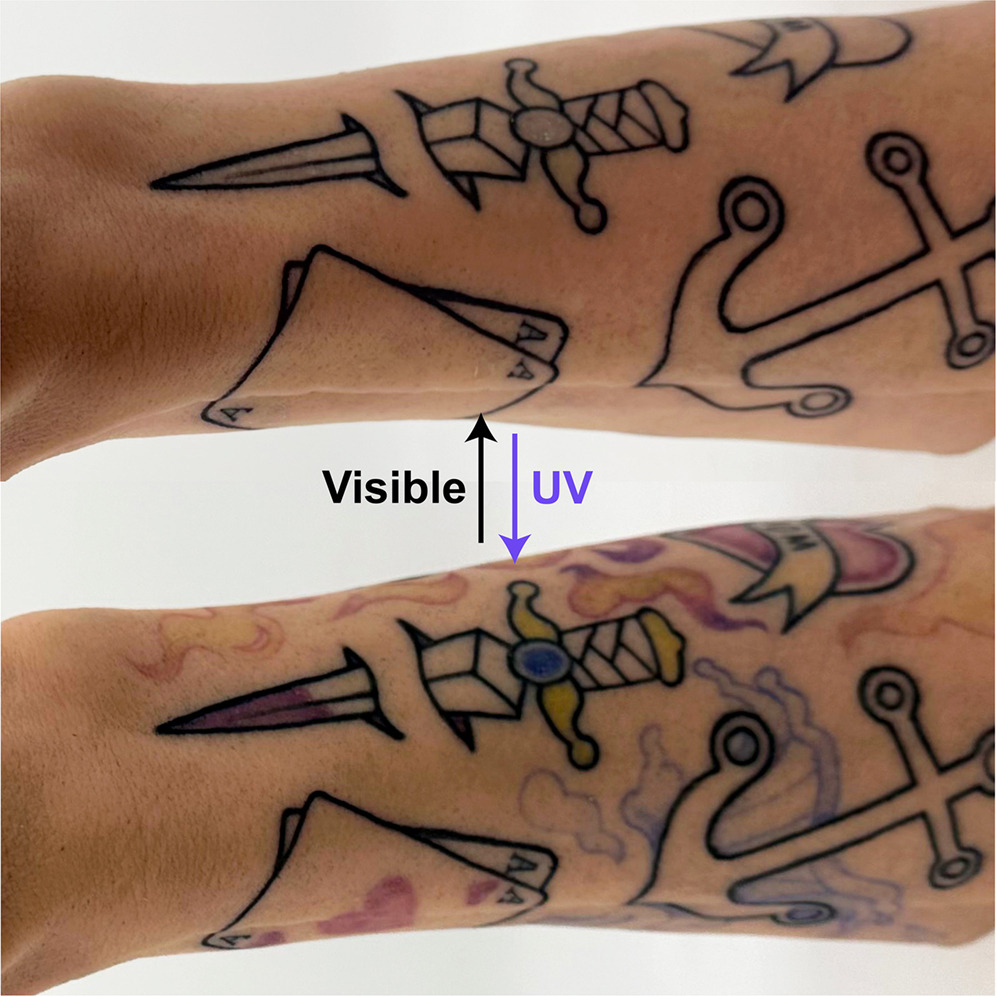
Traditional tattoo inks have long been criticized for their permanence and, in some cases, the presence of potentially hazardous materials. The newly developed UV-responsive ink utilizes advanced chemical engineering to create a pigment that remains largely invisible under standard ambient lighting conditions but exhibits a vibrant, fluorescent response when exposed to specific wavelengths of UV radiation.
At the molecular level, these inks function similarly to quantum dots or specialized fluorophores that absorb energy from photons in the ultraviolet spectrum and re-emit that energy as visible light. Unlike traditional "glow-in-the-dark" inks, which often rely on phosphorescent materials like zinc sulfide—and have historically been associated with safety concerns—the new generation of research-focused inks aims to prioritize biocompatibility. The researchers involved in this study have focused on encapsulating these light-sensitive molecules in inert carriers, minimizing the risk of systemic absorption or inflammatory reactions that can occur when the body’s immune system attempts to break down foreign ink particles.
Chronology of Development: From Concept to Skin
The journey toward functional, responsive skin art has been a gradual progression in the field of "smart" tattoos. The timeline of this research can be traced back to early experiments in the 2010s, where scientists first began embedding sensors into patches that adhered to the skin.
- 2015–2018: Initial research focused on dermal biosensors, such as pH-sensitive inks that changed color based on the acidity of the interstitial fluid. These were primarily proof-of-concept studies conducted in lab settings.
- 2019–2021: Refinement of encapsulated pigments occurred. Researchers began investigating how to make these pigments stable enough to survive the body’s macrophage activity—the process where immune cells consume ink particles, often leading to tattoo fading.
- 2022–2023: The focus shifted toward UV-activation. By moving from chemical-sensing inks to light-responsive pigments, researchers sought to create a "display" that could be triggered externally, rather than relying on internal biochemical triggers that are harder to calibrate.
- 2024: Publication and peer-review processes have brought the latest iterations of these inks into the public sphere, demonstrating their efficacy in both controlled laboratory environments and preliminary testing.
Supporting Data and Technical Specifications
To understand the viability of this technology, one must look at the physical limitations of current tattoo methodologies. Standard tattoo inks are particles ranging from 50 nanometers to several micrometers in size. When injected into the dermis, they are sequestered by fibroblasts and macrophages.
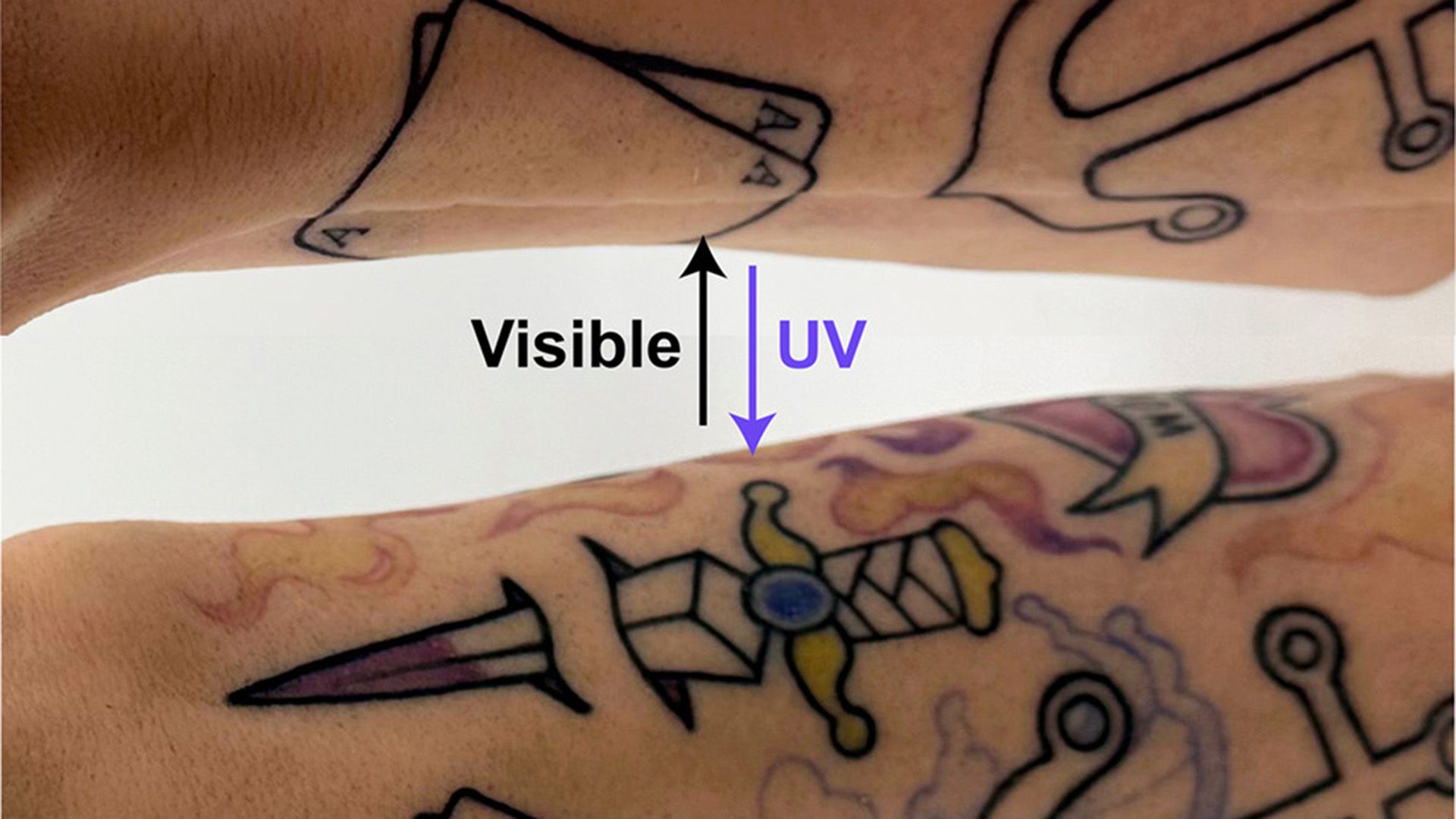
Current research suggests that the UV-responsive ink maintains its integrity for an extended period because the fluorescent molecules are shielded from the digestive enzymes of the body. Data from preliminary bench tests indicate that the luminosity of these inks remains consistent across hundreds of cycles of UV exposure. Furthermore, the intensity of the fluorescence is proportional to the concentration of the ink injected, allowing for precise design patterns.
From a safety standpoint, the primary concern remains the migration of ink particles to the lymph nodes. However, the researchers emphasize that the materials used in these new formulations are designed to be larger than the average cellular pore, ensuring they remain "locked" in the dermal layer. While long-term human longitudinal studies are still pending, the initial toxicity profiles are promising, showing minimal impact on surrounding cellular structures in in vitro models.
Expert Perspectives and Medical Implications
The medical community is watching these developments with cautious optimism. Dr. Aris Thorne, a dermatologist specializing in advanced tissue engineering, notes that while the technology is exciting, "the leap from a laboratory demonstration to a clinical medical tool is significant."
"The primary utility here is not just for aesthetic tattoos," Dr. Thorne explained. "Imagine a diabetic patient who has a small, discrete tattoo that changes its UV-fluorescent properties based on glucose levels in the interstitial fluid. This would provide a real-time, non-invasive health dashboard that doesn’t require constant skin piercing or disposable sensor patches."
Beyond diabetes management, researchers are looking at the potential for UV-responsive tattoos to serve as personal UV-dosimeters. A tattoo could theoretically be calibrated to glow with increasing intensity as the skin is exposed to harmful levels of UV radiation, effectively warning the wearer to seek shade or apply sunscreen. This would turn a piece of body art into a life-saving device for individuals at high risk for skin cancer.
Broader Implications and Societal Impact
The transition of tattoos from a medium of self-expression to a medium of information technology raises several ethical and societal questions. As with any wearable technology, data privacy and the potential for "hacking" biological markers are concerns that may emerge as the technology matures.
Furthermore, there is the question of normalization. If "smart" tattoos become a standard method for medical monitoring, the cultural perception of tattoos—which has already shifted from counter-culture to mainstream—may undergo another evolution. The concept of the "cyborg" or "augmented human" is brought closer to reality when the skin itself acts as an interface for external data.
The regulatory path forward is also complex. In many jurisdictions, tattoo ink is regulated as a cosmetic product rather than a medical device. If these UV-responsive inks are marketed for health monitoring, they will likely fall under the jurisdiction of health authorities like the FDA (in the United States) or the EMA (in Europe). This transition will necessitate rigorous clinical trials to prove not just efficacy, but long-term safety.
Future Outlook: What Lies Ahead
As the technology moves toward the next phase of development, the research team is focused on expanding the color spectrum of the fluorescent pigments. Currently, most UV-responsive inks are limited to a narrow band of the spectrum, usually blues and greens. Developing a full-color palette that remains stable under UV light is the next major hurdle.
Additionally, researchers are investigating "switchable" inks—pigments that can be toggled on or off not just by UV light, but by other environmental factors like temperature or electromagnetic fields. This would allow for even more sophisticated medical monitoring, such as tracking body temperature fluctuations during a fever or detecting changes in blood chemistry that correlate with specific pathological conditions.
While the current public release of the research highlights the aesthetic appeal—a tattoo that only reveals itself in specific lighting—the underlying implications suggest a future where the skin is a canvas for far more than art. It is becoming a platform for data, a interface for health, and a testament to the blurring lines between the biological and the technological.
As we move forward, the collaboration between chemists, tattoo artists, and medical professionals will be essential to ensure that this technology is accessible, safe, and ethically implemented. The era of the "smart tattoo" is no longer the domain of science fiction; it is currently being written into the dermis of our evolving medical reality. Whether these tattoos will be used to warn us of solar radiation, track our blood sugar, or simply provide a hidden layer of aesthetic wonder, one thing is clear: the canvas of the human body is about to become a lot more interactive.