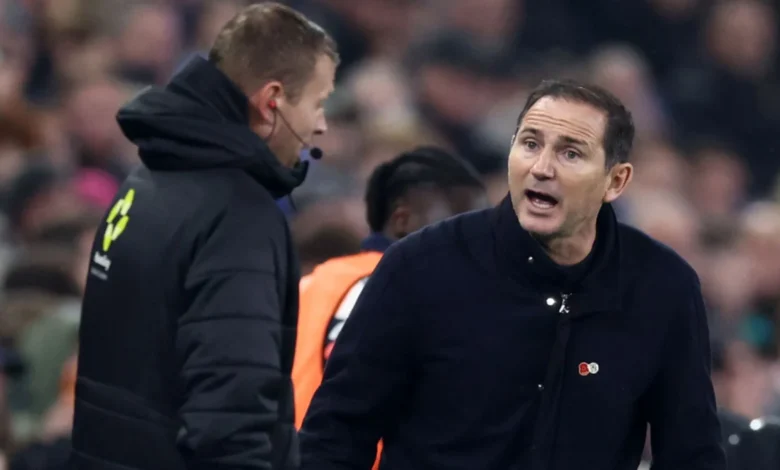
Everton 3-1 Coventry: Frank Lampard says VAR didn’t do its job after three incidents went against Sky Blues in Premier League defeat

The match, played under the lights at Goodison Park, served as a flashpoint for ongoing debates regarding the consistency of the Video Assistant Referee (VAR) system. Throughout the ninety minutes, Coventry City saw two penalty appeals waved away and a pivotal second goal for Everton survive a handball check, leaving Lampard to publicly question the application of the rules.
A Controversial First Half: The Tarkowski Incident
The initial point of contention arose late in the first half when Everton defender James Tarkowski challenged for a high ball in the penalty area. During the aerial duel with Ethan Pinnock, Tarkowski was seen making contact with the head of Caleb Yirenkyi, appearing to pull the attacker’s hair. The incident effectively negated Yirenkyi’s ability to compete for the ball, yet the on-field referee, Stuart Attwell, opted against awarding a spot-kick.
VAR officials Timothy Wood and Gary Beswick reviewed the footage but opted not to overturn the decision. Under the Premier League’s updated guidance for the current season, a red card is reserved for "clear and deliberate" actions involving "excessive force or brutality." While the officials likely determined the hair pull did not meet this high threshold for a dismissal, the absence of a penalty award for a foul that clearly impeded an opponent’s movement sparked immediate criticism.
Sky Sports pundit Jamie Redknapp, analyzing the match, noted that while the action might not necessitate a red card under modern interpretations, it remained a clear foul. "He yanks it down," Redknapp stated. "It’s not the best piece of defending, and he is clearly stopping any elevation. It is a definite penalty for me." The incident highlighted a growing divide between technical definitions and the reality of physical contact in the box, leaving Coventry supporters and staff questioning why the review process failed to rectify an obvious error.
The Second Half and the Penalty Dispute
The dissatisfaction for the visitors compounded early in the second half when Taiwo Awoniyi made a surging run into the Everton penalty area. As he drove toward the goal, he was challenged from behind by Vitalii Mykolenko. The striker went to ground, but the referee again signaled for play to continue. The subsequent VAR check concluded that any potential contact occurred outside the penalty area, thus denying Coventry a chance to equalize from the spot.
Frank Lampard was visibly dismayed by the ruling, arguing that the mechanics of the foul were clear. "I can’t believe it’s not given," Lampard remarked. "Taiwo’s foot is entering the box and the back of his knee is on the line of the box. If the contact is on the line, it is a penalty."
The technicality of the "line being part of the box" is a fundamental rule in football, and the failure of VAR to identify that the contact occurred on the boundary line suggests a breakdown in the review process. Redknapp added further weight to this sentiment, criticizing the pace of the VAR review. "It’s a poor decision," he said. "They rush it too quickly. If you’re on the line, you’re in the box. Just take a breather, tell the referee to have a look at it, and he would have come to a different conclusion."
The Handball Debate: Barry’s Second Goal
The final point of contention involved Everton’s second goal, scored by Barry. Following a cross from Tyrique George, the ball bounced in a congested area before Barry bundled it into the net. Replays suggested the ball may have brushed his hand in the final motion of the shot. VAR conducted a check and determined there was no conclusive evidence of a deliberate or punishable handball, allowing the goal to stand.
Audio from the VAR booth later revealed that official Timothy Wood dismissed the concerns, stating, "That’s his side, that’s definitely not hand." However, this was met with skepticism from those watching the high-definition replays. Lampard remained steadfast in his assessment, noting, "Barry’s second goal comes off his hand. It was a really quick check."
While Redknapp conceded that the goal was difficult to disallow due to the lack of "clear and obvious" proof of a deliberate touch, he acknowledged that the ball did appear to make contact. "It brushes his fingers," Redknapp explained. "It’s accidental, but it does divert the ball. The problem is that when we look at these things forensically, we start to lose the flow of the game, yet we still end up with decisions that leave everyone frustrated."
Broader Implications for the Premier League
The match at Goodison Park raises significant questions about the current state of officiating in the English top flight. The frustration voiced by Frank Lampard is not an isolated incident; rather, it reflects a season-long trend of managers and players struggling to understand the thresholds for VAR intervention.
Statistically, the Premier League has seen a slight reduction in the number of times referees visit the pitchside monitor this season, as the league attempts to speed up the game. However, matches like this one demonstrate that speed often comes at the cost of accuracy. The reliance on VAR officials to make binary, "yes or no" calls without sufficient consultation of the primary referee can lead to high-stakes errors that change the trajectory of an entire match.
For Everton, the win was a vital result, though manager David Moyes was quick to acknowledge the complexities of the system. "We’ve had decisions go against us," Moyes noted, referencing previous matches against Newcastle and Manchester City. "Sometimes they go for you, sometimes they don’t. If they were going against me, I’d be complaining a bit more."
Chronology of Discontent
- The Tarkowski Incident (Late First Half): Tarkowski challenges for an aerial ball, allegedly pulling Yirenkyi’s hair. VAR reviews for a red card but finds no offense. No penalty awarded.
- The Awoniyi Foul (Early Second Half): Mykolenko challenges Awoniyi near the box. Referee waves play on. VAR reviews and determines contact occurred outside the box, despite visual evidence suggesting the contact was on the line.
- The Barry Goal (Mid-Second Half): Barry scores his second goal of the evening. VAR reviews for potential handball. The goal is allowed to stand despite claims of an accidental touch.
Conclusion: The Need for Transparency
The events of Friday night serve as a case study for the persistent friction between technological intervention and on-field officiating. While the Premier League has made strides in providing more transparency regarding the "why" behind decisions, the application remains inconsistent.
For Coventry City, the implications of these three decisions are substantial, potentially costing them at least a point in a competitive league table. As the season progresses, the pressure on the Professional Game Match Officials Limited (PGMOL) to standardize the interpretation of "clear and obvious" errors will only intensify. Until then, managers like Lampard are left to navigate a landscape where the result of a match is increasingly influenced by the interpretation of a monitor rather than the actions on the pitch. The challenge moving forward for the league will be to find a balance where technology supports the game without becoming the primary protagonist.
Related posts: