China’s Record October NEV Sales Mask Deep Domestic Slump as Exports Surge to Historic Highs

China’s new energy vehicle (NEV) sector achieved a historic milestone in October, with cumulative sales reaching an unprecedented 1.94 million units, representing a 13.1% increase year-over-year. However, a deeper examination of the data released by the China Association of Automobile Manufacturers (CAAM) reveals a stark dichotomy within the world’s largest automotive market. While aggressive international expansion propelled overall figures to new heights—with exports skyrocketing by 140% to 606,000 units—the domestic market continued to suffer. Local NEV sales fell by 8.6%, marking the eleventh consecutive month of year-over-year decline for domestic purchases.
This complex market dynamic underscores a broader economic reality in China: while state-backed manufacturing capacity remains fiercely robust, domestic consumer confidence is flagging. The widening chasm between booming overseas shipments and a sluggish local retail environment raises critical questions about the long-term sustainability of the sector’s current trajectory, particularly as international trade barriers begin to multiply across key export destinations.
A Chronology of the Domestic Slump and Export Pivot
The roots of China’s current domestic automotive stagnation can be traced back to the structural shifts initiated at the close of 2025. For years, the Chinese government heavily subsidized the NEV sector, sparking rapid consumer adoption and immense industrial scaling. However, the domestic sales slide officially began in December 2025, driven by a pre-emptive buying rush as consumers hurried to make purchases before the complete expiration of full purchase tax exemptions for NEVs in January.
Once the tax incentives rolled back, the market lost its primary short-term catalyst. Throughout the subsequent ten months, general domestic vehicle sales fell by more than 20% year-over-year for seven consecutive months. Broader macroeconomic pressures, including persistent property sector sluggishness and general consumer belt-tightening, created a severe squeeze on local buyers.
Compounding these domestic pressures, external geopolitical events further disrupted the traditional fuel and vehicle markets. Following conflict in the Middle East, domestic pump prices for internal combustion engine (ICE) vehicles spiked, causing ICE sales to plummet by nearly half in October alone. Consequently, while NEVs captured a record 68.4% share of domestic vehicle sales—and the China Passenger Car Association (CPCA) noted a record 67.5% domestic retail penetration—this dominance was largely pyrrhic. NEV market share rose not because local demand for electric vehicles was surging, but because the traditional combustion engine segment of the market was collapsing at an even faster rate.
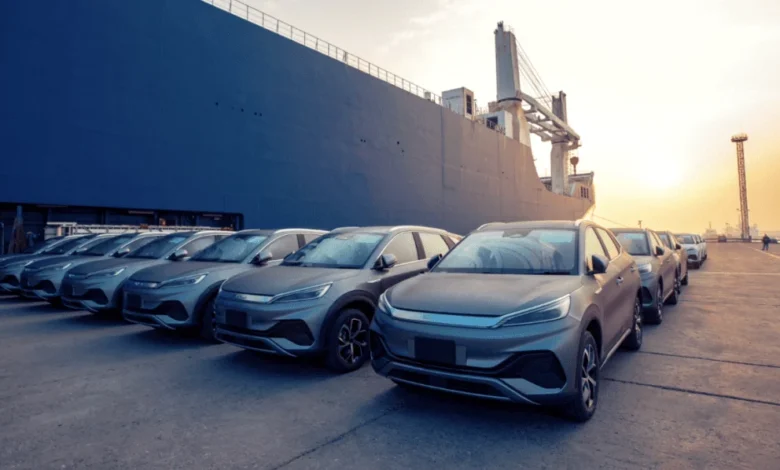
Faced with mounting domestic overcapacity and weak local purchasing power, Chinese automotive original equipment manufacturers (OEMs) executed a strategic pivot toward overseas markets. This export-heavy strategy prevented catastrophic production cuts, driving total vehicle exports for October to 1.07 million units—a 60.2% increase—and bringing the ten-month aggregate to 9.27 million vehicles.
Detailed Breakdown of Sales, Segments, and Export Metrics
The October data illustrates distinct trends across different powertrain technologies, heavily influenced by international regulatory landscapes. Battery-electric vehicles (BEVs) spearheaded total market gains, with sales rising 22% to cross the 1.35 million unit threshold, establishing an all-time monthly high.
Conversely, plug-in hybrid electric vehicle (PHEV) sales slipped by approximately 3% globally to 587,000 units. This contraction was entirely driven by domestic declines that overseas volumes could not fully absorb. Nevertheless, PHEV exports experienced staggering growth, surging roughly 160% to 233,000 units—accounting for approximately 40% of all PHEV sales during the month.
Chinese automakers strategically redirected hybrids abroad to navigate specific regulatory frameworks. Notably, the European Union’s anti-subsidy duties target BEVs specifically, leaving a regulatory opening for plug-in hybrids. Capitalizing on this, Chinese brands captured one in four hybrid sales and one in three PHEV sales across Europe as of August.
On a cumulative basis, total NEV sales for the first ten months of the year reached 14.41 million units, representing an 11.3% year-over-year expansion. Exported models accounted for 31.2% of total NEV sales in October, more than double the 14.9% share recorded during the same period in the previous year.
Official Responses and Industry Assessments
Industry leaders and trade bodies have offered contrasting interpretations of these unprecedented figures. Chen Shihua, Deputy Secretary-General of CAAM, emphasized the remarkable resilience of China’s automotive sector in official statements.
"China’s auto exports have maintained a high growth rate this year with strong resilience, which will exceed 10 million units throughout the year," Chen stated, dismissing the notion that rising domestic fuel prices were the primary driver of NEV market share gains and describing the shift as "not a short-term phenomenon."
However, CAAM’s broader official assessments paint a more cautious picture of the domestic landscape. The association acknowledged that the local market has yet to exhibit meaningful improvement, characterized persistently by "strong supply and weak demand." Low industry profitability continues to squeeze manufacturers, prompting CAAM to argue that coordinated macroeconomic policy interventions will be vital to restoring consumer confidence.
Furthermore, analysts note that the heavy reliance on exports is a symptom of domestic overproduction rather than organic market maturity. Without targeted stimulus to revitalize local purchasing power, domestic manufacturers face prolonged margin compression.
Global Implications, Trade Barriers, and Strategic Shifts
The massive influx of Chinese NEVs into international markets has triggered immediate protective responses from foreign governments, threatening to close the very pressure valves Chinese OEMs have relied upon.
In Southeast Asia, Thailand announced plans to raise its excise tax on fully imported battery-electric vehicles from 10% to 35%, effective January, though locally established Chinese assembly plants will be partially insulated. Meanwhile, regulatory bodies in Brussels are drafting stringent "Made in EU" requirements designed to favor locally manufactured vehicles while heavily scrutinizing hybrid shipments routed through intermediary nations in Southeast Asia.
In anticipation of these protectionist hurdles, major Chinese automakers such as BYD and Chery have initiated the construction of manufacturing plants in European nations like Hungary and Spain. While these localized footprints will help bypass certain tariffs, they do little to alleviate the immense structural overcapacity residing within mainland China’s domestic factories.
As the industry closes out the final quarter of the year, October’s record-breaking figures serve as a dual indicator of industrial might and structural vulnerability. Unless domestic consumer demand recovers or alternative international markets emerge to absorb excess production, China’s automotive sector risks running into a formidable wall of international trade friction and domestic financial strain.
Related posts: