The American automotive landscape has undergone a seismic shift over the last half-decade, with the average price of a new vehicle now hovering near the $50,000 mark. For the average household, this figure represents a significant portion of annual income, making the search for affordable, reliable transportation more difficult than ever. However, a select group of manufacturers continues to prioritize the sub-$30,000 segment, offering "entry-level" crossovers that provide the utility families require without the premium price tag. For the 2026 model year, five specific models—the Chevrolet Trax, Nissan Kicks, Toyota Corolla Cross, Mazda CX-30, and Kia Niro Hybrid—represent the vanguard of this affordable tier. Simultaneously, for those whose budgets cannot stretch to $25,000 or $30,000, the pre-owned market offers robust alternatives that maintain high reliability scores and modern safety features for under $20,000.
The Economic Context of the $30,000 Threshold
To understand why a $30,000 SUV is considered a bargain in 2026, one must look at the trajectory of the market since 2020. Supply chain disruptions, the pivot toward expensive electric vehicle (EV) development, and a consumer preference for larger, tech-heavy vehicles have driven MSRPs upward. According to industry data, the "entry-level" segment has shrunk as manufacturers discontinued smaller sedans in favor of more profitable, larger SUVs.
For families, the crossover—or "SUV" as it is colloquially termed—has become the standard. These vehicles offer a higher seating position, easier ingress and egress for child seats, and flexible cargo holds. The challenge for 2026 buyers is finding these traits without incurring a decade of high-interest debt. The following analysis explores the top new contenders for the 2026 model year and how they compare to seasoned veterans of the used car market.
The 2026 Chevrolet Trax and the 2015 Mazda CX-5
The Chevrolet Trax has become a symbol of General Motors’ renewed commitment to the budget-conscious consumer. After a complete redesign for the 2024 model year, the Trax moved from a cramped, uninspired subcompact to a sleek, wagon-like crossover that punches well above its $23,495 starting price. Its success is measurable: in 2025, it became Chevrolet’s second-best-selling non-truck model, surpassing 200,000 units sold. This is particularly notable as competitors like Ford have largely abandoned the sub-$30,000 SUV market entirely.
The 2026 Trax utilizes a 1.2-liter turbocharged three-cylinder engine. While critics note that the engine note can be unrefined and the power delivery modest, its pairing with a traditional six-speed automatic transmission—rather than a Continuously Variable Transmission (CVT)—offers a driving feel that many consumers prefer. However, a significant limitation remains: the Trax is exclusively front-wheel drive (FWD).
For buyers requiring all-wheel drive (AWD) or a more premium interior on a smaller budget, the 2015 Mazda CX-5 stands as a formidable used alternative. Priced around $11,000 to $14,000 for examples with roughly 100,000 miles, the 2015 CX-5 was a high-water mark for Mazda. It earned "above-average" reliability ratings from Consumer Reports and offers a more sophisticated multi-link rear suspension and a choice of 2.0-liter or 2.5-liter four-cylinder engines. The CX-5 provides the mechanical "soul" and AWD capability that the new Trax lacks, at nearly half the entry cost.
The 2026 Nissan Kicks and the 2020 Toyota C-HR
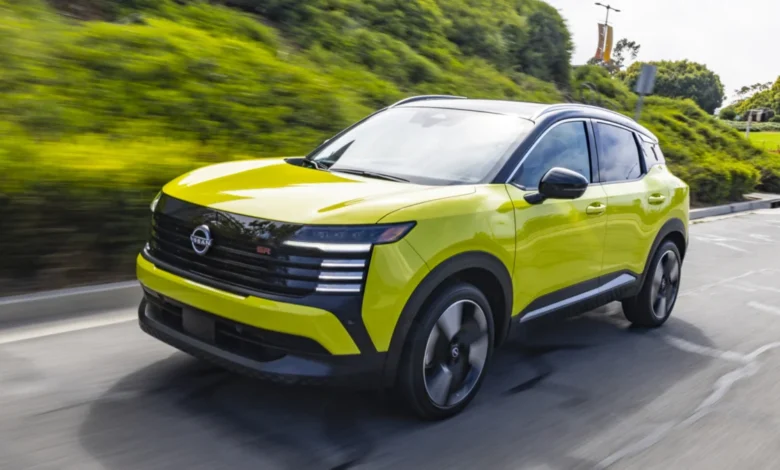
Nissan recently overhauled the Kicks for the 2025 model year, a move that resulted in a 32.8% surge in sales. The 2026 model continues this momentum with a starting price of $24,275. Perhaps the most significant update in this generation is the availability of AWD, a feature missing from the first-generation Kicks. At an MSRP of $25,775 with AWD included, the Kicks holds the title of the least expensive AWD vehicle on the American market.
The Kicks is powered by a 2.0-liter four-cylinder engine producing 141 horsepower. While its 0-to-60 mph time of approximately 9 seconds is leisurely, it offers a functional 60 cubic feet of maximum cargo space.
For those seeking Toyota-level reliability in a similar form factor, the 2020 Toyota C-HR is a compelling used option, typically found between $16,000 and $19,000. While the C-HR is also FWD-only and has a somewhat polarizing "coupe-like" design that limits rear visibility, its 2020 iteration includes a standard suite of driver-assistance technology, including adaptive cruise control and lane-keep assist. Its high reliability scores make it a "safe" bet for buyers who prioritize longevity over the latest infotainment screens.
The 2026 Toyota Corolla Cross and the 2017 Honda HR-V
The Toyota Corolla Cross, starting at $26,610, is the pragmatic choice for the 2026 model year. It fills the void left by the discontinued Corolla hatchback and the older C-HR, offering a more traditional SUV silhouette. It features a 2.0-liter engine paired with Toyota’s "Direct Shift" CVT, which utilizes a physical first gear to eliminate the "rubber band" feel common in other CVTs. This model is also notable for its low depreciation; data suggests it retains its value better than almost any other vehicle in its class, losing only about 30% of its value over five years.
If the $26,000 price point is too high, the 2017 Honda HR-V offers a unique solution for families. Priced between $13,000 and $15,000, the 2017 HR-V is famous for its "Magic Seats." This interior configuration allows the rear seat bottoms to flip up, creating a tall cargo area behind the front seats, or fold completely flat to maximize floor space. Honda discontinued this feature in later generations, making the 2017–2022 models highly sought after on the used market. With "above-average" reliability ratings and available AWD, the 2017 HR-V remains a benchmark for subcompact utility.
The 2026 Mazda CX-30 and the 2019 Subaru Crosstrek
The 2026 Mazda CX-30 is often cited as the "luxury" choice within the budget segment. Starting at $27,870, it comes standard with AWD and a 186-horsepower engine that provides significantly more "zip" than the Nissan Kicks or Chevy Trax. The CX-30’s interior quality often rivals that of entry-level luxury brands like Lexus or Acura, making it a favorite for buyers who want an upscale feel without the $40,000 price tag.
Conversely, the 2019 Subaru Crosstrek is the "outdoors" alternative. Available for approximately $15,000, the 2019 Crosstrek offers 8.7 inches of ground clearance and a rugged AWD system that is superior to most "slip-and-grip" systems found in competitors. For families who live in snow-prone regions or frequent unpaved roads, a used Crosstrek with under 90,000 miles provides a level of capability that the more urban-focused Mazda CX-30 cannot match.
The 2026 Kia Niro Hybrid and the 2017 Toyota RAV4 Hybrid
As fuel prices remain a primary concern for American households, the 2026 Kia Niro Hybrid emerges as a standout value. With a starting price of $28,885, it is the most affordable hybrid SUV in the United States. Its 53-mpg combined rating makes it an exceptional commuter vehicle. Furthermore, despite its small exterior footprint, the Niro offers 39.8 inches of rear legroom—more than many mid-sized sedans.
However, for those who need more space and AWD in their hybrid, the 2017 Toyota RAV4 Hybrid is the gold standard of the used market. The 2017 model year is particularly praised because it avoided the "first-year" mechanical issues of the 2016 debut and comes standard with AWD. Found today for approximately $17,000 to $19,000, the 2017 RAV4 Hybrid offers a larger 70-cubic-foot cargo area and Toyota’s legendary hybrid durability.
Chronology of the Crossover Boom (2010–2026)
The dominance of the vehicles listed above is the result of a fifteen-year evolution in the automotive market:
- 2010–2015: The "Subcompact SUV" segment begins to take shape as manufacturers realize consumers want the efficiency of a compact car with the height of an SUV.
- 2016–2019: Major players like the Honda HR-V, Toyota C-HR, and Subaru Crosstrek solidify the segment. Safety tech becomes standard in base trims.
- 2020–2023: Pandemic-related shortages drive new car prices to record highs. The used market see-saws in value, but reliability becomes the top consumer priority.
- 2024–2026: A "Correction" occurs. Manufacturers like Chevrolet and Nissan redesign their entry-level crossovers to be larger and more stylish to capture buyers priced out of the mid-sized SUV market.
Broader Implications and Market Analysis
The existence of these sub-$30,000 models is vital for market stability. As interest rates for auto loans have remained elevated, the "monthly payment" has become the deciding factor for most families. A $24,000 Chevrolet Trax represents a manageable monthly obligation, whereas a $50,000 average-priced vehicle requires a financial stretch that many households cannot sustain.
Furthermore, the shift toward these smaller crossovers has effectively killed the "economy car" segment. The Nissan Versa and Mitsubishi Mirage are among the few remaining sub-$20,000 cars, but they lack the utility families demand. Consequently, the vehicles like the Kicks and Trax are the new "people’s cars."
In conclusion, while the $50,000 average car price is a daunting headline, the 2026 market still offers havens of value. Whether a buyer chooses the modern tech and warranty of a new 2026 Mazda CX-30 or the proven reliability and lower entry cost of a 2017 Toyota RAV4 Hybrid, the path to affordable family transportation remains open. The key for consumers is to balance the desire for new features against the long-term value of proven reliability ratings.
Related posts: