China Accelerates Past LNG and Diesel in Heavy Truck Electrification, Leaving Western OEMs Facing an Expanding Technology and Cost Chasm

The global commercial vehicle sector is witnessing a profound structural shift as China rapidly accelerates its transition toward heavy-duty vehicle electrification, leaving Western original equipment manufacturers (OEMs) struggling to close a rapidly widening technological and financial gap. Recent industry data underscores this monumental transformation: electric models officially captured 50.3% of all heavy truck sales in China during September, defying a broader 21% contraction in the overall heavy truck market. With monthly sales surging 37% year-on-year to 33,100 units, the world’s largest automotive market is not merely adopting green technology; it is completely rewriting the operational paradigms of freight, logistics, and heavy-duty transportation.
This hyper-acceleration is having immediate, highly visible repercussions on global energy markets. According to commodity data and analytics firm Kpler, the mass displacement of traditional internal combustion engines by electric and alternative-fuel vehicles is expected to reduce Chinese diesel demand by approximately 230,000 barrels per day in 2026 alone—representing a staggering 10% reduction in the nation’s baseline diesel consumption. While liquefied natural gas (LNG) fleets have historically acted as a crucial transitional bridge away from diesel, the market has pivoted toward full electrification with a velocity that caught even domestic policymakers off guard.
The Chronology of Policy and Surpassing Government Targets
The speed at which Chinese fleet operators and manufacturers have embraced battery-electric heavy trucks has severely outdated official state forecasts. As recently as June, the Chinese government outlined an ambitious strategic roadmap targeting 40% new-energy heavy truck sales by 2030, alongside a cumulative target of 1.6 million such commercial vehicles on the nation’s roads. Yet, monthly sales metrics have already eclipsed that 2030 threshold years ahead of schedule.
Industry giants like Contemporary Amperex Technology Co. Limited (CATL) have consequently revised their domestic outlooks upward. CATL now projects that new-energy vehicles will account for fully 50% of China’s annual heavy truck sales by 2028, reflecting sustained multi-month adoption rates rather than isolated sales spikes.
Historically, the commercial adoption curve followed a predictable, state-guided sequence. Initially, liquefied natural gas was championed as the primary eco-friendly alternative to diesel. LNG trucks gained immense popularity due to lower fuel costs compared to petroleum and a relatively established domestic gas-refueling infrastructure. However, Kpler registration data highlights a dramatic dethroning of LNG as the undisputed successor to diesel. LNG’s share of heavy-duty truck registrations plummeted from 37% in March to a mere 11% by July. Simultaneously, electric heavy-duty truck registrations skyrocketed from 23% to 47% over the exact same four-month window.
Together, electricity and LNG are actively displacing roughly 680,000 barrels per day of diesel. Despite this rapid scaling, electric heavy trucks still accounted for only about 8% of China’s total operating heavy truck fleet by the end of the year, signaling that the structural transformation has immense runway remaining.
Breaking Down the Cost Barriers: Subsidies and Total Cost of Ownership
The primary catalyst drawing commercial fleet operators toward electrification remains total operating cost efficiency, though government intervention was vital in bridging the initial capital expenditure divide.
Acquiring a brand-new electric heavy truck remains a significant upfront investment. On average, a battery-electric heavy truck commands a price premium of approximately CN¥450,000 (roughly US$64,000) over a comparable diesel-powered equivalent. To neutralize this steep financial penalty, Beijing deployed aggressive trade-in subsidies offering up to CN¥450,000 in localized and national incentives, with numerous municipal governments augmenting these packages with localized rebates.
The profound influence of these financial levers was vividly demonstrated in December, when commercial buyers rushed to execute purchases ahead of expiring tax incentives. During that single month, the electric market share for heavy trucks briefly surged to 53.9%, before naturally stabilizing back to around 23% by March as policy parameters recalibrated. Once financial parity at the point of purchase was artificially induced by policy, the superior operational economics of electric propulsion—characterized by lower maintenance overhead and cheaper electricity relative to diesel and volatile LNG prices—did the rest of the work.
The Infrastructure Revolution: Battery Swapping Eliminates Range Anxiety
While high upfront costs initially hindered mass adoption, a distinct infrastructural innovation largely absent in Western markets completely eliminated the operational objections that typically plague commercial electric vehicles: standardized battery swapping.
For years, commercial fleet operators argued that lengthy charging times made heavy-duty electric trucking economically unviable. Heavy trucks require massive battery packs, and tethering a commercial asset to a high-powered DC fast charger for hours destroys operational efficiency and freight revenue. China solved this by scaling automated battery-swapping ecosystems on major logistical corridors.
Industry leader CATL has spearheaded this charge, laying out plans to operate 900 heavy truck battery-swapping stations by the close of the year, with an aggressive expansion target of 2,000 stations by 2027. Demonstrating its deep commitment to this infrastructure model, CATL agreed in August to acquire nearly a quarter stake in Qiyuan Green Power, cementing its position as the country’s largest swap operator.
Through standardized battery architectures, automated swap stations can completely exchange a heavy truck’s depleted energy pack for a fully charged one in approximately five minutes. This operational turnaround time mirrors—and in some cases exceeds—the time required to refuel a diesel or LNG tank, transforming fleet management and rendering range anxiety obsolete.
The Western Lag: A Widening Cost and Technological Chasm
While China’s logistics sector rapidly modernizes through aggressive electrification and swapping infrastructure, Western original equipment manufacturers are falling alarmingly behind.
In the European Union, electric models captured a paltry 2.5% of heavy truck registrations, while the United States market languished with well under 1% of Class 8 sales consisting of electric variants. Notably, pockets of Europe—specifically Switzerland, Norway, the Netherlands, and Sweden—have bucked the continental trend, recently surpassing 10% adoption due to stringent carbon regulations and localized road-toll exemptions.
In the United States, however, severe structural hurdles persist. An electric Class 8 tractor currently commands a price tag roughly 2.4 times higher than a diesel counterpart. Compounding this financial barrier, federal tax credits for electrified commercial vehicles expired at the conclusion of 2025, and regulatory tailwinds have faltered; notably, California shelved its aggressive zero-emission fleet rule following sustained political pressure from the Trump administration.
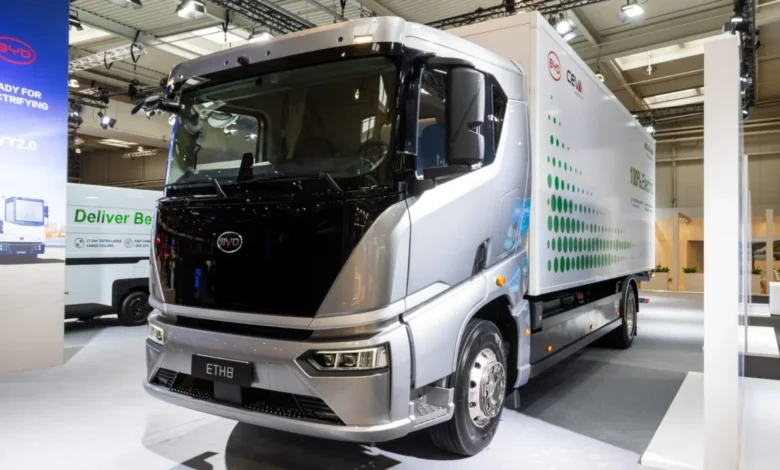
Consequently, Western OEMs face a double-edged crisis: not only do they confront a severe technology gap in battery management, heavy-duty powertrain design, and swapping architecture, but they also face an ever-widening cost gap driven by economies of scale mastered by Chinese competitors like BYD, FAW, and Sany—many of which are now actively eyeing entry into European and international markets.
Strategic Implications and Future Outlook
The trajectory of China’s heavy truck market offers a masterclass in industrial policy sequencing. Chinese authorities and industrial conglomerates understood that mandating green technology would fail without addressing the fundamental economics of logistics.
By strategically deploying subsidies to manage the initial purchase price gap, simultaneously supporting the development of a ubiquitous battery-swapping infrastructure, and fostering cutthroat domestic competition among battery and vehicle manufacturers, China transformed electric trucks from an expensive regulatory compliance burden into the most economically rational choice for fleet operators.
For Western automotive legacy brands, policymakers, and logistics providers, the implications are stark. As Chinese OEMs refine their cost structures, secure raw material supply chains, and export sophisticated zero-emission heavy commercial vehicles to global markets, the window to catch up is rapidly closing. The global race to decarbonize heavy freight is no longer a distant environmental ambition; it is an economic contest that is already being won and lost on the highways of Asia.