Ancient Dinosaur Blood Preserved Inside Fossilized Bones Rewrites the Limits of Paleontology

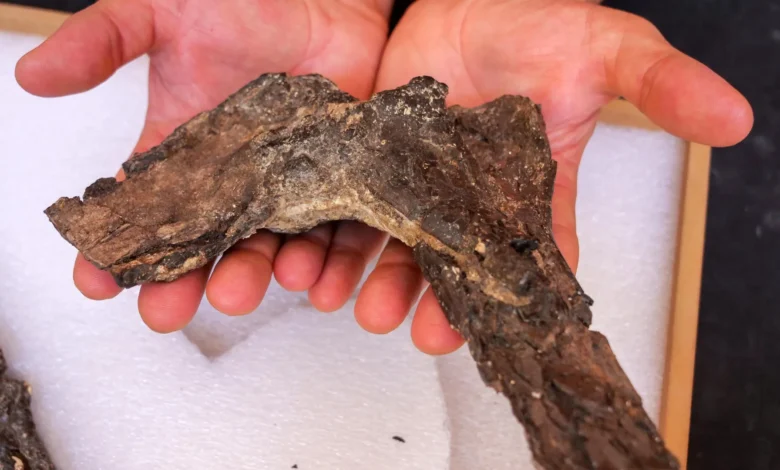
In a monumental breakthrough that upends decades of paleontological dogma, an international team of scientists has successfully discovered and chemically verified remarkably preserved traces of dinosaur blood inside 115-million-year-old bones. The research, published in the prestigious Proceedings of the National Academy of Sciences, focuses on the fossilized remains of Aratasaurus museunacionali, a predatory theropod dinosaur unearthed in the arid expanses of northeastern Brazil. By identifying intact heme molecules and fossilized red blood cells, the multidisciplinary research consortium has shattered previous timelines regarding how long delicate biological molecules can endure, opening an unprecedented molecular window into the physiology of extinct creatures and potentially reshaping the search for ancient biosignatures across the cosmos.
For generations, standard scientific consensus dictated that complex organic structures—such as proteins, soft tissues, and blood components—were simply too fragile to survive the immense pressures of fossilization over millions of years. Biological molecules typically degrade rapidly through hydrolysis, microbial activity, and thermal breakdown soon after an organism’s death. While sporadic claims of soft tissue recovery have surfaced over the last several decades, many were met with intense skepticism and debate within the scientific community due to potential modern microbial contamination or the lack of definitive chemical confirmation. This latest study, however, bypasses morphological guesswork by providing undeniable chemical signatures derived directly from hemoglobin, the iron-containing oxygen-transport protein found in vertebrate red blood cells.
Anatomy of a Landmark Discovery
The focal point of this historic discovery is Aratasaurus museunacionali, a medium-sized carnivorous theropod that roamed South America during the Cretaceous period, roughly 115 million years ago. When researchers from Curtin University and their global partners subjected the dinosaur’s limb bones to rigorous advanced imaging and chemical analysis, they uncovered an extraordinary micro-landscape preserved within the fossil matrix.
Deep inside the vascular canals—the microscopic tunnels that once pulsed with blood vessels supplying nutrients to the living bone—lay numerous mineralized red blood cells. Unlike previous discoveries where researchers identified structures that merely resembled blood cells under a microscope, this team pushed further by conducting advanced mass spectrometry and isotopic profiling. The chemical analysis confirmed the unequivocal presence of preserved heme molecules, the distinct structural components of hemoglobin responsible for binding and transporting oxygen throughout the body.
Furthermore, the analytical techniques revealed preserved amino acid sequences associated with collagen, the primary structural protein that forms the scaffolding of bone, skin, and other connective tissues. The dual presence of both heme signatures and collagen-related amino acids within the same fossilized micro-environment provides a holistic, chemically verified snapshot of the dinosaur’s internal biology, shifting the field of paleontology from the study of mere stone casts to the realm of molecular-level investigation.
The Mechanics of Deep-Time Preservation
How organic material could evade complete molecular destruction for more than a century of millions of years has long remained one of the greatest mysteries in geosciences. The answer, according to the research team, lies in a rare convergence of mineralogical stabilization and unique burial conditions.
The exceptional preservation observed in the Aratasaurus fossil is heavily tied to a mineral known as hausmannite, a manganese oxide. Researchers believe that in the wake of the dinosaur’s death, hausmannite acted as a stabilizing agent, encasing the microscopic biological structures and shielding them from environmental degradation. In effect, the mineral forged a microscopic, natural time capsule, locking the red blood cells and protein fragments into a stable state that could withstand deep geological time.
Equally critical was the specific depositional environment surrounding the carcass. Scientists deduce that the dinosaur was rapidly and deeply covered by fine-grained sediment in an oxygen-depleted, anoxic environment. This rapid burial choked off aerobic bacteria and scavengers that would normally consume soft tissues, while the unique chemical conditions of the sediment facilitated the mineral replacement processes that ultimately fossilized the bone while preserving its microscopic internal architecture.
A Global Collaboration of Scientific Excellence
The magnitude of this discovery required a massive, coordinated international effort, uniting leading researchers across multiple scientific disciplines and continents. Led by John Curtin Distinguished Professor Kliti Grice—founding director of the WA-Organic and Isotope Geochemistry Centre and an Australian Research Council Laureate Fellow—the project pooled the expertise of institutions including Curtin University’s School of Earth and Planetary Sciences, the Japan Agency for Marine-Earth Science and Technology, the Brazilian National Museum, the Regional University of Cariri, and Johns Hopkins University.
Reflecting on the achievement, Professor Grice emphasized the sheer improbability and significance of the find. To detect intact heme-derived molecules in 115-million-year-old red blood cells is astonishing, she noted, describing the milestone as a landmark event that extends the known fossil record of blood and offers a direct molecular window into the physiology of long-extinct fauna.
Professor Martin Van Kranendonk, head of Curtin University’s School of Earth and Planetary Sciences, echoed these sentiments, highlighting how the breakthrough exemplifies the power of cross-disciplinary and cross-continental scientific synergy. The research was made possible in part by a 2021 Australian Research Council Laureate Fellowship awarded to Professor Grice, providing the long-term funding necessary to pursue such high-risk, high-reward analytical investigations.
Challenging the Dogma of Molecular Decay
For decades, biochemistry textbooks taught that proteins and complex biomolecules have a definitive expiration date. Under standard conditions, scientists calculated that even under the most favorable circumstances, proteins would completely hydrolyze and vanish within a few million years at most.
The confirmation of 115-million-year-old heme molecules directly challenges these foundational assumptions, forcing geochemists and paleontologists to recalculate the parameters of organic decay. It suggests that under optimal mineralogical and environmental conditions, specific biomolecules can persist far longer than previously thought possible.
This paradigm shift opens vast new avenues for molecular paleontology. Rather than relying solely on skeletal morphology, osteological measurements, and comparative anatomy to reconstruct the lives of dinosaurs, researchers can now begin probing fossils for chemical clues regarding metabolism, oxygen-carrying capacity, thermoregulation, and evolutionary adaptations. Understanding the specific physiological demands of predatory theropods like Aratasaurus could eventually allow scientists to model their activity levels, endurance, and metabolic rates with a precision previously thought unattainable.
Implications for Astrobiology and the Search for Life Beyond Earth
While the terrestrial implications for dinosaur research are profound, the ripples of this discovery extend far beyond Earth’s prehistoric past, touching heavily upon the field of astrobiology.
Astrobiologists are tasked with searching for signs of past or present life on other worlds, such as Mars or the icy moons of the outer solar system. A central challenge in this quest is understanding how biosignatures—molecular traces left behind by living organisms—can survive harsh environmental conditions and intense radiation over astronomical timescales.
By demonstrating that delicate biological molecules can remain structurally and chemically detectable for over 100 million years when protected by specific mineral matrices, the Curtin University-led study provides a vital conceptual framework for space exploration agencies. If organic signatures can endure the extreme pressures of Earth’s geological history, similar preservation mechanisms might operate on other planetary bodies. Consequently, astrobiologists may need to adjust their search parameters, focusing not just on surface materials, but on specific mineral deposits and subterranean environments where ancient biomarkers could be safely locked away.
Looking toward the Future of Biosignature Research
As analytical technologies continue to advance—ushering in higher-resolution mass spectrometry, nanoscale imaging, and more sensitive spectroscopic techniques—paleontologists are returning to museum drawers and fossil archives with renewed urgency. Many specimens previously dismissed as poorly preserved or structurally uninformative may now harbor overlooked molecular treasures waiting to be unlocked.
The discovery of blood inside the bones of Aratasaurus museunacionali stands as a testament to the resilience of nature and the relentless ingenuity of modern science. By bridging the gap between paleontology, organic geochemistry, and astrobiology, this milestone study proves that the deep past is not entirely lost to time. Instead, encoded within the microscopic architecture of ancient stone, the molecular echoes of life millions of years dead continue to speak, forever altering our understanding of biology’s endurance across the universe.