Germany’s Political Landscape Quakes As State Elections Signal Deepening Fragmentation and Traditional Party Erosion

Published September 20, 2026, the political reality across Germany has entered a period of profound uncertainty following a pivotal state election earlier in the month that sent shockwaves through both traditional center-right strongholds and the historically crowded left-wing political spectrum. For decades, the German electorate could reliably navigate a predictable political matrix defined by major catch-all parties. However, recent ballot results have exposed a fracturing system where voters are increasingly abandoning mainstream establishments in favor of fringe, populist, and newly minted political movements.
The September 2026 state elections served as an acute stress test for modern German democracy. Voters heading to the polls found themselves navigating a dense ideological marketplace. On the center-left, the Social Democrats (SPD) faced stiff competition from their more progressive coalition partners, the Greens. Further to the left sat The Left party (Die Linke), alongside the populist, left-leaning Sahra Wagenknecht Alliance (BSW), and the ideological remnants of the former East German Communist Party. Yet, despite this cornucopia of options for left-leaning voters—metaphorically described as maneuvering under a marmalade sky—the outcome was not a victory for progressive politics, but rather a structural catastrophe.
The electoral fallout extended far beyond the fractured left. It dealt an equally severe blow to the Christian Democratic Union (CDU). Historically the nation’s most powerful and influential political force since the turbulent post-World War II rebuilding era of 1945—when currency in a bombed-out Berlin was frequently substituted with American Lucky Strike and Pall Mall cigarettes—the CDU watched its traditional dominance buckle under the weight of surging anti-establishment sentiment.
Background Context of the Electoral Shift
To understand the gravity of the September 2026 state vote, one must examine the steady erosion of the German party system over the past decade. For generations, German politics was anchored by two dominant political camps: the center-right Christian Democrats (CDU/CSU) and the center-left Social Democrats (SPD). Together, these parties routinely commanded over 70% to 80% of the national vote, enabling stable, predictable coalition governments.
However, compounding crises have steadily dismantled this duopoly. The 2015 European migrant crisis, the COVID-19 pandemic, the subsequent European energy crunch following the outbreak of the Russia-Ukraine war, and ongoing inflation have severely tested the resilience of the German middle class. As economic anxiety mounted and public dissatisfaction with infrastructure, immigration control, and bureaucratic stagnation grew, voters began turning away from the traditional establishment.
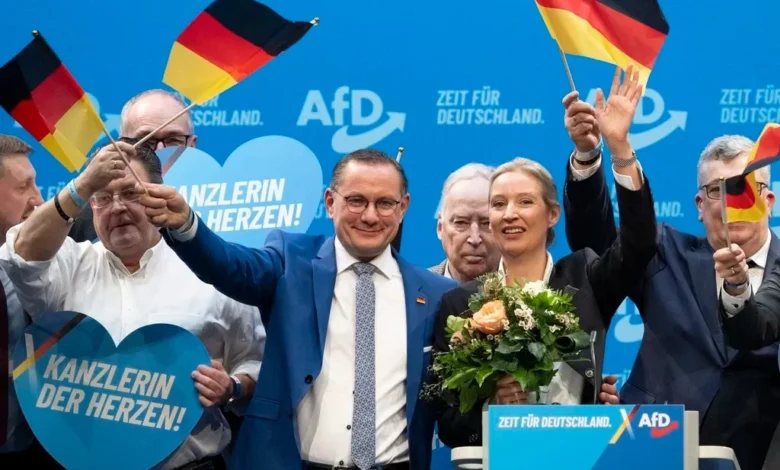
The splintering of the political landscape accelerated as new parties emerged to capture disenchanted segments of the population. On the right, the Alternative for Germany (AfD) capitalized heavily on anti-immigration sentiment and skepticism toward green transition policies. Concurrently, the left experienced its own centrifugal forces. The founding of the Sahra Wagenknecht Alliance (BSW) in late 2023 and early 2024 created a formidable populist force that combined socially conservative views with traditional leftist economic policies, drawing heavily from working-class voters who felt alienated by the modern, urban-focused platforms of the SPD and the Greens.
Chronology of the Crisis
The road to the September 2026 electoral reckoning was paved by a series of regional contests that consistently chipped away at the governing federal coalition’s legitimacy.
In late 2023 and throughout 2025, regional parliaments across eastern and western Germany witnessed dramatic shifts in voter intentions. Incumbent state governments struggled to form functioning coalitions as the number of parties clearing the crucial 5% electoral threshold multiplied.
By mid-2026, campaigning in the target state had intensified, focusing heavily on national economic stagnation, housing shortages, and immigration pressures. Federal figures from both the SPD and the CDU attempted to nationalize the campaign, framing the regional vote as a referendum on national leadership.
When the polls closed in early September 2026, the results defied conventional political forecasting. Rather than a consolidation around reliable governing partners, the electorate delivered a deeply fragmented legislature. The traditional major parties experienced historic lows in vote share, while populist movements on both the radical left and the right surged. Coalition arithmetic instantly became nearly impossible, plunging the regional government into a prolonged constitutional and political stalemate.
Supporting Data and Electoral Metrics
An analysis of voter migration patterns reveals alarming trends for the established parties:
- Decline of the Volksparteien (Catch-all Parties): Combined vote shares for the CDU and SPD dropped significantly compared to previous legislative cycles, dipping below historic floors in key industrial and rural districts.
- The Rise of the Fringe: Anti-establishment parties collectively absorbed nearly a third of the total ballots cast, reflecting a profound crisis of confidence in representative institutions.
- Voter Turnout Dynamics: Despite the high stakes, voter turnout fluctuated unevenly, with high engagement driven by protest voting in rural areas contrasted by voter apathy in traditional urban strongholds.
- Coalition Fractures: The proliferation of parties clearing the 5% threshold means that forming a majority government now requires unprecedented three-party or even four-party coalitions—often grouping ideologically incompatible entities together.
Official Responses and Political Reactions
In the wake of the catastrophic regional results, party headquarters in Berlin entered emergency session mode.
Spokespersons for the Christian Democrats acknowledged the deep frustration coursing through the electorate. Party leadership emphasized the need to refocus on core conservative principles, particularly economic competitiveness, fiscal responsibility, and robust border management. However, internal factions quickly began pointing fingers, questioning whether the party’s moderate wing had drifted too far from its traditional base.
Meanwhile, representatives of the governing federal coalition—led by the SPD—faced intense pressure to evaluate their national agenda. Cabinet members defended their ongoing legislative efforts, citing global economic headwinds and the complex transition toward renewable energy. Nevertheless, private acknowledgments from senior party strategists conceded that the federal government’s communication strategy had failed to resonate with citizens bearing the brunt of inflation and industrial restructuring.
Leaders from the populist BSW and other challenger parties hailed the election outcome as a democratic awakening. They argued that the establishment had ignored the economic security and social concerns of ordinary citizens for far too long, framing their electoral gains as an indispensable corrective to top-down governance.
Broader Impact and Implications for German Democracy
The September 2026 state election is far more than a regional political anomaly; it serves as a bellwether for the future of Germany’s political stability.
First, the extreme fragmentation of state parliaments complicates the fundamental task of governance. When governments require unwieldy coalitions of three or four parties to pass basic legislation, political paralysis often ensues. Compromise becomes protracted, reforms stall, and public frustration deepens further—creating a vicious cycle of disillusionment.
Second, the normalization of populist alternatives on both extremes of the political spectrum forces mainstream parties into difficult strategic dilemmas. The historical political taboo against cooperating with radical factions faces continuous pressure as traditional coalitions become mathematically impossible to assemble. This threatens to shift the Overton window and reshape political norms that have governed the Federal Republic for nearly eight decades.
Finally, the reverberations of this regional vote will inevitably influence federal policymaking as Germany looks ahead to subsequent national elections. Chancellor and cabinet ministers must now navigate an increasingly hostile domestic terrain, balancing the demands of international allies—particularly within the European Union and NATO—with a domestic populace that is visibly fatigued, economically anxious, and rapidly turning away from the political center.
As Germany digests the lessons of this electoral watershed, the fundamental question facing its democratic institutions is whether traditional leadership can adapt swiftly enough to rebuild public trust before political fragmentation becomes permanent.