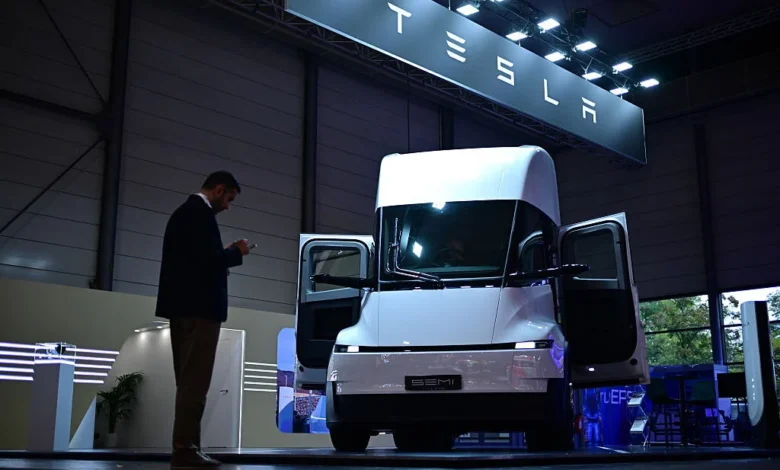
The heavy-duty logistics sector is currently navigating a period of unprecedented volatility, defined by the dual pressures of geopolitical instability in the Middle East and a pivot in domestic energy policy. Despite a challenging regulatory environment—marked by the Trump administration’s decision to rescind billions in federal subsidies for electric vehicles (EVs) and a concerted effort to relax fuel economy standards for heavy-duty truck engines—the market for electrified long-haul transportation is demonstrating unexpected resilience. This surge in demand is anchored by a landmark agreement this week, in which a coalition of corporate giants, including Microsoft and PepsiCo, finalized a record-setting order for 2,500 Tesla Semis.
The procurement, which is slated for fulfillment over the next 18 months, serves as a significant bellwether for the trucking industry. If successfully deployed, these 2,500 units will effectively double the current population of heavy-duty electric trucks operating on American highways, marking a critical inflection point in the decarbonization of the freight sector.
The Macroeconomic Catalyst: The Diesel Crisis
The impetus for this massive shift is primarily economic rather than purely ideological. As the ongoing conflict in Iran continues to disrupt global oil production and maritime shipping lanes, US diesel prices have ascended to record-breaking highs. With costs nearly doubling compared to this time last year, the traditional diesel-reliant business model of the American trucking industry has become increasingly untenable for major logistics providers.
Elon Musk, addressing the shift in a pre-taped industry briefing, underscored the economic inevitability of the transition. "The truck is going to make a ton of sense economically because the cost of electricity is much less than the cost of diesel, especially in these crazy times," Musk noted. This statement highlights the growing divergence between the administration’s stated policy goals—which favor conventional internal combustion engines—and the fiscal reality facing corporate supply chains.
The reliance on heavy-duty diesel trucks is not a trivial matter for the American economy or the environment. According to the Environmental Protection Agency (EPA), heavy-duty vehicles account for approximately 7 percent of total US greenhouse gas emissions. By lowering fuel economy standards for truck engines, the administration has signaled a priority for lower short-term manufacturing costs, yet this strategy appears to be colliding with the long-term operational cost-saving strategies of major corporations.
A Chronology of the Tesla Semi
The journey of the Tesla Semi from concept to commercial viability has been lengthy and marked by iterative delays.
- November 2017: Tesla officially unveils the Semi prototype, promising 500 miles of range and a suite of advanced driver-assistance features, including Enhanced Autopilot.
- 2018–2021: Production timelines are repeatedly pushed back due to battery supply constraints and the prioritizing of consumer vehicle lines like the Model 3 and Model Y.
- December 2022: Tesla delivers the first production units to PepsiCo, marking the transition from prototype testing to real-world commercial application.
- 2023: The administration and Congressional allies move to cut federal EV tax credits, creating uncertainty in the heavy-duty sector.
- Early 2025: A coalition of shippers, led by organizations like the Smart Freight Centre, aggregates demand to finalize a bulk purchase agreement for 2,500 units, demonstrating that large-scale corporate demand can override the absence of federal incentives.
The Logistics Coalition: Why Tesla?
The decision by Microsoft, PepsiCo, and their partners to select Tesla over traditional incumbents like Kenworth, Ride, and Volvo was the result of a rigorous evaluation process. According to Meena Bibra, a spokesperson for the Smart Freight Centre, the selection criteria were strictly defined: "The group assessed price, performance, production capability, and service support."
The ability of this alliance to pool demand was a decisive factor in making the deal viable. By aggregating the purchasing power of multiple large-scale carriers, the coalition effectively reduced the unit cost for the automakers, allowing for economies of scale that might otherwise be unavailable to smaller firms.
However, the industry remains diverse. While Tesla has captured this specific contract, the landscape for electric trucking is expanding. Legacy manufacturers are aggressively updating their lineups to remain competitive. Volvo Trucks, for instance, has invested heavily in its VNR Electric platform, while Kenworth continues to leverage its deep history in the trucking sector to provide reliable service infrastructure—a critical concern for fleet managers who cannot afford the downtime associated with nascent technology.
Technological Hurdles and Future Outlook
Despite the excitement surrounding the record order, the Tesla Semi faces ongoing scrutiny regarding its technological capabilities. The vehicle does not yet offer Tesla’s "Full Self-Driving (Supervised)" feature, a software stack that has remained a central point of contention for regulators and safety advocates.
While Musk promised in his recent address that the feature would debut in "the very near future," industry analysts remain cautious. The transition from Enhanced Autopilot—promised in the original 2017 rollout—to a fully autonomous trucking solution involves significantly higher technical hurdles, including the handling of extreme braking distances and complex maneuvers inherent to 80,000-pound vehicles. The absence of this feature in the current fleet does not appear to have deterred major shippers, who are currently more concerned with the immediate operational savings provided by the electric powertrain than the promise of future autonomy.
Policy Implications and the Energy Paradox
The current situation presents a distinct paradox: the administration that has worked to dismantle support for electric vehicles finds itself overseeing a market where the private sector is accelerating the adoption of that very technology to mitigate the fallout of energy market instability.
By scaling back federal support for EV infrastructure and lowering engine standards, policymakers have effectively forced the private sector to innovate in a vacuum. The current strategy of large-scale corporate buyers—pooling demand to lower costs without government intervention—suggests that the EV transition in the logistics sector may be reaching a point of self-sustaining momentum.
However, the lack of a cohesive federal policy framework remains a risk. As manufacturers like Volvo and Kenworth continue to refine their electric offerings, the lack of standardized charging infrastructure across the US interstate system threatens to bottleneck the rollout of these vehicles. While corporations can secure the trucks, they cannot unilaterally secure the massive electrical grid upgrades required to charge thousands of heavy-duty vehicles simultaneously at regional distribution centers.
Conclusion
The record-breaking purchase of 2,500 Tesla Semis represents more than a simple equipment upgrade; it is a signal that the private sector is decoupling its environmental and operational strategies from the shifting whims of federal policy. Faced with the volatile reality of record-high diesel prices and a global energy market made precarious by regional conflicts, the nation’s largest shippers are betting on electrification as a hedge against future price shocks.
Whether the industry can meet the production timelines and infrastructure demands of this massive shift remains the primary variable in the coming 18 months. As the trucking sector moves toward a cleaner, electric-driven future, the tension between legacy energy policies and modern corporate economic strategy will likely continue to define the logistics landscape for years to come.