Germany’s Shifting Political Landscape: Regional Elections Send Shockwaves Through Traditional Parties

The political horizon in Germany is undergoing a profound and unprecedented transformation, marked by recent regional electoral outcomes that have challenged the nation’s long-standing party structures. For voters aligned with center-left and progressive ideologies, the choices have traditionally been broad, encompassing the slightly left-of-center Social Democratic Party (SPD), the environmentalist Greens, the democratic socialist Left party (Die Linke), the populist far-left Sahra Wagenknecht Alliance (BSW), and various minor factions remaining from the political landscape of the former East Germany. However, the recent state-level electoral results have signaled a seismic shift, delivering a staggering blow not only to the fractured progressive coalition but also to the center-right Christian Democratic Union (CDU), which has historically stood as the dominant pillar of German governance since the conclusion of the Second World War.
This article examines the structural changes currently reshaping the Federal Republic of Germany, exploring the historical context of its political parties, the detailed timeline of recent state elections, the empirical data underlining the shift, the official responses from major political figures, and the broader implications for the future of European stability and national policymaking.
Historical Context and the Post-War Political Order
To understand the weight of the recent regional shocks, one must examine the architecture of modern German democracy established after 1945. Emerging from the ruins of the Second World War, the Federal Republic developed a stable, consensus-driven party system. For decades, German politics was defined by a two-party dominance between the center-right Christian Democratic Union (along with its Bavarian sister party, the Christian Social Union, or CSU) and the center-left Social Democratic Party. These two blocs routinely commanded the vast majority of the electorate, frequently forming coalition governments with smaller kingmaker parties, most notably the pro-business Free Democratic Party (FDP).
Over the late 20th and early 21st centuries, this duopoly gradually eroded. The rise of the Greens introduced environmental policy to the mainstream, while the unification of Germany integrated the successor of East Germany’s ruling communist party—ultimately evolving into Die Linke—into the federal parliament. More recently, the emergence of the right-wing Alternative for Germany (AfD) and, subsequently, the populist left Sahra Wagenknecht Alliance (BSW) has atomized the electorate. The traditional pillars of stability are finding it increasingly difficult to form stable majorities, leading to complex, multi-party coalition arrangements that often paralyze decisive governance.
Chronology of the Electoral Upheaval
The mounting crisis did not happen overnight; it is the culmination of years of voter dissatisfaction regarding economic stagnation, inflation, housing shortages, and immigration policies.
The trajectory intensified during the 2021 federal election, which resulted in the formation of the "traffic light" coalition comprising the SPD, the Greens, and the FDP. Conceived as a progressive modernization pact, the coalition quickly bogged down in internal ideological disputes, particularly over fiscal policy and the green energy transition.
By 2024 and moving toward the legislative milestones of 2026, regional elections in eastern and western states began to reflect deep public alienation from the federal administration. In recent state contests, particularly in eastern regions where historical voting patterns differ markedly from the former West Germany, the establishment parties suffered historic defeats. The CDU, despite remaining a formidable force nationally, found its regional strongholds severely contested or broken. Meanwhile, the parties of the federal coalition watched their vote shares plummet, reflecting a profound referendum on national leadership.
Supporting Data and Polling Trends
Quantitative analysis of recent electoral cycles illustrates a stark decline in the aggregate vote share of Germany’s traditional governing parties.
- The Erosion of the Duopoly: Historically, the CDU/CSU and SPD routinely captured between 70% and 80% of the combined federal vote. In recent regional and national polling averages, their combined share has frequently struggled to consistently clear the 50% threshold, highlighting a splintered electorate.
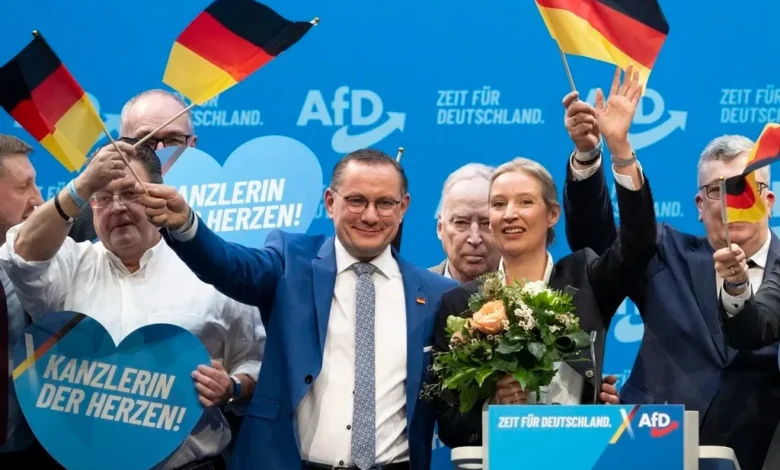
- Rise of Anti-Establishment Movements: The AfD has solidified its position as a major political force, particularly in eastern states like Saxony, Thuringia, and Brandenburg, frequently polling second or first in those regions. Concurrently, the BSW, founded by prominent leftist populist Sahra Wagenknecht, has successfully siphoned working-class voters away from both the SPD and Die Linke by combining socially conservative stances on cultural issues with traditional left-wing economic policies.
- Voter Turnout and Polarization: While regional turnout figures have occasionally risen due to heightened polarization, voter volatility—the percentage of electors switching parties between election cycles—has reached record highs, pointing to a volatile and unpredictable political future.
Official Responses and Political Reactions
The cascading electoral losses have triggered intense introspection and defensive maneuvering across the political spectrum.
Leadership within the Social Democratic Party has emphasized the necessity of better communicating its social welfare achievements and addressing cost-of-living concerns directly. Senior SPD officials have argued that global economic headwinds and post-pandemic recovery pressures have unfairly overshadowed domestic social investments. However, internal critics within the party’s left and moderate wings have openly debated whether the party should distance itself from its coalition partners to reclaim a distinct identity.
The Greens, who have faced fierce criticism from conservative and industrial sectors over rapid decarbonization mandates and industrial electricity costs, have defended their environmental agenda as an existential necessity. Yet, pragmatic elements within the party have acknowledged the urgent need to address the economic anxieties of rural and working-class voters who feel alienated by urban-centric progressive policies.
For the Christian Democrats, the regional setbacks serve as both a warning and a strategic opportunity. While party leadership under Friedrich Merz and other senior figures have sought to position the CDU as the natural, competent alternative to the current federal administration, regional anomalies—such as the difficulty of forming coalitions without partnering with populist extremes—have highlighted the severe constraints of modern German political arithmetic. The long-standing firewall ("Brandmauer") preventing mainstream parties from cooperating with the far-right AfD remains intact, but the rise of the BSW has created new, complex dilemmas regarding government formation.
Broader Implications for Germany and the European Union
The political fragmentation witnessed in recent German state elections extends far beyond domestic borders, carrying significant weight for the European Union and global geopolitics.
Germany has traditionally acted as the indispensable economic and political anchor of the European Union. A politically fractured Berlin, consumed by domestic coalition management and vulnerable to the pressures of populist extremes on both the left and the right, risks a paralysis in foreign policy and European integration. Key EU initiatives—ranging from fiscal harmonization and defense cooperation to migration policy and the implementation of the European Green Deal—rely heavily on decisive leadership from the German federal government.
Furthermore, the normalization of populist and anti-establishment parties in state legislatures changes the nature of legislative debate. Issues that were once settled within the traditional democratic consensus are now subjected to intense polarization, complicating long-term infrastructural and economic planning.
As Germany looks ahead to upcoming national electoral cycles, the central question remains whether the traditional parties can successfully recalibrate their platforms to recapture disillusioned citizens, or if the era of stable, predictable coalition governments has permanently given way to a fragmented, highly volatile multi-party landscape.