Tesla Finally Rolls Out Production Semi Trucks From Nevada Plant Amid Persistent Delivery Volume Questions By Stewart Burnett

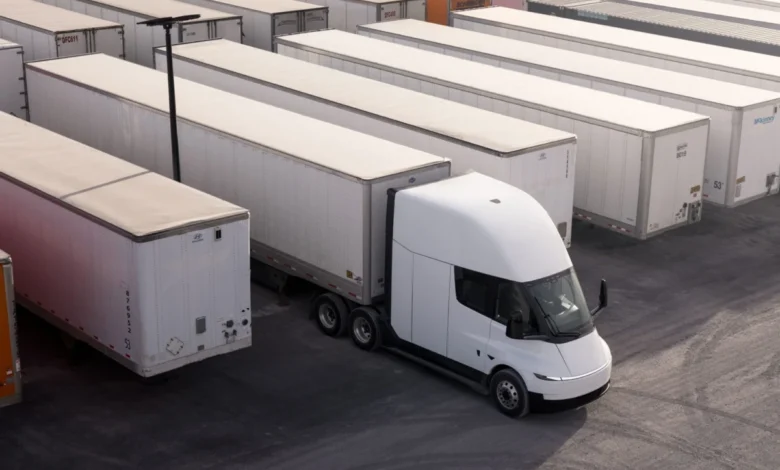
Tesla has officially commenced customer deliveries of its long-awaited Semi electric truck from its dedicated production facility in Sparks, Nevada. This milestone arrives nearly nine years after Chief Executive Officer Elon Musk first unveiled the heavy-duty vehicle concept to the public in 2017. While the automaker has formally inaugurated the factory and reiterated its theoretical maximum capacity of 50,000 trucks per year—equating to roughly 1,000 units weekly—the company notably refrained from disclosing official short-term production volume targets or final pricing structures during the launch event.
The rollout marks a critical juncture for Tesla’s commercial vehicle division. However, a significant chasm remains between the plant’s theoretical output and near-term market expectations. Independent industry analysts and outside estimates project that actual 2026 deliveries will range between 5,000 and 15,000 units. This conservative forecast underscores the operational hurdles that still lie ahead as the company attempts to transition from pilot-scale assembly to high-volume manufacturing.
A Chronological Look at the Tesla Semi Journey
The path to commercialization for the Tesla Semi has been marked by repeated delays, technological pivots, and shifting timelines.
- November 2017: Elon Musk formally unveils the Tesla Semi prototype during a high-profile media event, promising initial production by 2019 with targeted base prices starting at $150,000 for a 300-mile range variant and $180,000 for a 500-mile variant.
- 2019–2021: Production targets are pushed back repeatedly due to global supply chain disruptions, battery cell shortages, and the prioritization of passenger vehicle manufacturing lines.
- Late 2022: Tesla delivers its first pilot units to early adopter PepsiCo, initiating real-world fleet testing in daily regional logistics operations.
- December 2025: Logistics giant DHL receives its initial allocation of Tesla Semi trucks, expanding the pilot footprint.
- June 2026: Fleet operator ArcBest purchases units following a successful pilot program that demonstrated an energy consumption rate of 1.55 kWh per mile in real-world conditions.
- August 2026: Autonomous freight specialist Einride places a landmark order for 500 trucks, marking the largest single commercial Semi commitment recorded at the time.
- Late 2026: Tesla officially begins customer deliveries from the dedicated Sparks, Nevada production facility, rolling out trucks branded for at least nine major corporate clients.
Pricing Realities and Market Competitiveness
Although Tesla has maintained official silence regarding current retail pricing, leaked reports circulating earlier in the year suggested that the company has been quoting corporate customers roughly $290,000 for the 500-mile Long Range version. This figure represents a substantial increase over the original $150,000 to $180,000 price tags advertised when the vehicle was first announced in 2017.
Despite this upward price adjustment, the Semi maintains a notable cost advantage within the nascent zero-emission commercial vehicle sector. Competing Western-made electric trucks—such as the Volvo Trucks FH Electric—frequently command price tags exceeding $450,000. For fleet operators navigating stringent environmental regulations and tightening corporate sustainability mandates, the Tesla Semi offers a more economically viable entry point into electrification, provided the vehicles achieve their promised operational longevity.
Early Adopters and Growing Fleet Commitments
Tesla’s initial delivery wave supports a diverse portfolio of corporate giants. Trucks branded for at least nine major clients were lined up outside the Nevada manufacturing facility, including PepsiCo, DHL, US Foods, ArcBest, Einride, IMC Logistics, WattEV, and OK Produce.
PepsiCo, which served as the primary guinea pig for the platform with its late 2022 pilot deliveries, now operates dozens of Semis in grueling daily regional service routes. Meanwhile, the broader market continues to validate the truck’s operational viability through major procurement announcements. A coalition of major cargo-owning shippers, featuring enterprise names such as Microsoft and PepsiCo, selected Tesla to help supply a combined 2,500 zero-emission freight trucks for deployment in California, operating alongside legacy manufacturers like Kenworth and Volvo, as well as fleet partner RIDE.
Engineering Upgrades and Powertrain Specifications
Underneath the aerodynamic exterior, the production Tesla Semi incorporates a series of sweeping engineering revisions designed to maximize efficiency, reduce weight, and lower production costs.
The vehicle is offered in two core configurations:
- Standard Range: Rated for 325 miles of operational range at a maximum gross combination weight (GCW) of 82,000 pounds.
- Long Range: Rated for 500 miles of operational range under identical maximum load conditions.
Both trims draw power from a heavy-duty 800-kilowatt three-motor drivetrain. During the factory inauguration, Tesla’s Director of Semi Engineering, Dan Priestley, emphasized that these range figures are derived from fully loaded testing protocols rather than diminishing payload assumptions. Furthermore, Vice President of Engineering Lars Moravy noted that pulling a lighter payload of approximately 60,000 pounds can extend the vehicle’s operational range to roughly 600 miles.
A major technical evolution in the production model is the adoption of Tesla’s in-house 4680 battery cells, replacing the purchased 2170 cylindrical cells utilized in earlier prototype and pilot vehicles. This transition forms the backbone of a broader corporate efficiency push that has successfully reduced the truck’s energy consumption to approximately 1,700 Watt-hours per mile, down significantly from the original 2,000 Wh/mi target. By tightening energy draw, Tesla was able to equip the Semi with a smaller, lighter battery pack totaling an 822 kWh capacity without sacrificing its critical 500-mile range benchmark.
The drivetrain has likewise undergone a complete overhaul since 2017. Engineers replaced the original carbon-fibre-sleeved rotor design with a robust steel-caged rotor. The stator now shares its advanced bar-wound construction with the Tesla Cybertruck. Additionally, the drive axle is roughly 80 kilograms lighter than earlier iterations, achieved by eliminating two of the three separate oils traditionally required. The remaining single, shared motor and gearbox lubricant is engineered to endure more than 250,000 miles of heavy-duty operation, according to Moravy.
Monaeuvers and thermal management have also received modern updates. The steering system has shifted from traditional hydraulic assistance to a redundant electric power steering setup. Tesla states this modification enhances driving precision while delivering a turning radius comparable to a standard Model Y—a critical design choice engineered specifically to assist drivers navigating tight urban environments and congested loading docks.
Furthermore, the Semi shares its indirect thermal management architecture—including fluid pumps, compressors, and heat exchangers—with Tesla’s upcoming Cybercab. This integration eliminates long refrigerant plumbing lines, allowing thermal energy to transfer directly between the cabin, battery pack, and drive unit with minimal loss.
Infrastructure Constraints and Charging Capabilities
Despite impressive engineering specifications, charging infrastructure remains the most formidable bottleneck for heavy electric trucking. Operating an 822 kWh battery pack requires robust, high-capacity energy delivery systems.
To address this challenge, Tesla is deploying its proprietary Megacharger system, which delivers up to 1.2 megawatts of power per charging stall. The automaker announced plans to operate more than 30 dedicated Semi charging stations equipped with over 200 megawatt-capable charging posts by the conclusion of the year. During live demonstrations at the plant inauguration, a production Semi successfully charged from 3% to 60% capacity in approximately 30 minutes.
Tesla also claims that its fleet management software achieves an uptime exceeding 98%. This metric compares favorably against the historical industry average of 90% to 95% for conventional diesel-powered Class 8 commercial trucks. However, industry analysts frequently urge caution regarding internal corporate metrics, noting Tesla’s historically mixed record on self-reported performance and safety data transparency.
Broader Economic Implications and Industry Outlook
The fundamental question facing the commercial trucking industry is no longer whether electric Class 8 trucks can perform demanding logistics tasks, but rather how quickly Tesla can scale manufacturing to meet demand.
While Tesla’s July shareholder letter officially pushed volume production into 2026, it stopped short of confirming the exact timeline for when the Sparks facility will approach its advertised 50,000-unit annual capacity. With independent estimates pegging actual deliveries closer to the 5,000-to-15,000-unit bracket for the year, the substantial backlog of corporate orders will take considerably longer to fulfill than many eager fleet operators anticipated.
Nevertheless, macroeconomic conditions provide an exceptionally strong tailwind for alternative fuel adoption. Average United States diesel prices hovering above $6.50 per gallon—representing nearly double the price levels seen in previous years—provide Tesla’s total-cost-of-ownership (TCO) value proposition with ideal market timing. Fleet operators facing punishing fuel overhead are increasingly eager to transition to electric alternatives to insulate their balance sheets from volatile fossil fuel markets.
Ultimately, converting compelling cost advantages and technological demonstrations into permanent industry transformation depends entirely on execution. Tesla must prove it can finally deliver verified production volumes at scale—a persistent hurdle for a product line that has weathered multiple delays since its initial unveiling over eight years ago.