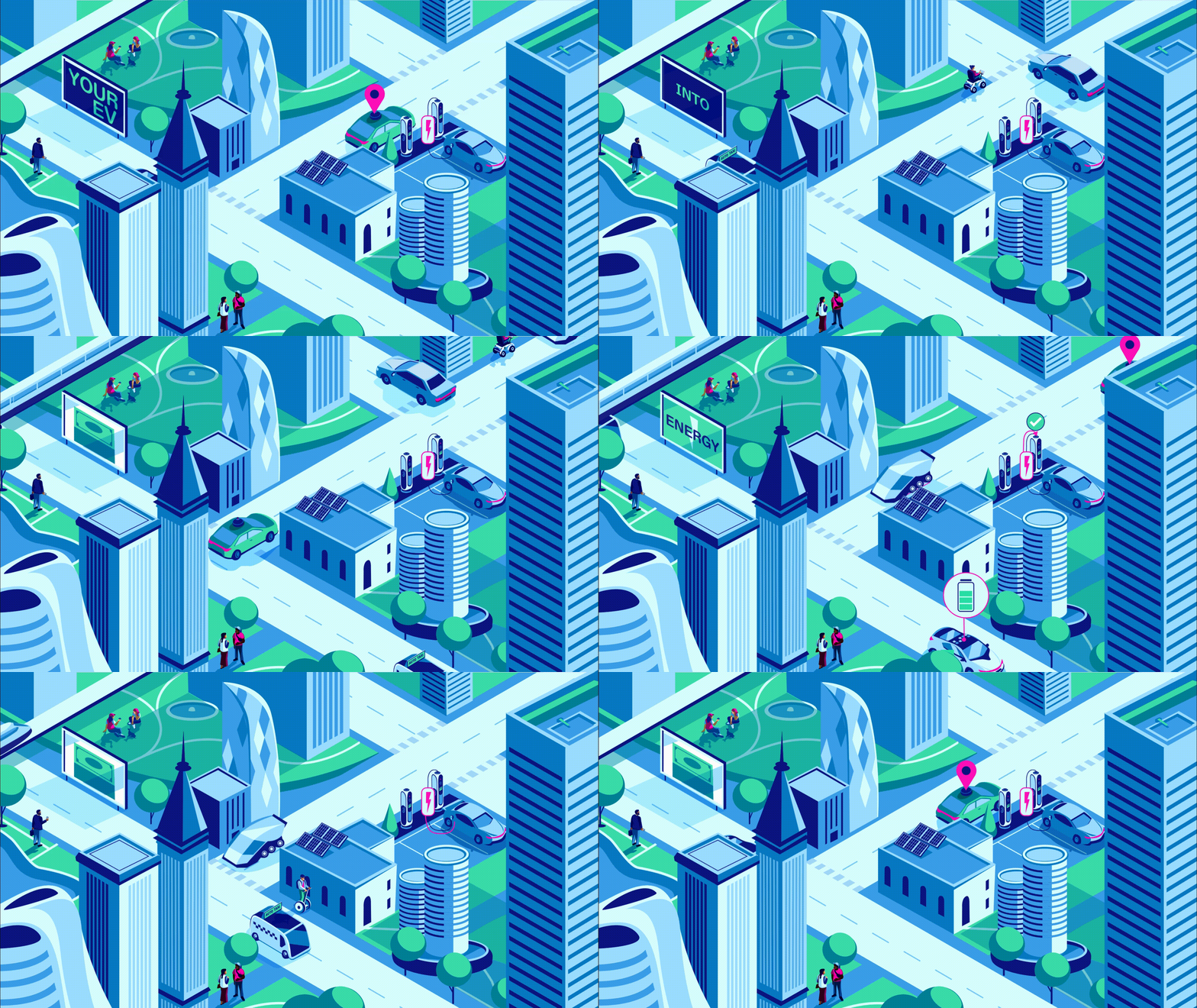
Imagine you are embarking on a cross-country road trip in 2034, navigating the sprawling highways of the American landscape with a level of ease and efficiency that was once relegated to the realm of science fiction. The journey begins with a brief stop at a high-speed charging station, but as you pull back onto the asphalt, the vehicle’s exterior—coated in advanced photovoltaic "solar paint"—begins to harvest ambient energy, supplementing the battery life as you cruise toward the horizon. Inside the cabin, the steering wheel remains stationary, and the pedals are untouched. Your attention is directed toward the panoramic vistas of the Rocky Mountains or the digital correspondence of your professional life, while the vehicle autonomously manages speed, lane positioning, and hazard avoidance.
This vision of the future is not merely a product of imagination; it is the culmination of decades of research in artificial intelligence, materials science, and telecommunications infrastructure. As we look toward the next ten years, the automotive industry stands at a critical juncture, transitioning from internal combustion engines and human-operated vehicles toward a highly interconnected, electrified, and automated ecosystem.
The Technological Architecture of Tomorrow
The core of this transformation lies in the concept of Vehicle-to-Everything (V2X) communication. Unlike the early iterations of autonomous vehicles that relied exclusively on onboard sensors such as LiDAR, radar, and cameras, the next generation of transport will leverage a collective intelligence. Through V2X, vehicles will broadcast their position, speed, and intended trajectory to other cars and surrounding infrastructure.
In a practical sense, this eliminates the "human factor" of delayed reaction times. When a vehicle five cars ahead encounters an obstacle and initiates braking, your car will receive that data instantaneously. Rather than a chain reaction of sudden, jarring stops—the primary cause of highway traffic congestion—your vehicle will calculate the optimal deceleration rate to maintain a fluid flow, effectively "smoothing" the traffic wave before it ever reaches you.
A Chronology of the Autonomous Transition
The road to the 2034 autonomous landscape has been paved by iterative milestones over the past two decades.
- 2004–2007: The DARPA Challenges: The U.S. Defense Advanced Research Projects Agency (DARPA) Grand Challenges served as the crucible for modern autonomous research, forcing roboticists to prove that vehicles could navigate desert terrain without human intervention.
- 2010–2015: The Sensor Revolution: Industry leaders began integrating sophisticated radar and computer vision systems into consumer vehicles, introducing advanced driver-assistance systems (ADAS) like lane-keeping assist and adaptive cruise control.
- 2016–2022: The Era of Pilot Programs: Major technology firms and legacy automakers launched localized robotaxi pilots in dense urban environments like Phoenix, San Francisco, and Beijing, testing the limits of Level 4 autonomy in controlled settings.
- 2023–2028: Integration and Standardization: This current phase focuses on the rollout of 5G and 6G connectivity, which provides the low-latency bandwidth necessary for real-time V2X communication.
- 2029–2034: Scaling and Infrastructure Overhaul: The final transition phase involves the implementation of "smart city" infrastructure—traffic lights that communicate directly with vehicles and road surfaces embedded with sensors to detect ice or structural degradation.
Supporting Data and Energy Innovation
The feasibility of this future relies heavily on advancements in battery chemistry and energy harvesting. Current lithium-ion technology is increasingly being challenged by solid-state batteries, which offer higher energy density and faster charging capabilities. According to the International Energy Agency (IEA), the global electric vehicle (EV) fleet is expected to surpass 250 million by 2030, necessitating a dramatic expansion in charging infrastructure.
However, it is the integration of passive charging technologies—such as the solar-conductive paint mentioned earlier—that promises to change the ownership experience. While solar paint currently exists in laboratory settings with efficiency rates hovering between 10% and 15%, researchers at major institutes like Caltech and MIT are working to improve these figures through perovskite-based solar cells. If deployed on the surface area of a standard sedan, such technology could potentially add 15 to 20 miles of range per day, significantly reducing the "range anxiety" that currently hinders mass EV adoption.
Industry and Regulatory Perspectives
The transition toward full autonomy has prompted significant debate among regulatory bodies. The National Highway Traffic Safety Administration (NHTSA) has recently signaled a shift toward performance-based standards rather than prescriptive requirements, acknowledging that as AI systems evolve, traditional vehicle safety regulations—such as those requiring a physical steering wheel or manual brake override—may eventually become obsolete.
Automakers are responding with "software-defined vehicle" architectures. By shifting from mechanical hardware to centralized computing hubs, manufacturers can push over-the-air (OTA) updates that improve vehicle handling, safety, and energy efficiency long after the car has left the factory floor. This marks a departure from the traditional model where a car’s capabilities were fixed at the time of sale.
Broader Socioeconomic Implications
The transition to autonomous, connected, and solar-powered transport will have profound ripple effects across society. First, the reduction in human error—which currently accounts for approximately 94% of traffic accidents according to federal data—is projected to save tens of thousands of lives annually. Second, the shift in traffic patterns will likely alter urban planning. With the need for downtown parking significantly reduced by autonomous fleets that can drop off passengers and proceed to remote charging hubs, municipalities may reclaim vast swaths of asphalt for green spaces or affordable housing.
However, the transition is not without challenges. Economists warn of the potential labor displacement for professional drivers in the logistics and transit sectors. Furthermore, the reliance on high-speed data connectivity necessitates robust cybersecurity protocols to prevent the weaponization of vehicle networks. As these systems become more interconnected, the vulnerability to cyberattacks or system-wide glitches increases, making cybersecurity a top priority for the next decade of development.
The Path Forward
As we look toward 2034, the transformation of the automotive experience is not merely about convenience; it is about the optimization of energy, time, and safety. The convergence of solar-harvesting materials, V2X communication, and AI-driven navigation suggests a future where the act of driving is no longer a chore, but a seamless integration of human travel and digital infrastructure.
While technical hurdles remain—particularly regarding the reliability of AI in extreme weather conditions and the legal liability frameworks for autonomous accidents—the momentum is undeniable. The vehicles of the next decade will function less like mechanical machines and more like mobile, intelligent nodes within a vast, efficient network. As the automotive industry continues to evolve, the focus will inevitably shift from what happens under the hood to what happens between the car and the world around it. The road ahead is not just paved with concrete, but with the data, energy, and connectivity that will define the next generation of mobility.