The Historical Context of Chiffon Cake and Its Modern Resurgence
To understand the significance of the 2026 "perfected" update, one must first examine the origin of the chiffon cake itself. Invented in 1927 by Harry Baker, a Los Angeles insurance salesman turned caterer, the chiffon cake was the first major cake innovation in over a century. Baker kept the recipe a closely guarded secret for two decades, serving the cake exclusively to Hollywood’s elite at the Brown Derby restaurant. It was not until 1947 that he sold the recipe to General Mills, which marketed it as "the cake of the century."

The defining characteristic of a chiffon cake is the use of vegetable oil instead of traditional solid fats like butter or shortening. This substitution, combined with a high volume of whipped egg whites, creates a crumb that remains soft and moist even when refrigerated—a feat butter-based sponges cannot achieve. However, this structural delicacy historically required a "fussy" set of instructions: sifting flour multiple times, using specialized superfine sugars, and employing an uneven ratio of egg components. The 2007 version of the Strawberry Chiffon Shortcake followed many of these traditional tropes, but the 2026 update seeks to dismantle these barriers to entry.
Chronology of Development: 2007 to 2026
The timeline of this recipe’s development mirrors the trajectory of digital food media and the professionalization of the home kitchen.

- June 2007: The original recipe was published during the nascent stages of food blogging. At the time, the focus was on replicating bakery-style towering cakes. The 2007 version was noted for its "featherweight" texture but was criticized for being labor-intensive, requiring at least three separate bowls for the layers and involving a high risk of the cake dipping or shrinking during the cooling process.
- The Intermediate Years: Over the next nearly two decades, chiffon cakes saw a global resurgence, particularly through the popularity of Japanese and Southeast Asian "cloud cakes," which emphasized a less sweet, more airy profile. Home bakers began experimenting with stabilizing agents and unconventional cooling methods to prevent structural collapse.
- June 2026: The recipe resurfaced in the "refresh" queue of major culinary platforms. This led to a series of rigorous tests aimed at reducing the "rigidity" of the process. The result was a "perfected" version that eliminated unnecessary steps like sifting while introducing high-impact techniques such as the "counter-drop" method to stabilize the crumb.
Technical Innovations and the Science of the "Drop"
One of the most notable additions to the 2026 protocol is the instruction to drop the cake pans onto a counter immediately after they are removed from the oven. While this may seem counterintuitive to the goal of maintaining a light structure, it is rooted in thermodynamics. When a chiffon cake is removed from the heat, the air cells within the cake begin to contract as they cool. If the internal structure is not "shocked" by a sudden impact, the steam can condense too quickly, causing the delicate cell walls to collapse and the cake to shrink. By dropping the pan from a height of several inches, the baker releases the built-up steam and equalizes the pressure within the air cells, effectively "setting" the structure in its expanded state.
Furthermore, the requirement to cool the cake upside down remains a non-negotiable step in the perfected recipe. Because chiffon cakes are so light, they can succumb to gravity and collapse under their own weight if cooled upright. By suspending the cake upside down (often on a wire rack or, traditionally, over the neck of a glass bottle), the cake is literally stretched as it cools, ensuring maximum volume.

Supporting Data: The Longevity Factor
A critical finding in the 2026 update is the cake’s exceptional shelf life. Data collected during the testing phase indicated that the cake layers remain fresh for five to six days at room temperature when wrapped properly. This is significantly longer than the standard two-day window for most homemade sponges.
| Metric | Traditional Sponge | 2026 Chiffon Update |
|---|---|---|
| Fat Source | Butter | Vegetable Oil |
| Refrigerated Texture | Firm/Hard | Soft/Moist |
| Preparation Time | 45-60 mins | 35 mins |
| Freshness Window | 2-3 Days | 5-6 Days |
| Structural Stability | High | Medium-High (if "dropped") |
The use of oil is the primary driver behind this data. Because oil is liquid at room temperature and does not solidify in the refrigerator, it coats the flour proteins more effectively than butter, preventing the starch from recrystallizing (staling) as quickly. This makes the Strawberry Chiffon Shortcake an ideal candidate for "make-ahead" event planning, a luxury rarely afforded to high-end pastry.

Culinary Reception and Social Impact
The efficacy of the perfected recipe was recently demonstrated at a high-volume social gathering where a "supersized" version of the cake was served. According to reports from attendees, the dessert was consumed with such urgency that standard serving protocols—such as the use of plates and individual cutlery—were largely ignored.
Witnesses described the experience as encountering a "weightless, melt-in-your-mouth" texture that bypassed the usual heaviness associated with cream-filled shortcakes. One guest reportedly requested a "double batch" for future events, citing an inability to secure a third helping before the platters were cleared. This level of reception underscores a broader cultural trend: a shift toward "craveable" desserts that prioritize lightness and mouthfeel over traditional, sugar-heavy icing.

Broader Implications for the Baking Industry
The move toward "Chiffon Cake Eras" among influential culinary figures suggests a move away from the dense, fondant-heavy cakes that dominated the early 2010s. The 2026 refinement of the Strawberry Chiffon Shortcake points toward several industry-wide implications:
- Democratization of Pastry: By simplifying the ingredient list (using all-purpose flour and standard granulated sugar instead of specialty items), professional-grade results are now attainable for the average consumer.
- Sustainability through Longevity: Recipes that stay fresh for nearly a week contribute to a reduction in food waste, as the "window of deliciousness" is expanded.
- The "Real-Life" Aesthetic: The recommendation to serve the cake in "wobbly" wedges that may not stay upright challenges the perfectionist "Instagram-ready" aesthetic, favoring instead an authentic, texture-first experience.
Standardized Methodology and Assembly
The perfected protocol involves a two-stage mixing process. The first stage creates a thick, yolk-based emulsion enriched with lemon zest and vanilla, which provides the flavor base. The second stage involves the precision-beating of egg whites to "firm peaks"—a state where the tip of the peak flops over slightly when the whisk is lifted.

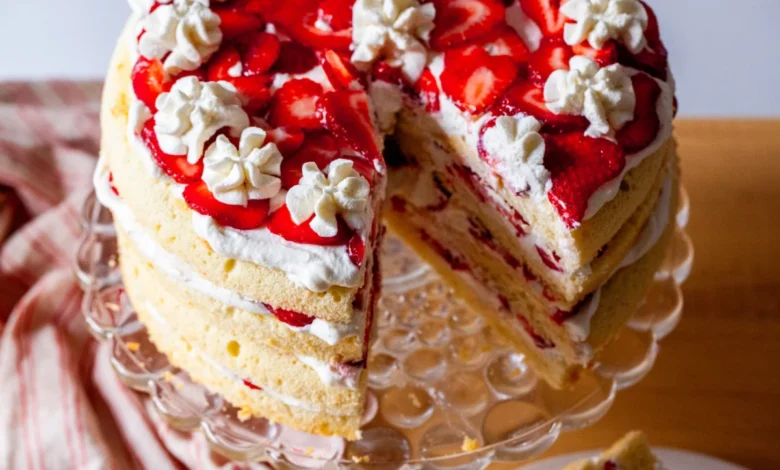
The assembly of the cake utilizes a stabilized whipped cream, achieved by incorporating sour cream or crème fraîche. This not only adds a sophisticated tang that cuts through the sweetness of the strawberries but also provides the structural "glue" necessary to hold the four thin layers together. The final result is a towering, four-layer construction that, despite its height, remains structurally sound enough to be sliced, provided the baker accepts the "fun" of its slightly unstable, ethereal nature.
In conclusion, Strawberry Chiffon Shortcake, Perfected is more than a mere recipe update; it is a testament to the ongoing refinement of domestic culinary science. By merging 1920s innovation with 2020s practicality, it provides a blueprint for the next generation of summer desserts—ones that are as resilient as they are light.