Pennsylvania Commits $37 Million in Federal NEVI Funds to Add 515 Public EV Charging Ports Across the Greater Philadelphia Region

The Commonwealth of Pennsylvania is dramatically accelerating its transition to electric mobility with a strategic investment of $37 million in federal funding. According to announcements by the Pennsylvania Department of Transportation (PennDOT), these funds will be deployed to establish 515 new public electric vehicle (EV) charging ports throughout the greater Philadelphia metropolitan area. This aggressive expansion encompasses both curbside urban charging infrastructure and high-speed suburban stations, aiming to alleviate range anxiety and make EV ownership viable for a much broader demographic of residents, including those who lack private off-street parking.
The newly allocated grants target five key counties in southeastern Pennsylvania: Bucks, Chester, Delaware, Montgomery, and Philadelphia. Regional planners project that this infusion of capital will expand overall public charging availability by 27% across the entire five-county region, while providing an even more dramatic 53% increase specifically within Philadelphia proper. As metropolitan centers grapple with how to accommodate the anticipated influx of electric vehicles over the next decade, this initiative serves as a critical blueprint for urban EV integration.
Bridging the Urban Gap: The Push for Curbside Charging
One of the most significant hurdles for urban electric vehicle adoption has historically been the lack of home charging options for residents living in row homes, apartments, or condominiums without driveways or dedicated garages. Without a place to plug in overnight, urban dwellers often rely entirely on slow, inconvenient public alternatives or expensive fast chargers.
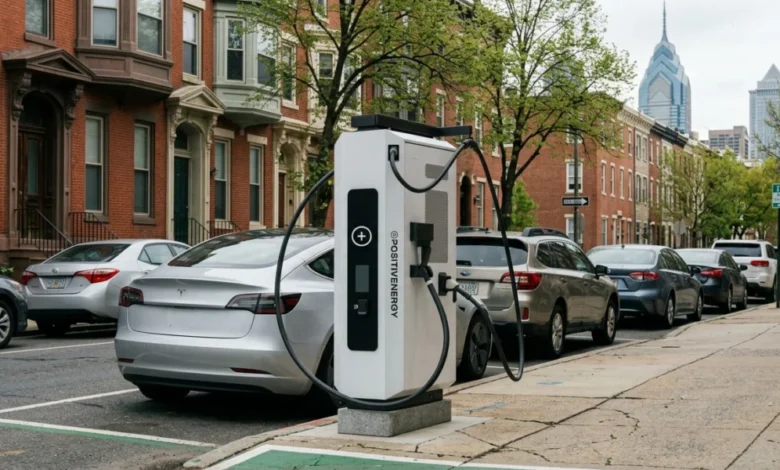
To combat this disparity, a substantial portion of the $37 million investment has been earmarked specifically for curbside and on-street charging solutions. Among the beneficiaries is It’s Electric PA, which has secured $2.93 million to install 157 on-street Level 2 charging ports distributed across 13 distinct Philadelphia neighborhoods. These low-profile, neighborhood-friendly chargers are designed to integrate seamlessly into existing streetscapes without impeding pedestrian traffic.
Simultaneously, Voltpost has received funding to deploy an additional 62 curbside ports spanning the four surrounding suburban counties. By embedding charging infrastructure directly into the residential fabric of both urban and suburban communities, state officials hope to replicate the convenience of home-charging for city residents who park on public streets.

High-Speed Charging and Strategic Partnerships
While Level 2 curbside chargers cater to overnight and long-duration parking, fast-paced commercial and commuter traffic requires high-speed infrastructure. To address this need, the funding package also incorporates significant investments in Direct Current Fast Charging (DCFC) stations.
PositivEnergy was awarded $7.2 million to install 54 DC fast-charging ports distributed across 11 Philadelphia Parking Authority (PPA) lots. These strategic locations will allow drivers to rapidly replenish their vehicle batteries while utilizing municipal parking infrastructure for errands, work, or transit connections.
Major private-sector players are also scaling up their footprint through the program. Tesla received two separate $392,000 awards to install eight fast-charging ports each at popular retail and transit-adjacent locations: a Royal Farms in Broomall and a Wawa in Plymouth Meeting. These partnerships underscore the vital role that convenience store chains and retail hubs play in the modern refueling ecosystem, offering drivers a familiar environment to recharge both their vehicles and themselves.
The Evolution of the Federal NEVI Program
The financial backing for this ambitious regional buildout originates from the National Electric Vehicle Infrastructure (NEVI) formula program, a cornerstone of the Bipartisan Infrastructure Law enacted by the federal government. Pennsylvania’s total five-year allocation under the NEVI program stands at an impressive $171.5 million, designed to fundamentally reshape the state’s transportation landscape.
During its initial rollout phases, the NEVI program maintained a strict focus on establishing a robust network of fast-charging stations along designated federal highway corridors, ensuring seamless long-distance travel across state lines. However, once a state successfully fulfills its mandated corridor requirements and receives formal certification from the Federal Highway Administration, it gains the flexibility to redirect funds toward broader community-based charging initiatives.

Pennsylvania achieved this critical corridor certification milestone on September 22, 2025. Moving swiftly to capitalize on this status, the commonwealth has already constructed 54 EV charging stations utilizing direct NEVI funds—a deployment rate that reportedly doubles that of any other state in the nation.
Stringent State Standards for Public Infrastructure
To ensure long-term reliability, accessibility, and compatibility, PennDOT has established rigorous minimum operational standards for all community charging projects funded through the program. Published guidelines dictate that every proposed station must feature a minimum of four charging ports to prevent chronic queuing and congestion. Furthermore, each port must deliver a continuous power output of at least 6 kW to guarantee efficient charging speeds.
Accessibility and equity are also central to the state’s criteria. Every station funded through the program must include at least two ADA-compliant parking spaces, ensuring that drivers with disabilities have unhindered access to charging infrastructure. In terms of hardware, all ports must be equipped with industry-standard J1772 or CCS connectors (with broader accommodations for emerging standards), and the equipment must strictly comply with federal "Buy America" manufacturing requirements to support domestic supply chains.
Phased Rollout and Future Funding Rounds
The current southeastern regional awards represent 71 distinct projects folded into a broader statewide community charging initiative valued at approximately $100 million. While the southeastern Pennsylvania application cycle has culminated in these recent announcements, other regions of the commonwealth are following close behind on the timeline.
Applications for the western region of Pennsylvania closed on November 20, with announcements expected soon. Meanwhile, municipal and private entities in central and eastern Pennsylvania have until March 12, 2027, to submit their funding applications for subsequent rounds.

For the newly minted southeastern projects, PennDOT’s projected development schedule outlines a methodical path forward. Environmental reviews are slated to take place between November 2026 and January 2027. Following the completion of environmental assessments, administrative agreement executions will run through January and February of 2027. Drivers in the Philadelphia region will subsequently need to exercise patience as winning contractors move into the physical construction, utility interconnection, and final commissioning phases before these 515 ports officially go live.
Implications for the Regional Economy and Environment
Industry analysts note that Pennsylvania’s aggressive deployment of federal infrastructure funds carries profound implications for both the local economy and regional air quality. Transportation remains one of the largest sources of greenhouse gas emissions in the United States, and the Greater Philadelphia area has historically struggled with localized air pollution stemming from heavy vehicular traffic.
By systematically dismantling the barriers to EV adoption—chiefly range anxiety and the absence of home charging for urban renters and row-home owners—the commonwealth is laying the groundwork for a structural shift in personal mobility. Economically, the rollout supports local electrical contractors, green-tech startups, and municipal parking authorities, creating sustainable jobs while modernizing urban infrastructure for the 21st century.
As these 515 new ports transition from blueprint to reality over the coming years, Pennsylvania solidifies its position as a national leader in electric vehicle readiness, offering a scalable model for other densely populated states seeking to balance rapid infrastructural expansion with equitable community access.