Michael Carrick future: Man Utd head coach position increasingly in doubt but no final decision made

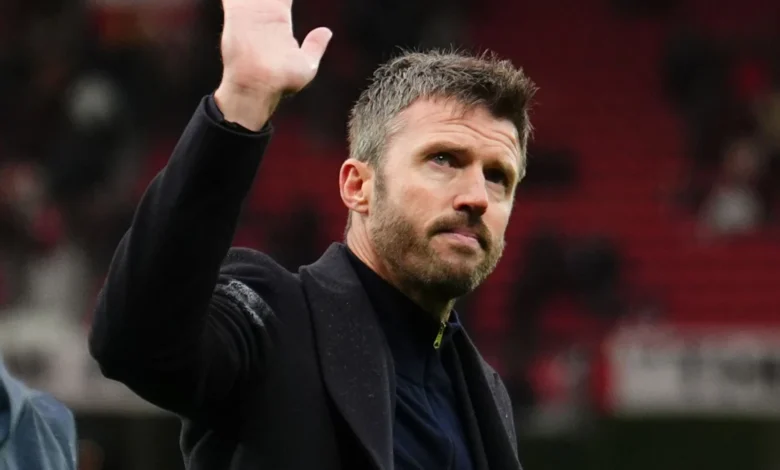
The tenure of Michael Carrick as Manchester United head coach has reached a critical juncture, with the club’s leadership currently conducting a high-stakes evaluation of the team’s performance. While the board has yet to reach a definitive conclusion regarding his immediate future, the reality of an eight-match winless streak in the Premier League has placed his position under unprecedented scrutiny. Directed by the club’s director of football, Jason Wilcox, this internal audit is expected to yield a formal decision before the domestic schedule resumes, leaving the club at a crossroads regarding their long-term sporting strategy.
A Season Defined by Statistical Decline
The pressure surrounding the managerial hot seat is supported by a series of alarming statistics that illustrate the club’s downward trajectory. Manchester United currently finds itself in the midst of its worst-ever start to a Premier League campaign. Perhaps most damning is the defensive fragility that has plagued the side; the team has conceded 30 goals across all competitions this season, a statistic that ranks as the worst defensive record among any club in the top five European leagues.
This defensive instability is compounded by a lack of attacking consistency, resulting in a solitary victory across the last 11 competitive fixtures. While the club famously prides itself on the "United way"—a philosophy built on late comebacks and relentless attacking pressure—the recent draws against Aston Villa and the narrow European victory over Roma have been viewed as fleeting moments of respite rather than indications of a genuine tactical turnaround.
Chronology of a Crisis
The current unrest follows a turbulent few weeks at Old Trafford. The decline became impossible to ignore following a demoralizing 3-0 home defeat to Bournemouth, a result that served as the catalyst for the current internal review. At that juncture, the board provided Carrick with a "three-game reprieve," a grace period intended to allow the coaching staff to stabilize the team.
However, failing to secure a win in that window has only served to deepen the doubts within the boardroom. The upcoming fixture list, which includes a high-profile, high-stakes encounter against Liverpool at Anfield, has created a sense of urgency. The hierarchy is now forced to determine whether Carrick remains the appropriate individual to navigate what is arguably the most challenging fixture in the English football calendar, or if a change in leadership is required to avert further collapse.
The Dynamics of Retention: Why No Decision Yet?
Industry analysts and club insiders have pointed to three specific factors that have prevented an immediate dismissal, effectively providing Carrick with a temporary stay of execution.
First, there is a unique relationship between the fanbase and the former United midfielder. Unlike other clubs where poor results trigger immediate, vitriolic protests, the Old Trafford faithful remain largely supportive of Carrick, who is revered for his playing career—a decorated tenure that included 11 major trophies and a Champions League title. This lack of external toxicity has allowed the board more breathing room to weigh their options than they might otherwise have had.
Second, the internal feedback loop from the dressing room remains a point of contention. Despite the poor results, the board is operating under the impression that the playing squad has not "downed tools." The late-game efforts against Villa and the resilience shown in Europe are being interpreted as evidence that the players remain committed to the manager’s methods, even if the execution is failing on the pitch.
Finally, the club is deeply cautious about the alternative. The board is adamant that if they were to move on from Carrick, they would prioritize a permanent appointment rather than an interim solution. While high-profile tacticians like Julian Nagelsmann and Eddie Howe are currently unattached and reportedly open to discussions, the United hierarchy has refrained from entering formal negotiations, fearing that a hasty change could exacerbate the existing instability.
Strategic Implications and Ownership Questions
The broader implications of this crisis extend far beyond the dugout. There is a growing sentiment among industry experts that the current managerial uncertainty is merely a symptom of a much larger, systemic failure.
Kaveh Solhekol, chief reporter for Sky Sports News, has articulated a view shared by many observers: the issue at Manchester United is structural rather than purely managerial. According to this analysis, the club is struggling to maintain its status as an elite European powerhouse because the foundational ownership and administrative structures are no longer fit for purpose.
"The club needs to become Manchester United again," Solhekol noted. "They need to turn into a club that is capable of winning the title regularly and competing for the European Cup. It doesn’t matter who is in charge; whether you bring in a manager with the pedigree of Carlo Ancelotti, Pep Guardiola, or Jurgen Klopp, you are likely only papering over the cracks. As long as the current ownership structure persists, it is difficult to see how the cycle of underachievement will be broken."
The Road Ahead
As the Premier League pauses for the international break, the atmosphere at the Carrington training ground is one of guarded reflection. With most of the first-team squad departing for international duty, the coaching staff has been granted a brief window to conduct a forensic analysis of their tactical approach.
The task facing Jason Wilcox and the board is immense. They must reconcile the sentiment and history of the club with the cold, hard realities of their current table position. The assessment of whether the current crop of players is "under-achieving" compared to the perceived "over-achievement" of last season—which saw the club secure a third-place finish and Champions League qualification—will define the coming weeks.
Should the board conclude that the current malaise is irreversible under the existing leadership, they face the monumental challenge of finding a successor who can navigate the "circus" that has come to define the club. If they decide to persist with Carrick, they must find a way to plug the defensive leaks and restore the competitive identity of a team that currently finds itself drifting further away from its traditional rivals.
For now, the silence from the boardroom speaks volumes. Manchester United is a club holding its breath, waiting for the results of an audit that will either serve as a fresh start or the final chapter of a turbulent era. The decision made in the coming days will not only determine the fate of Michael Carrick but will signal the intended direction of the club for the remainder of the season and beyond. The margin for error has evaporated, and for a club of Manchester United’s stature, the current status quo is becoming increasingly untenable.
Related posts: