IG Metall’s tariff demands align with management’s own competitive concerns more less than in past disputes. By Stewart Burnett

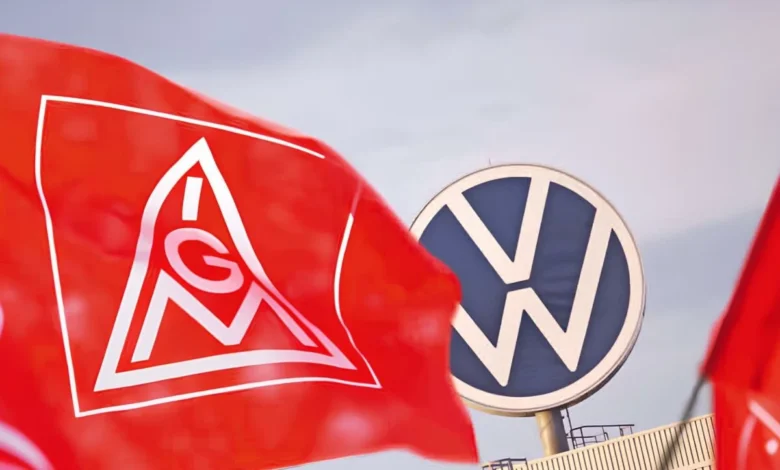
The German automotive sector is facing an unprecedented structural crisis, culminating in nationwide protests organized by the powerful industrial union IG Metall. Tens of thousands of manufacturing workers took to the streets on September 21, directing their grievances primarily at Volkswagen’s aggressive restructuring campaign. The demonstrations also swept up other German automotive giants, including Mercedes-Benz, BMW, Audi, Porsche, and major automotive supplier Bosch, all of which are navigating similar operational contractions.
As labor leaders and corporate executives grapple with declining profit margins, high domestic energy costs, and mounting pressure from low-cost Chinese imports, the traditional adversarial dynamic between union representatives and management has shifted. For the first time in recent history, IG Metall’s core demands closely mirror the competitive concerns of corporate leadership, creating a unified front against external market pressures. This alignment comes at a precarious time for Germany’s economic foundation, coinciding with critical annual wage negotiations, political instability, and sweeping workforce reductions across the continent’s largest manufacturing ecosystem.
Nationwide Protests and the Call for Trade Protection
The September 21 demonstrations served as a stark physical manifestation of worker anxiety across Germany’s industrial heartlands. Protesters converged on corporate headquarters and manufacturing hubs, demanding robust protections for domestic plants and jobs. Addressing a restless crowd outside Volkswagen’s Wolfsburg headquarters, IG Metall leader Christiane Benner delivered a direct message to both corporate boards and policymakers.
"Workers didn’t cause this crisis," Benner told reporters, echoing the sentiment of tens of thousands of union members.
A central pillar of IG Metall’s platform is a call for the European Union to expand its protective trade measures, specifically targeting Chinese car imports. Currently, EU tariffs exclusively penalize battery-electric passenger vehicles (BEVs), leaving hybrids and other powertrain technologies largely untouched beyond a standard 10% baseline duty. Furthermore, European import duties remain substantially lower than those enforced in the United States. Under the current EU framework, the heaviest financial penalties are levied against state-owned Chinese manufacturers like SAIC, which face maximum tariffs of approximately 43.6%.
Recent reports from the Financial Times indicate that the European Commission has formally warned Beijing to curb its rapidly accelerating hybrid exports to the European market or face subsequent trade penalties. However, the ultimate efficacy and timeline of these prospective measures remain uncertain, leaving domestic manufacturers exposed to sustained import competition. Beyond trade policy, IG Metall’s demonstrations also pressured Chancellor Friedrich Merz’s federal government to enact immediate relief measures to lower exorbitant domestic energy costs, which have long handicapped German industrial competitiveness relative to global peers.
Chronology of the Crisis: A Sector Under Siege
The unrest on September 21 arrived immediately prior to annual wage negotiations, with IG Metall scheduled to formally announce its bargaining demands on September 23. This timing set the wage talks against a financial backdrop considerably bleaker than any seen in prior bargaining rounds.
The current turmoil is the culmination of years of systemic pressures within the German automotive industry. According to data from the German Association of the Automotive Industry (VDA), the sector has shed roughly 100,000 jobs since 2019. Automotive suppliers have been hit even harder, eliminating approximately 74,000 positions—representing nearly a quarter of their total workforce—over the same comparative period.
The operational strain intensified rapidly over the summer months. In June, BMW issued a significant margin warning, which subsequently triggered plans to cut 8,000 jobs. Simultaneously, Mercedes-Benz accelerated its strategy of shrinking domestic German production capacity while expanding lower-cost manufacturing operations in Hungary.
Compounding these operational headwinds, Volkswagen suffered a major financial and symbolic blow when it was officially excluded from the Euro Stoxx 50 benchmark index. Confirmed the exact same week as a severe profit warning, the exclusion carried immediate mechanical consequences beyond mere market sentiment. Exchange-traded funds (ETFs) tracking the index were transformed into forced sellers of Volkswagen shares, executing divestments regardless of the company’s underlying fundamentals. This dynamic injected additional structural pressure into equity markets, compounding the internal operational crisis at Wolfsburg.
Corporate Responses and Internal Turmoil
Faced with sliding market shares and escalating cost pressures, executive leadership across Germany’s premier automakers have doubled down on aggressive austerity measures.
At Volkswagen Passenger Cars, brand chief Thomas Schäfer adopted a resolute tone during a staff meeting at the Wolfsburg plant, signaling that management would accelerate, rather than pause, its existing cost-cutting initiatives.
"We have absolutely no time to lose and will therefore significantly ramp up our performance program once again," Schäfer stated. He reported that the company had already finalized 16,300 redundancies in Germany, with agreements secured for just under 28,800 workers out of an initial target of 35,000.
Meanwhile, Porsche’s leadership found itself managing public relations and internal morale amid conflicting reports regarding further workforce reductions. Porsche Chief Executive Michael Leiters directly disputed a report published by the German daily Handelsblatt, which alleged that Volkswagen’s supervisory board viewed an additional 4,100 jobs at Porsche as superfluous, coming on top of 9,000 jobs already agreed upon for elimination.
"There are no plans to cut an additional 4,000 jobs at Porsche," Leiters emphasized in an internal memo distributed to staff. He reiterated that the existing restructuring framework had already been formally approved by Porsche’s own supervisory board and asserted that management "do not anticipate any changes to it."
Despite Leiters’ public denials, the origin of the Handelsblatt report—sourced directly from internal Volkswagen supervisory board documentation—has fueled speculation. Industry analysts suggest the contradiction points either to a genuine internal disagreement over the ultimate scope of corporate restructuring or to a calculated effort by executive leadership to manage worker sentiment ahead of Porsche’s upcoming Capital Markets Day. Regardless of the motivation, the discrepancy has left employees facing deep uncertainty regarding the long-term job security of thousands of workers.
The Geopolitical and Electoral Aftermath
The timing of the September protests added a volatile political dimension to an already fraught economic landscape. The demonstrations unfolded precisely one day after Chancellor Friedrich Merz’s Christian Democratic Union (CDU) suffered severe defeats in two regional elections. Most notably, the conservative party was entirely excluded from the state assembly in Mecklenburg-Western Pomerania for the first time in its history.
This electoral setback provided the far-right Alternative for Germany (AfD) party with an opening to draw a direct line between Volkswagen’s industrial struggles and broader accusations of systemic government failure. Sensing the political vulnerability, German Vice Chancellor Lars Klingbeil separately voiced support for specialized tariffs targeting imported plug-in hybrid electric vehicles. This policy shift by federal officials arrived in tandem with the mounting electoral pressure, illustrating how the automotive crisis has rapidly evolved into a central pillar of national political debate.
Fact-Based Analysis of Broader Implications
The convergence of labor unrest, executive restructuring, and political maneuvering highlights a profound structural transition within Europe’s most vital manufacturing sector. For decades, the German economic model relied on stable domestic labor relations, affordable energy imports, and a dominant position in internal combustion engine technology. The accelerated global shift toward electrification, combined with aggressive state-subsidized competition from Chinese automakers—whose market share in Europe climbed to 11% by July, heavily fueled by hybrid models—has dismantled those foundational assumptions.
The alignment between IG Metall and corporate leadership is a clear indicator of the severity of the threat. While past labor disputes typically focused on wage increases and working hours, current negotiations center on fundamental survival. Unions and management now share a mutual interest in safeguarding domestic production capacity against foreign encroachment, prompting joint lobbying efforts for defensive trade barriers and state energy subsidies.
However, these shared objectives do not eliminate internal friction. As automakers like Volkswagen and Porsche push forward with tens of thousands of job cuts to preserve liquidity and fund their own electric vehicle transitions, the human cost of the restructuring remains immense. The aggressive downsizing risks hollowing out Germany’s skilled manufacturing base, potentially creating long-term talent shortages even if corporate balance sheets stabilize.
Ultimately, the trajectory of the German automotive industry over the coming months will serve as a bellwether for the broader European industrial economy. The decisions made by European regulators regarding trade tariffs, combined with the resolution of domestic wage talks and energy policy reforms, will determine whether traditional European manufacturers can successfully pivot to a new technological era or whether structural retrenchment will permanently diminish Europe’s industrial standing on the global stage.
Related posts: