Dwyane Wade Shares What Daughter Zaya Wade Has Taught Him About Fatherhood

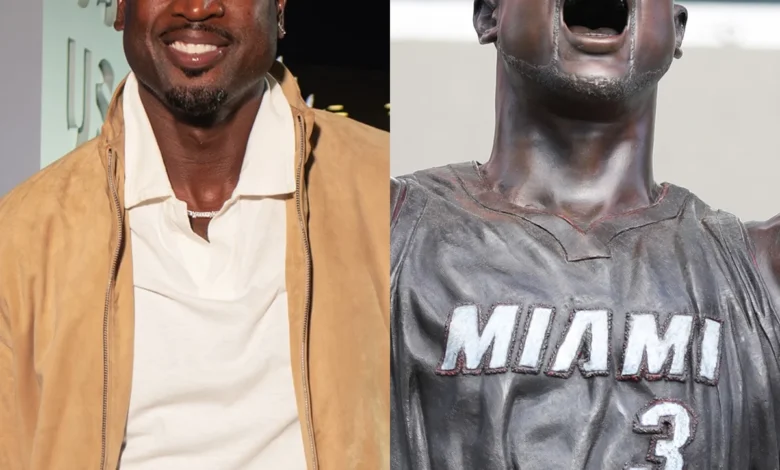
Basketball icon Dwyane Wade has embraced the latest chapter in the public life of his historic Miami Heat bronze statue, demonstrating characteristic humor regarding its much-discussed facial reconstruction. Two years after the original artwork outside the Kaseya Center triggered an internet storm of memes and critiques over its likeness, the franchise unveiled a polished version of the eight-foot tribute. Wade, ever the sportsman, took to social media to celebrate the adjustment, while simultaneously publishing an introspective essay detailing the deeper community and familial values that guided his perspective through the controversy.
The Evolution of a Monumental Tribute
The journey of the statue began in October 2024, when the Miami Heat honored their legendary shooting guard with the first-ever permanent sculpture outside their arena. Capturing Wade’s iconic 2009 "This is my house" celebration—instantly recognizable to NBA fans worldwide following a double-overtime victory against the Chicago Bulls—the bronze monument was intended to cement his legacy of 15 seasons, three NBA championships, and countless franchise records with the organization.
However, the initial unveiling faced immediate and widespread scrutiny. While the physique and posture accurately reflected the celebrated athlete, the facial features bore an uncanny and distorted resemblance that alienated supporters and sports commentators alike. Social media platforms were inundated with side-by-side comparisons and satirical commentary, transforming what was supposed to be a moment of unadulterated civic pride into a viral internet phenomenon.
Recognizing the weight of the tribute and the collective sentiment of the city of Miami, the franchise quietly initiated a redesign process. On October 30, the Miami Heat revealed the revamped headpiece and facial enhancements. The updated sculpture successfully bridged the gap between artistic interpretation and realistic likeness, drawing overwhelmingly positive feedback from fans and critics alike.
Public Reaction and Wade’s Reflective Essay
Dwyane Wade addressed the unveiling with characteristic grace and self-deprecation. Sharing images of the refreshed artwork on his official Instagram account, the 44-year-old retired athlete joked, "Ok ok ok there’s nothing wrong with getting a little work done!"
Beyond the social media levity, Wade published a detailed essay on Substack on October 30, offering a profound look at the psychological and communal implications of public monuments. He emphasized that the sculpture transcends individual accolades, serving instead as a shared touchstone for the entire Miami community, frequently referred to as "The 305."
"This is the first statue ever to stand in front of that arena," Wade wrote. "That means something to me, but it also means something to the city. Miami deserves to feel proud of it. The 305 deserves to look at that statue and feel the same energy it felt that night. And the fans deserve to see themselves in that moment because their noise, their belief and their love were part of what made it possible."
By acknowledging the organization’s willingness to listen to supporters and return to the drawing board, Wade framed the redesign not as a concession to critics, but as a collaborative triumph between the team, the player, and the fan base. He concluded his thoughts with a unifying message: "I hope when people see it now, they see a better likeness of me. But more than that, I hope they see themselves. Because it may be my likeness, but it will always be our house."
The Foundation of Fatherhood and Family Resilience
While Wade’s professional legacy is cemented in bronze outside the Kaseya Center, his personal evolution is anchored by his robust, blended family and his outspoken dedication to parenting. Alongside his wife, actress Gabrielle Union, Wade shares a dynamic household that includes daughter Zaya, 19, and son Zaire, 24, from his previous marriage to Siohvaughn Funches; son Xavier, 12, with Aja Metoyer; and daughter Kaavia, 7, whom he shares with Union.
Wade has frequently credited his children, particularly Zaya, with reshaping his worldview and expanding his understanding of leadership, courage, and unconditional support. In previous interviews, including a landmark 2019 appearance on the All the Smoke podcast following Zaya coming out as transgender, Wade articulated a philosophy centered on active listening and protective advocacy.
"First of all, if you want to talk about strength and courage, my 12-year-old has way more than I have," Wade shared at the time. "You can learn something from your kids. In my household, man, that’s all we talk about. We talk about making sure our kids are seen by each of us, me and my wife. We talk about making sure our kids understand the power in their voice."
This protective posture extends across the entire family unit. Whether shielding his children from online vitriol following family holiday photographs or publicly supporting Gabrielle Union through professional controversies—such as her departure from America’s Got Talent in 2019—Wade has consistently positioned family solidarity as his highest priority. The couple’s unified front during major adolescent milestones, such as accompanying Zaya to her winter formal and celebrating her sixteenth birthday, underscores a parenting ethos built on resilience against external pressures.
Broader Implications of Public Art and Accountability
The rapid adjustment and successful re-debut of the Dwyane Wade statue offer a fascinating case study in modern public art, corporate accountability, and fan engagement. Historically, once a civic monument or sports sculpture was cast in bronze, its form was considered permanent, leaving communities to live with artistic miscalculations regardless of public consensus.
By taking swift corrective action, the Miami Heat organization demonstrated a new paradigm in sports marketing and fan relations. In an era where digital feedback loops are instantaneous and unforgiving, sports franchises are increasingly compelled to treat monumental art not as a top-down decree, but as a living dialogue with the fan base that finances and sustains the institution.
Furthermore, Wade’s handling of the situation provides a masterclass in public relations. By leaning into the humor of the initial backlash rather than retreating into defensiveness, and subsequently redirecting the narrative toward community pride and inclusivity, Wade neutralized potential embarrassment and turned a public relations misstep into an enduring display of humility.
As the refreshed eight-foot bronze figure stands guard outside the Kaseya Center, it now represents more than just a legendary basketball career. It symbolizes adaptability, the value of listening to a community, and the enduring connection between an athlete and the city that watched him grow. For Dwyane Wade, whose life continues to balance public accolades with private commitments to his wife and children, the monument serves as a daily reminder that true legacy is defined not by perfection from the start, but by the willingness to evolve.