Canada and the European Union Launch Landmark Alliance for the Future as Prime Minister Mark Carney Moves to Solidify Associate Member Status

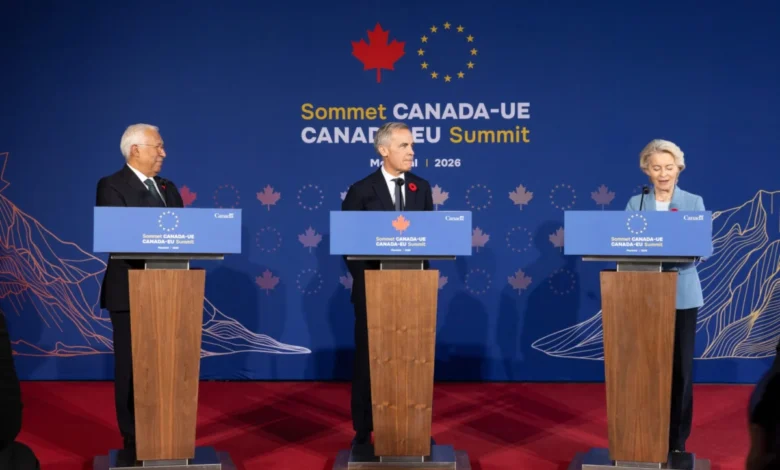
In a move that signifies a tectonic shift in North Atlantic geopolitics, Canadian Prime Minister Mark Carney announced on Friday that his government expects to finalize negotiations by June to secure an unprecedented "associate member" status within the European Union. The declaration, delivered at the conclusion of a high-level summit in Montreal, marks the formal inception of the "Alliance for the Future"—a strategic partnership designed to insulate both Canada and Europe from the volatility of the current global order and the unpredictability of traditional trade relations.
The initiative, spearheaded by Prime Minister Carney, European Commission President Ursula von der Leyen, and European Council President António Costa, is explicitly aimed at fostering economic resilience and safeguarding democratic sovereignty. By deepening institutional ties, both parties intend to reduce their systemic dependence on the United States, a transition accelerated by the recent implementation of aggressive protectionist policies and trade tariffs directed at Western allies by the Trump administration.
A Chronology of Converging Interests
The push toward this integration follows a period of mounting friction in transatlantic trade. The trajectory of this partnership can be traced through several key phases:
- 2023–2024: Heightened volatility in U.S. trade policy prompts Canada to seek alternative export markets, leading to the preliminary conceptualization of a "privileged partnership" with the EU.
- Early 2025: Formal diplomatic channels are opened between Ottawa and Brussels to explore how the Comprehensive Economic and Trade Agreement (CETA)—which has already eliminated over 98% of tariffs—can be upgraded into a structural, political association.
- February 2025: The two-day Montreal Summit serves as the venue for the formal launch of the "Alliance for the Future," covering defense, digital trade, and critical minerals.
- March 2025: Scheduled meetings between Canadian Cabinet ministers and European commissioners are set to iron out the technical frameworks for the associate membership model.
- June 2025: Prime Minister Carney is slated to attend the European Council meetings in Brussels, where he aims to finalize the legal and political architecture of the new relationship.
- 2027: The anticipated deadline for the definition of an "ever-closer association" that will govern the long-term integration of Canadian and European bureaucratic and regulatory standards.
Economic Implications and Strategic Data
The economic rationale for this alliance is rooted in the necessity of market diversification. Currently, the United States remains Canada’s primary economic engine, accounting for approximately 71.7% of all Canadian merchandise exports as of 2025. Prime Minister Carney has set an ambitious policy goal to double exports to non-U.S. markets over the coming decade, a move that requires more than just tariff-free trade; it requires deep regulatory alignment.
The newly announced digital trade agreement serves as a cornerstone of this shift. By harmonizing data standards and easing digital commerce, the agreement is designed to reduce the "red tape" that currently hinders small-to-medium-sized enterprises (SMEs) in Canada from accessing the European Single Market.
Furthermore, the partnership includes significant technological and industrial integration:
- Critical Minerals: The European Investment Bank has secured a mandate to finance Canadian mining projects, a move that directly supports the EU’s "Green Deal" industrial plan by securing a stable, democratic supply chain for rare earth elements and battery materials.
- Supercomputing and AI: Canada’s inclusion in the European JUPITER supercomputing initiative represents a massive leap in research capacity. Preliminary assessments suggest that calculations requiring six months on existing Canadian hardware could be completed in a single day, dramatically accelerating breakthroughs in pharmaceutical research, climate modeling, and artificial intelligence.
- Financial Infrastructure: Exploratory talks are underway to link instant-payment systems between the Bank of Canada and the European Central Bank’s TARGET Instant Payment Settlement (TIPS) network, which would significantly lower the cost and latency of cross-border financial transactions.
The Sovereignty Debate and International Reaction
While the alliance is framed by its architects as a defensive move for prosperity, it has not been without controversy. U.S. officials have expressed skepticism regarding the deepening ties, with some reports suggesting that the White House views the proposed arrangement as a "hostile act" aimed at circumventing American market influence.
Prime Minister Carney, however, has consistently framed the initiative as a proactive, rather than reactive, endeavor. "It is about reinforcing sovereignty. Why? So we can live our lives as we choose, our people can live their lives as they choose," Carney stated during the Montreal press conference. He emphasized that the alliance is not designed in opposition to any specific nation but is rather a positive assertion of the shared values held by Canada and the European Union.
European Commission President von der Leyen echoed this sentiment, suggesting that the current geopolitical climate is not a temporary anomaly but a permanent shift in global dynamics. "What brings us together goes far beyond geography. We see the world through the same eyes. These headwinds won’t stop blowing. This change is permanent," she remarked, underscoring the European commitment to the partnership.
Beyond Trade: Security and Education
The "Alliance for the Future" transcends mere economic policy, extending into the realms of security, defense, and social integration. The joint declaration includes provisions for:
- Defense and Cybersecurity: Enhanced intelligence sharing and joint development of cyber-defense protocols to protect critical infrastructure from state-sponsored interference.
- Arctic Security: A collaborative framework to monitor and defend sovereignty in the Arctic, a region of increasing strategic importance due to melting ice caps and renewed geopolitical competition.
- Human Capital: A significant expansion of the Erasmus+ program to facilitate student and worker mobility between Canada and the EU, aiming to foster a new generation of "transatlantic citizens" who can seamlessly navigate the labor markets of both regions.
Analysis of the "Associate Membership" Model
The use of the term "associate member" has sparked debate within international legal circles. While the joint declaration signed in Montreal stopped short of using this specific label—opting instead for the phrase "ever-closer association"—both Carney and von der Leyen have publicly championed the "associate" designation.
This model is historically significant. It suggests a middle path between a standard Free Trade Agreement (FTA) and full EU membership. For Canada, full membership is geographically and politically impossible due to the EU’s treaty requirements. However, an associate status could allow Canada to participate in specific European regulatory agencies, environmental standards, and security initiatives without relinquishing national parliamentary authority.
António Costa noted that the relationship is intended to be unique, stating, "Our relationship is so special that we want to create something new: to go beyond a simple association, everything short of full EU membership."
Conclusion: A New Era of Transatlantic Relations
As the June negotiations approach, the world will be watching closely to see how the United States reacts to the formalization of this alliance. The success of the "Alliance for the Future" will ultimately depend on the ability of Canadian and European bureaucracies to synchronize complex regulatory frameworks while managing the political friction of their largest trading partner.
For Canada, the stakes are existential. By tethering its economy to the European bloc, Ottawa is signaling that it no longer intends to be a passive observer of a bifurcated global economy. Whether this strategy will lead to long-term prosperity or escalate regional tensions remains the central question of the coming decade. However, for now, the path is clear: Canada is looking eastward, not just to diversify its markets, but to anchor itself firmly within a European-led vision of a rules-based, sovereign future.