California Forges Ahead on Electric Vehicle Adoption Independently of Federal Shifts

California is cementing its position as the vanguard of the American electric vehicle movement, deliberately insulating its clean transportation transition from shifting federal priorities. In a decisive legislative maneuver on September 20, Governor Gavin Newsom signed a comprehensive package of six bills specifically engineered to aggressively accelerate electric vehicle (EV) adoption and fast-track charging infrastructure deployment across the state. This strategic regulatory overhaul directly tackles historical pain points that have long hindered the state’s green transition, including persistent permitting delays, limited apartment charging access, and consumer transparency regarding zero-emission trucks and EV batteries.
The newly enacted legislative package—comprising Senate Bills 969, 1283, 1213, 1267, and 615, alongside Assembly Bill 1820—arrives as California achieves a major market milestone. Data from the second quarter of 2026 indicates that zero-emission vehicles (ZEVs) have captured a commanding 19.1% share of all new vehicle sales statewide. By proactively tackling infrastructure bottlenecks and consumer protection concerns, Sacramento is signaling that its clean transportation mandates will continue to progress irrespective of federal incentive structures or administrative changes in Washington, D.C.
Targeting Infrastructure Bottlenecks and Permitting Delays
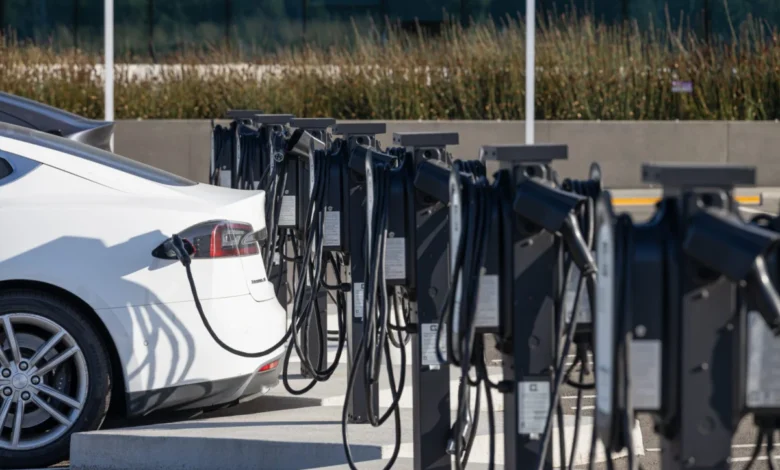
The physical build-out of charging infrastructure has historically suffered from extensive administrative and bureaucratic friction. Two pivotal bills within the September package take direct aim at these physical and regulatory logjams. Senate Bill 969 modernizes a notoriously outdated inspection regime that previously left completed public chargers sitting idle for months. Under the new statute, original equipment manufacturer (OEM)-tested charging units can be activated significantly faster, while statutory safeguards remain firmly in place to guarantee that consumers receive accurate electricity measurements and billing transparency for the power they purchase.
Complementing this measure, Senate Bill 1283 drastically extends California’s streamlined charger permitting framework. Previously, permitting relief often applied only to the core charging pedestal, leaving critical ancillary infrastructure exposed to separate, lengthy municipal reviews. The new law encompasses critical supporting work such as trenching, necessary electrical capacity upgrades, solar canopy installations, and localized battery storage systems. By preemptively clearing these hurdles, the state prevents preparatory civil and electrical work from morphing into isolated project bottlenecks.
Addressing Equity and Access in Multi-Unit Housing
A critical friction point in the broader adoption of electric vehicles has been the profound accessibility gap facing urban residents and renters who lack access to private driveways, garages, or dedicated home charging solutions. Assembly Bill 1820 directly confronts this structural inequity by systematically reducing municipal permitting barriers and substantially cutting municipal fees for charger installations at apartment complexes and mixed-use real estate developments.
Furthermore, the legislative package incorporates protections and streamlining provisions for homeowners living within common-interest communities. Senate Bill 1267 specifically eases charging access restrictions traditionally imposed by homeowners’ associations (HOAs), ensuring that residents in managed communities cannot be unreasonably barred from installing residential charging equipment. Concurrently, Senate Bill 1213 enhances price and incentive transparency specifically tailored for zero-emission commercial trucks, while Senate Bill 615 mandates clearer, standardized battery health and performance disclosures when consumers evaluate and compare competing EV models.
A Massive Quantitative Challenge
The sheer scale of the logistical undertaking required to electrify California’s transportation sector cannot be overstated. During the bill-signing announcements, Electric Vehicle Charging Association Chair Matthew Chen articulated the daunting mathematical reality facing the state’s energy planners and industrial developers. "Meeting California’s clean transportation goals means building more than 400 new chargers a day, every day, through 2030," Chen noted, highlighting the immense coordination required across municipal governments, electric utilities, and private capital markets.
Despite these hurdles, California boasts a robust existing foundation. Statewide infrastructure inventories indicate that California operates more than 216,445 public and shared charging plugs, a figure that includes in excess of 20,000 dedicated DC fast-charging ports capable of rapid highway turnaround. To maintain this momentum, the California Energy Commission (CEC) has separately allocated US$98.5 million in light-duty ZEV infrastructure funding for the current fiscal year, designed to strategically seed underserved communities and commercial corridors.
Financial Incentives and the MyFirstEV Programme
Infrastructure deployment runs parallel to consumer financial incentives designed to make zero-emission vehicles economically viable for low- and moderate-income households. The September legislative package builds directly upon the framework of the state’s popular MyFirstEV rebate programme. This initiative provides instant point-of-sale rebates of up to US$3,500 for the purchase of a new zero-emission vehicle, or up to US$1,750 for a qualified used model.
The economic engine behind MyFirstEV relies on a US$135.5 million state investment that is matched dollar-for-dollar by participating automotive manufacturers, resulting in a combined US$271 million capital pool dedicated entirely to consumer savings. This flagship programme operates under the broader umbrella of a US$600 million clean-vehicle investment strategy financed primarily through the state’s Cap-and-Invest revenue streams and dedicated smog-abatement fees. These funds concurrently sustain auxiliary equity-focused initiatives, including the Clean Cars 4 All retirement and replacement programme, the Clean Truck and Bus Voucher Incentive Project, and the Carl Moyer Program for reducing heavy-duty diesel emissions.
The Legal Battle Over Federal Waivers and States’ Rights
The aggressive self-reliance demonstrated by California’s latest legislative push unfolds against the backdrop of an intense, ongoing legal conflict regarding the state’s sovereign authority to establish independent vehicle emissions standards. Under Section 209 of the federal Clean Air Act—a statutory authority maintained continuously since the Nixon administration—California holds a special federal waiver allowing it to enact tailpipe pollution rules that are significantly more stringent than baseline federal standards.
However, this foundational regulatory arrangement has faced persistent legal and political challenges. Recent federal efforts by the executive branch, routed through the Environmental Protection Agency (EPA) and the Department of Justice, have actively sought to revoke, narrow, or reclassify this historical waiver. In response, California Attorney General Rob Bonta has led multi-state coalitions filing federal lawsuits to vigorously defend the state’s regulatory autonomy. While the underlying constitutional and statutory questions wind their way through federal appeals courts, district and appellate judges have consistently issued preliminary injunctions and stays, effectively maintaining California’s enforcement powers while litigation proceeds.
The National Ripple Effect: Section 177 and the Wider Auto Market
The legislative and regulatory decisions made in Sacramento carry profound economic and operational implications that extend far beyond California’s geographic borders. Under Section 177 of the Clean Air Act, other U.S. states possess the legal option to voluntarily adopt California’s superior vehicle emissions standards rather than defaulting to looser federal rules.
Currently, roughly a dozen states—including major automotive markets such as New York, Washington, Massachusetts, and Oregon—have officially tied their regulatory frameworks to California’s tailpipe standards. Consequently, any legislative or administrative action taken by California to streamline EV adoption, clarify battery standards, or mandate zero-emission sales quotas exerts a gravitational pull on the entire national automotive manufacturing sector. Automakers targeting the American market must design, build, and distribute compliant vehicles capable of satisfying this multi-state bloc, rendering California’s state-level policies de facto national industrial standards regardless of shifting federal political landscapes.
Fact-Based Analysis of Broader Implications and Future Outlook
While the passage of Senate Bills 969, 1283, 1213, 1267, 615, and Assembly Bill 1820 represents a decisive regulatory triumph for the Newsom administration, seasoned energy analysts emphasize that legal decrees and streamlined permitting represent only one piece of a vastly complex puzzle. Eradicating bureaucratic delays at municipal permit offices directly addresses regulatory friction, but it does not automatically resolve underlying engineering and economic constraints.
Moving forward, the ultimate success of California’s ambitious clean transportation agenda will hinge heavily on three interdependent variables:
- Utility Grid Capacity: Ensuring that local electric grids can absorb the massive localized power spikes demanded by high-output DC fast-charging plazas and multi-vehicle apartment depots without triggering localized brownouts or requiring prohibitively expensive transformer upgrades.
- Private Capital Deployment: The willingness of private charging network operators, venture capital firms, and institutional investors to deploy billions of dollars into capital-intensive charging infrastructure, particularly in lower-income or rural census tracts where initial utilization rates may take years to achieve profitability.
- Supply Chain Resilience: Maintaining a steady, diversified supply of critical raw materials—such as lithium, cobalt, and nickel—alongside manufacturing capacity for EV battery packs to prevent inflationary price spikes that could dampen consumer demand.
Ultimately, by systematically dismantling local administrative hurdles and shoring up consumer confidence through enhanced price and battery transparency, California is engineering a self-sustaining ecosystem for electric mobility. Even as federal policies face potential turbulence and legal challenges persist in federal courts, the Golden State’s statutory scaffolding ensures that its transition toward an electrified transportation future will march forward unabated.
Related posts: