Tesla Rolls Out Full Self Driving v15 Targeting Potholes Sign Detection and Safety Margins

Tesla has officially commenced the rollout of its Full Self-Driving (FSD) v15 software package, bringing a comprehensive overhaul to its driver-assistance architecture. The latest iteration targets several of the system’s most persistent historical vulnerabilities, including erratic sign detection, failure to avoid road hazards like potholes, and inconsistent speed management in sensitive environments such as school zones.
Alongside these operational updates, the release features a revamped live visualization suite branded as Reality View, alongside bold manufacturer claims regarding safety improvements. However, industry observers and safety advocates continue to scrutinize the update, balancing Tesla’s ambitious metrics against a history of iterative updates that have frequently taken two steps forward and one step back.
Anatomy of the FSD v15 Release
According to details shared via official channels and release notes distributed to early recipients, FSD v15 upgrades every foundational component of Tesla’s end-to-end neural network. While the company has not explicitly detailed a phased deployment schedule for specific vehicle trims, prior communications with investors indicate that vehicles equipped with the AI4 (Hardware 4) computing suite possess the necessary computational bandwidth to run the software natively.
Among the prominent functional additions is the integration of speed camera deceleration, a feature that aligns vehicle speeds with automated enforcement infrastructure where present. Additionally, Tesla has introduced a dedicated Bike Rack Mode, accommodating hitch-mounted accessories that previously interfered with ultrasonic and vision-based obstacle detection sensors. Navigation learning has also been updated, though functionality is currently limited to the commencement and termination points of a given route, with broader route-wide learning promised in subsequent point releases.
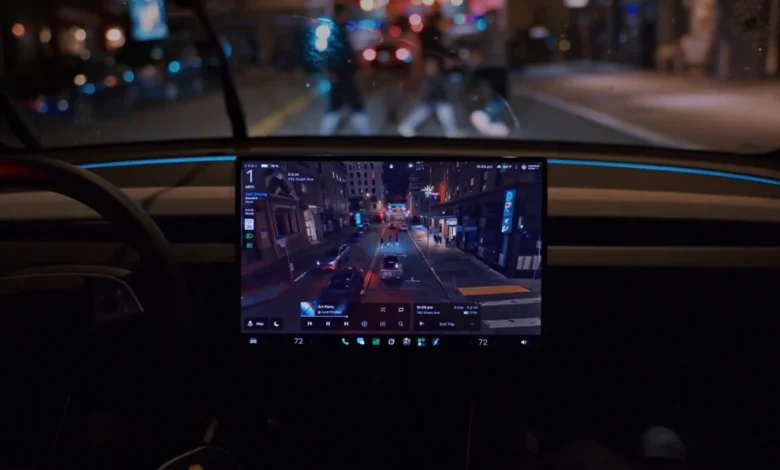
The centerpiece of the user-facing updates is Tesla Reality View, alternatively referenced in technical notes as Tesla Augmented Reality. This system consolidates various independent model signals into a unified, end-to-end visualization designed to consume less vehicle compute while rendering a hyper-detailed representation of the immediate driving environment on the center touchscreen. Tesla states that the interface is engineered to provide drivers with unprecedented transparency regarding the system’s immediate navigational intentions.

Addressing Longstanding Operational Weaknesses
FSD v15’s primary departure from past versions lies in its targeted focus on well-documented failure points. Speed sign recognition has been a major point of contention for regulators and independent testers alike. A notable study published in September by European nonprofit Johanna.be revealed that previous FSD iterations exceeded speed limits in 55 percent of tested 30 km/h zones, averaging 44 km/h due to the system’s failure to accurately parse localized signage.
Pothole avoidance represents another long-promised capability finally making its way into the software ecosystem. Though CEO Elon Musk initially promised dynamic pothole mitigation as early as 2019 and reiterated the claim in August, drivers have routinely reported vehicles navigating directly through severe road surface defects. Furthermore, the software arrives amid heightened scrutiny from federal safety regulators. The National Highway Traffic Safety Administration (NHTSA) is currently reviewing petitions concerning automated vehicles speeding through active school zones, building upon an overarching investigation opened in October 2025 regarding FSD-related traffic violations.
Conversely, the update introduces adjustments that have raised eyebrows among safety advocates. Tesla has opted to decrease the strictness of driver monitoring profiles when operating under higher-speed settings. This modification arrives concurrently with ongoing public scrutiny regarding instances of operators sleeping behind the wheel while utilizing autonomous modes, and it contrasts sharply with regulatory demands in Europe, where authorities are compelling manufacturers to tighten driver vigilance protocols.
The 25x Critical Intervention Metric and Mathematical Realities
A focal point of the v15 announcement is Tesla’s claim of a 25-fold improvement in handling safety-critical cases, attributed to enhancements within the new vision encoder. While this metric serves as the industry-standard indicator for measuring progress toward fully unsupervised autonomy, Tesla has refrained from publishing the foundational baseline numbers from which the multiplier is derived.
Independent data analyses of previous software iterations, such as FSD v14, estimated an average distance of roughly a couple of thousand miles between critical interventions. Applying a 25x multiplier to these figures yields a theoretical interval of approximately 50,000 miles between critical disengagements. Should this metric hold true across the broader consumer fleet, it would comfortably surpass the ten-thousand-mile threshold frequently cited by autonomous vehicle analysts as a prerequisite for launching limited, unsupervised commercial robotaxi services.
Nevertheless, these projections exist alongside a pattern of aggressive corporate forecasting. In April, executive statements claimed that v15 would "far exceed human levels of safety, even in completely unsupervised and complex situations"—echoing similar declarations made during the rollouts of v12 and v14. During an August briefing with financial institutions, corporate leadership described v15 as a definitive "step-change" driven by seven core technologies, approximately 40 percent of which were already active within the Austin robotaxi pilot fleet.

Chronology of Iterative Development
The trajectory of Tesla’s Full Self-Driving software has historically been characterized by cyclical volatility rather than linear progression. When FSD v14 debuted in October 2025, early crowdsourced telemetry data indicated a regression in baseline stability, characterized by frequent phantom braking, visual hallucinations, and aggressive speed fluctuations, yielding an average of roughly 732 miles between critical disengagements.
Subsequent point releases throughout late 2025 and early 2026 attempted to stabilize the platform. Updates such as v14.2 experienced performance regressions that prompted hurried patches, culminating in v14.3 being marketed as the definitive architectural puzzle piece. Yet, nearly seven months later, end-users remain legally classified as supervisors, placing the burden of operational safety squarely on human operators while the ecosystem transitions to v15.
Broader Implications for the Autonomous Vehicle Sector
The deployment of FSD v15 carries significant weight for both Tesla’s commercial valuation and the wider autonomous vehicle industry. By attempting to resolve localized regulatory compliance issues—such as school zone speeds and sign recognition—Tesla is addressing the primary friction points inhibiting regulatory approval for unsupervised deployment.
At the same time, the divergence between Tesla’s relaxed driver monitoring in high-speed profiles and tightening European regulatory frameworks highlights a growing transatlantic divide in autonomous vehicle oversight. As municipalities and federal agencies demand quantifiable safety validation, the refusal of manufacturers to release raw disengagement datasets continues to complicate objective risk assessments.
Ultimately, while the visual enhancements and theoretical safety multipliers of v15 represent a substantial engineering push, the true efficacy of the software will be determined by real-world telemetry gathered across millions of disparate driving environments. Until independent verification confirms whether v15 successfully neutralizes its predecessor’s persistent anomalies, the system remains an advanced, highly supervised driver-assistance technology rather than a fully realized autonomous platform.
Related posts: