Why fitness enthusiasts are taping their trackers to their arms and the science behind the trend

The emergence of wearable technology has transformed the way the general public monitors physiological data, yet the hardware design remains largely tethered to the wrist. While companies like Whoop have pioneered "any-wear" technology, allowing sensors to be placed on the bicep or within specialized apparel, the majority of mass-market fitness trackers, such as the Fitbit Air, are designed exclusively for wrist-based monitoring. Recently, a growing contingent of users has begun circumventing these design constraints by manually attaching their devices to their upper arms using medical-grade adhesives, a trend that highlights both the demand for diverse form factors and the limitations of current device ergonomics.
The Evolution of Wearable Ergonomics
The reliance on wrist-based tracking is rooted in the history of horology. By mirroring the form factor of a traditional wristwatch, early activity trackers benefitted from high consumer familiarity and ease of adoption. However, for serious athletes and weightlifters, the wrist is often an suboptimal location. The presence of a device can interfere with wrist wraps, gymnastic grips, and the structural mechanics of exercises like kettlebell cleans or snatches.
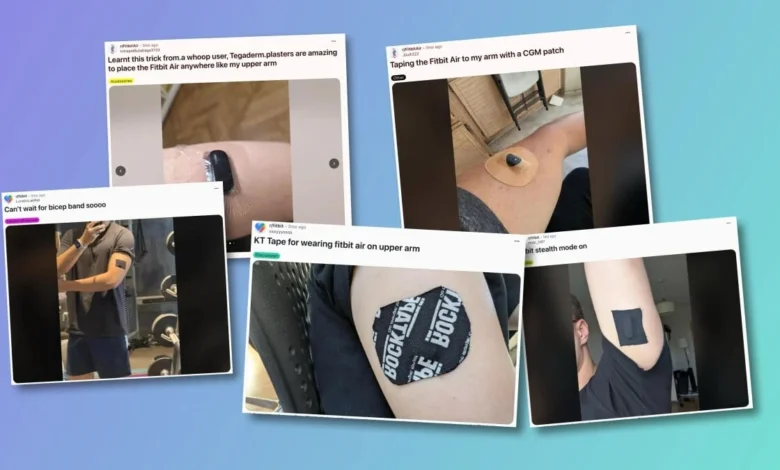
This ergonomic friction has led to a grassroots movement among Fitbit users. On various online forums and subreddits, enthusiasts have documented their transition from wearing trackers on the wrist to securing them directly to the bicep or tricep area. This transition is not merely about aesthetic preference; it is a pursuit of "invisible" tracking, where the device provides data without impeding the user’s range of motion or causing physical distraction during high-intensity training.
Chronology of the DIY Wearable Movement
The trend began gaining significant traction following the release of lightweight, screen-less, or minimalist trackers that rely heavily on automated data collection. As these devices became smaller, users began questioning why the wrist remained the default location.
- Early Phase (2020–2022): Initial experiments involved repurposing adhesive bandages or athletic tape to keep trackers in place during sports. These early attempts were largely inconsistent, often failing due to sweat-induced adhesive degradation.
- Expansion Phase (2023): As the "bicep band" form factor gained popularity through competitors like Whoop and Oura, the DIY community began sourcing more professional-grade materials, such as KT tape and medical-grade silicone adhesives.
- Current Phase (2024–Present): The integration of CGM (Continuous Glucose Monitor) overpatches into this lifestyle has provided the necessary durability to sustain the trend, leading to a more standardized approach among power users who prioritize data consistency over the convenience of a simple watch strap.
Technical Analysis: The Adhesive Hierarchy
The primary hurdle for those taping their devices is ensuring that the adhesive remains secure under conditions of high moisture, friction, and heat. Through trial and error, the community has identified a hierarchy of effectiveness:
- Athletic/Medical Tape: While readily available, these options are generally considered the least effective. They often lack the hydrophobic properties necessary to maintain a seal during a cardiovascular workout, leading to premature peeling.
- Kinesiology (KT) Tape: Often used by physical therapists to support muscles, KT tape is more durable than standard athletic tape but struggles with long-term adhesion when used to hold a weighted device. Its fabric-like consistency can absorb sweat, weakening the bond over time.
- CGM Overpatches: These are widely considered the gold standard for this specific application. Designed to hold medical-grade sensors in place for 10 to 14 days, these patches are engineered to be hypoallergenic, breathable, and water-resistant. Because they are designed to interface with human skin for extended periods, they offer the highest level of security for a Fitbit device.
Physiological and Technical Implications
Taping a device to the upper arm offers a distinct advantage in terms of heart rate (HR) accuracy. Optical heart rate sensors—photoplethysmography (PPG)—work by shining light into the skin and measuring the rate at which blood flows through capillaries. The wrist is a complex area with significant movement, bony prominences, and thin skin, all of which can introduce "noise" into the data.
The upper arm, conversely, offers a larger muscle mass and more consistent blood flow. Furthermore, when a device is held firmly against the skin by an adhesive patch, it blocks ambient light, which is one of the most common sources of error in wrist-worn sensors. Consequently, many users report higher heart rate tracking fidelity when the device is positioned on the bicep.
However, there is a significant trade-off regarding activity recognition. Most fitness trackers are programmed with proprietary algorithms trained specifically to recognize the movement patterns of the wrist (e.g., the repetitive arm swing of running or the rhythmic motion of rowing). When the sensor is relocated to the upper arm, the acceleration data captured by the internal accelerometer is fundamentally different from what the software expects. This frequently results in a failure to trigger "Auto-Detect" workout modes, necessitating manual input from the user to ensure the data is categorized correctly.
Broader Industry Impacts
While no major manufacturer has issued a formal statement on the practice of "taping" trackers to the body, the trend presents a clear signal to the industry. The demand for flexible, multi-positional wearables is at an all-time high.
Data from the wearable tech market suggests that consumers are increasingly viewing health monitoring as a 24/7 requirement rather than a periodic activity. By forcing users to adopt DIY solutions, companies are missing an opportunity to provide specialized accessories—such as adhesive-backed mounts or dedicated bicep straps—that could improve the user experience.
There are also safety and maintenance considerations to address. Using adhesives on the skin for extended periods carries a risk of contact dermatitis or skin irritation. Furthermore, the reliance on high-strength adhesives creates a logistical challenge: if the device needs to be removed daily for charging, the recurring cost and physical irritation of applying and removing adhesives become a significant deterrent.
Future Outlook
As the line between medical-grade monitoring and consumer fitness tracking continues to blur, the hardware design is likely to evolve. We may see a future where trackers are modular, allowing the sensor unit to be snapped into a wristband, a bicep sleeve, or even an adhesive patch.
Until that time, the practice of taping remains a testament to the "hacker" spirit of the fitness community. While it is an imperfect solution involving costs, risks to skin health, and potential inaccuracies in auto-detection, it underscores a fundamental reality: users prioritize the data quality and comfort over the factory-intended design of their devices. For now, those who choose to tape their devices are effectively acting as beta testers for the next generation of wearable form factors, proving that the wrist is not necessarily the final frontier for fitness technology. As these users continue to share their experiences, it is highly probable that manufacturers will begin to integrate these findings into future iterations, potentially offering official "any-body" attachment solutions to ensure safety, accuracy, and brand loyalty.