The Enduring Appeal of the Classic Oxford Button-Down: How a Menswear Staple Survived a Century of Fast Fashion

In the modern landscape of men’s fashion, where trends pivot rapidly and the definition of professional dress continues to evolve in a post-pandemic corporate ecosystem, certain foundational items remain entirely insulated from shifting aesthetics. While foundational garments like tailored blazers, premium denim, and heavyweight cotton T-shirts function as individual instruments within a broader sartorial orchestra, the missing link that unifies these elements is exceptional shirting. More specifically, the Oxford cloth button-down shirt (OCBD) retains an unrivaled status as the cornerstone of versatile menswear.
The Evolution and Heritage of the Oxford Cloth Button-Down
The lineage of the Oxford shirt traces back to late 19th-century British polo players who sought a practical solution to keep their collars from flapping in the wind during matches. They engineered a system of fastening the collar points directly to the shirt fabric using small buttons, an innovation that was quickly imported to the United States by Brooks Brothers in the early 1900s. From there, the garment became synonymous with Ivy League style, worn by academics, jazz musicians, and mid-century cultural icons alike.

Despite decades of synthetic fabric introductions and hyper-casual streetwear dominance, traditional manufacturers have maintained the construction integrity that made the garment famous. Brands such as J. Press—a venerable purveyor of Ivy League heritage—continue to produce these garments in historic manufacturing hubs, utilizing robust 100 percent Oxford cotton sourced from mills that have supplied the industry for nearly a century. This commitment to domestic manufacturing highlights a broader consumer shift back toward durability, provenance, and "slow fashion" principles over disposable, trend-driven apparel.
Anatomy of a Classic: Fit, Fabric, and Maintenance
The enduring appeal of the Oxford shirt lies in its precise balance of formality and casual ease. Unlike poplin or broadcloth dress shirts, which demand a sharp crease and formal neckwear, the heavier weave of Oxford cotton allows for a softer hand-feel and a more relaxed drape.
When evaluating fit, tailoring experts generally advocate for a middle ground—a regular or classic cut that avoids excessive boxiness while rejecting the restrictive tightness of modern slim-fit variations. This structural versatility ensures the shirt can be tucked cleanly into trousers or worn untucked for a casual weekend silhouette. Furthermore, the garment’s natural texture improves with age; proper laundering, followed by line-drying or light pressing, preserves the distinct roll of the unlined button-down collar—a defining characteristic prized by tailoring enthusiasts for the natural "S" curve it creates beneath a jacket.

Styling the OCBD for Contemporary Work and Leisure
As hybrid work environments blur the boundaries between professional and domestic life, wardrobes must adapt accordingly. The classic blue Oxford shirt serves as a masterclass in adaptability, anchoring three distinct styling paradigms for the modern wardrobe.
Outfit 1: The Remote Work Aesthetic
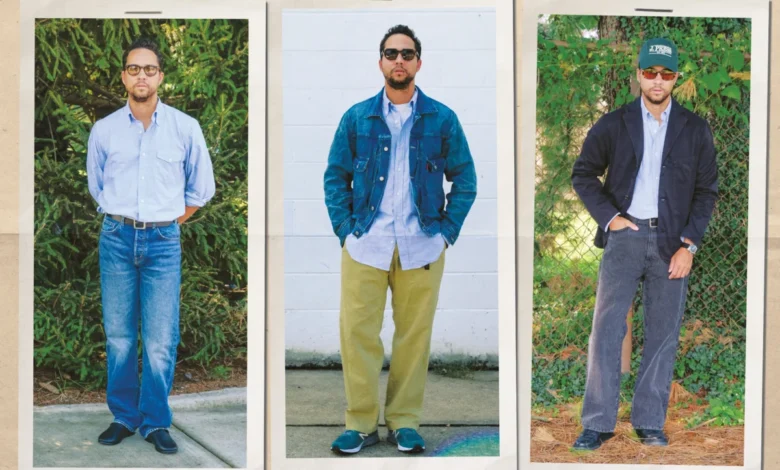
For professionals navigating the blurred lines of work-from-home (WFH) environments, the reflex to dress purely for comfort can sometimes lead to a slump in productivity. Styling an Oxford shirt tucked into straight-leg denim bridges the gap between casual comfort and psychological readiness. Paired with minimalist leather slipper loafers—a footwear choice gaining traction for its transitional indoor-outdoor utility—this combination provides an effortless uniform for casual meetings, creative endeavors, or running mid-day errands without sacrificing personal presentation.
Outfit 2: Elevated Casual Streetwear
When transitioning into outdoor environments or weekend city strolls, the Oxford shirt easily adopts a more laid-back persona. By unbuttoning the top placket and layering the shirt beneath a vintage-wash denim trucker jacket, wearers can subvert the garment’s traditional academic stiffness. Paired with relaxed utility trousers and technical heritage footwear—such as domestically produced athletic runners—the resulting ensemble leans into contemporary menswear’s embrace of high-low mixing, pairing tailored heritage with rugged workwear.

Outfit 3: Practical Transitional Tailoring
As seasonal temperatures fluctuate, the Oxford shirt proves its worth as a mid-layer capable of anchoring transitional outerwear. Layering a black twill blazer that mimics the utilitarian construction of a chore coat over a crisp Oxford shirt creates a sharp yet unpretentious silhouette. Combined with charcoal denim and subtle accessories, this configuration accommodates a wide range of daily activities, from attending local markets to evening dining, demonstrating that classic tailoring can successfully integrate with contemporary utility wear.
Industry Implications and the Future of Menswear Essentials
The sustained market demand for heritage garments like the Oxford cloth button-down reflects a broader economic and cultural recalibration among consumers. Market data from retail analytics firms indicates a steady rise in consumer preference for investment dressing—purchasing fewer, higher-quality items designed to last decades rather than seasons.
As manufacturing costs rise and supply chain vulnerabilities prompt brands to reevaluate offshore production, heritage brands that maintain domestic factories are seeing renewed interest from younger demographics. These consumers are increasingly educated on textile sourcing, weave types, and manufacturing ethics, viewing classic menswear not as a rigid set of rules, but as a modular toolkit for personal expression.

Ultimately, the Oxford shirt secures its place on the metaphorical Mount Rushmore of menswear essentials not through reinvention, but through consistency. By remaining fundamentally unchanged in a rapidly modernizing world, it offers a reliable anchor for an infinite array of personal styles, proving that true quality never falls out of favor.