When Rock Legend Meets Herpetology: Newly Discovered New Guinea Groundsnake Named Lielaphis slashi in Honor of Guns N’ Roses Guitarist

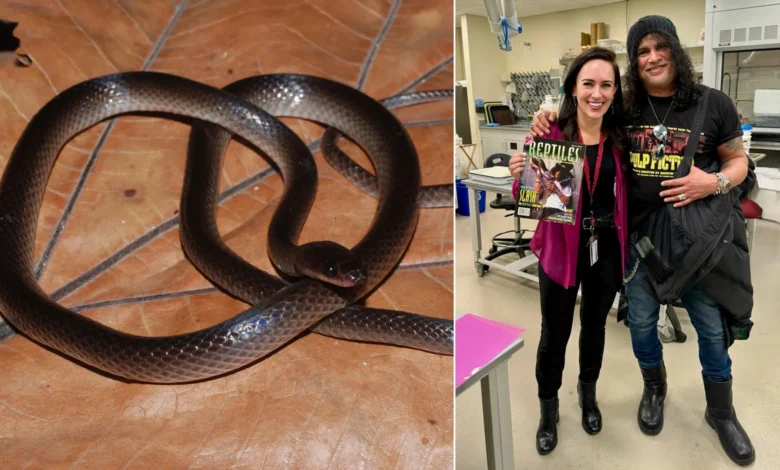
To millions of music enthusiasts worldwide, Saul Hudson—universally recognized by his stage name, Slash—is the iconic, top-hat-wearing lead guitarist of the legendary rock band Guns N’ Roses. Known for blistering guitar solos and driving the sonic foundation of some of rock and roll’s most enduring anthems, Slash’s public persona has long been intertwined with a deeply personal, lifelong passion that exists entirely outside the recording studio. Beyond his contributions to modern music history, the musician has spent decades nurturing a profound fascination with reptiles, conservation, and natural history, frequently lending his voice and platform to the support of global zoos, museums, and wildlife institutions.
Now, that decades-long advocacy and personal passion have culminated in a remarkably unique scientific accolade. A team of international herpetologists and evolutionary biologists, detailing their findings in the peer-reviewed scientific journal Zootaxa, has officially named a newly identified snake species discovered in the tropical rainforests of New Guinea Lielaphis slashi, commonly referred to in literature as Slash’s groundsnake.
For the legendary guitarist, the honor bridges a lifetime of affinity for cold-blooded creatures with the formal annals of taxonomic science. Expressing his genuine astonishment and gratitude, Slash remarked that as a lifelong enthusiast of reptiles—frequently referred to in scientific and hobbyist circles as a herpetophile—receiving this distinction is both deeply humbling and entirely surreal. He noted that he never could have imagined such a moment arriving, cementing his lifelong connection to the scientific community in a permanent, biological legacy.
A Childhood Inspiration Realized Through Scientific Discovery
The path toward immortalizing the rock icon in taxonomic nomenclature began decades prior, rooted in the formative childhood experiences of the study’s senior author, Dr. Sara Ruane. Currently serving as the Associate Curator of Herpetology at Chicago’s esteemed Field Museum, Ruane’s journey into the scientific study of reptiles began long before her academic credentials were established.
Growing up in the United States, Ruane recalls that Guns N’ Roses was among her absolute favorite musical acts as early as the first grade. By the time she reached the fifth grade, her career aspirations were already firmly set; she boldly informed her elementary school teacher that she intended to grow up and become a herpetologist—a scientist dedicated to the academic study of reptiles and amphibians.
That trajectory found a profound catalyst in 1991 when, at the age of twelve, Ruane opened a mailed edition of Reptiles Magazine to find Slash featured prominently on the cover, cradling his pet reticulated python. Witnessing a global rock superstar openly sharing a home and affinity for constrictors left an indelible impression on the young science enthusiast. It reinforced her belief that an interest in reptiles was not only fascinating but shared across diverse walks of life.
Years later, after completing advanced academic training and establishing herself as a professional herpetologist with the authority to designate and name newly recognized species, Ruane reflected on that foundational magazine interview. Upon rereading the piece, she noted how explicitly the musician detailed his childhood spent searching for snakes outdoors, his enduring love for museums and zoological institutions, and his deep-seated appreciation for natural history. Recognizing the shared philosophical ground between her own upbringing and the musician’s lifelong interests, Ruane concluded that naming a newly discovered species in his honor would be a fitting tribute to a cultural figure who had quietly championed herpetology to a massive global audience.
The opportunity to actualize this tribute finally materialized following the laboratory and field analysis of a distinct, reddish-brown snake measuring approximately 28 inches in length, collected years prior from the dense and biologically rich forests of the world’s second-largest island.
Unraveling the Mysteries of New Guinea’s Nocturnal Fauna
The specimen that would eventually bear the name Lielaphis slashi was initially encountered during nocturnal fieldwork conducted in 2006. The expedition was led by Dr. Chris Austin, a prominent professor and curator of herpetology at the Louisiana State University Museum of Natural Science, who serves as a co-author on the descriptive research paper.
New Guinea, situated immediately north of Australia and politically divided between Indonesia and the independent nation of Papua New Guinea, is widely recognized by biogeographers as a global hotspot of terrestrial biodiversity. Its equatorial rainforests, rugged mountain ranges, and expansive wetland systems harbor an extraordinary concentration of flora and fauna, a significant proportion of which remains undocumented, understudied, or entirely unknown to formal science.
Conducting fieldwork in this challenging terrain requires specialized methodologies, particularly when targeting subterranean or nocturnal species. Austin recounted that New Guinea groundsnakes are strictly nocturnal, compelling researchers to conduct surveys under the cover of darkness. The optimal window for locating these elusive reptiles typically occurs immediately following sunset, as the creatures emerge to forage for prey around the buttress roots and bases of large tropical trees.
Furthermore, Austin emphasized the inherent occupational hazards associated with nighttime herpetological fieldwork in the region. The tropical understory of New Guinea is populated by numerous highly venomous elapid snake species that exhibit striking morphological and color mimicry when compared to their non-venomous counterparts, such as groundsnakes. Consequently, researchers must exercise extreme caution to properly identify specimens in field conditions before handling them.
Following the completion of her doctoral studies, Ruane accepted a postdoctoral position working alongside Austin at Louisiana State University in 2016. The academic pairing forged a collaborative partnership centered on resolving the complex evolutionary relationships and taxonomy of New Guinea’s notoriously understudied snake assemblages—a research trajectory they have maintained collaboratively ever since.
Genomic Analysis Distinguishes a Novel Species
Upon initial physical collection in the field, the 28-inch reddish-brown specimen did not immediately stand out as an obvious candidate for a species novel to science. Cryptic coloration and morphological similarities among groundsnakes frequently obscure underlying taxonomic diversity, making traditional visual identification alone insufficient for accurate classification.
To resolve the taxonomic status of the specimen, the research team deployed advanced molecular laboratory techniques. Tianqi Huang, a postdoctoral researcher at the Field Museum and Rutgers University who served as the primary author of the descriptive study, explained that the research team utilized cutting-edge genetic analyses to evaluate the evolutionary distinctiveness of the animal.
By sequencing and comparing mitochondrial and nuclear DNA markers, the scientists determined that L. slashi is robustly distinct at a genetic level from other morphologically similar snake lineages occupying the same genus. This molecular evidence was systematically cross-referenced with detailed physical examinations, which quantified variations in scale counts and anatomical proportions.
To further substantiate the validity of the new species, the investigators integrated ecological niche modeling. This computational technique demonstrated that Lielaphis slashi occupies a distinct ecological envelope, preferring habitat parameters and microclimates that diverge subtly from those utilized by its closest phylogenetic relatives. It was this triad of empirical evidence—molecular divergence, diagnostic scale morphology, and ecological modeling—that ultimately confirmed the discovery of an entirely new species to science.
Behavioral Ecology and Anatomy of Slash’s Groundsnake
Despite the successful formal description of Lielaphis slashi, the broader behavioral ecology and natural history of the species remain largely shrouded in mystery. Herpetologists note that observing snakes in their native, undisturbed rainforest habitats presents formidable logistical challenges, as the animals typically retreat rapidly into leaf litter or subterranean burrows upon detecting human presence.
Nevertheless, comparative anatomical analysis of the specimen provides reliable inferences regarding the lifestyle, foraging strategies, and trophic role of Slash’s groundsnake within its ecosystem. Ruane noted that snakes belonging to this particular genus frequently possess enlarged, specialized teeth situated toward the rear of the upper jaw.
Rather than employing the active constriction strategies utilized by large boas and pythons to subdue mammalian prey, these rear-fanged groundsnakes rely on targeted strikes to capture and manage agile, slippery-scaled forest lizards and the subterranean eggs of other reptiles inhabiting the forest floor.
Addressing the public perception of the animal’s namesake, researchers were quick to clarify any potential misconceptions regarding its temperament or biological potency. While Guns N’ Roses earned international notoriety and the moniker of the "most dangerous band in the world" during their peak touring years of the late 1980s and 1990s, their reptilian namesake poses zero threat to human safety. Lielaphis slashi does not synthesize or deliver venom capable of inducing systemic toxicity or serious clinical harm in humans.
Conservation Imperatives Amid Environmental Degradation in New Guinea
While Lielaphis slashi represents no physical danger to humanity, anthropogenic pressures operating across the island of New Guinea pose an escalating and severe threat to the long-term survival of the species, alongside countless other endemic plants and animals.
The lowland and foothill tropical rainforests that serve as the native habitat for Slash’s groundsnake are increasingly compromised by industrial and agricultural expansion. Commercial activities, including large-scale coffee cultivation, aggressive timber extraction, and expanding mining operations, are rapidly fragmenting and destroying primary forest ecosystems across the region.
According to Ruane, these mounting environmental threats underscore the urgent necessity of baseline taxonomic research. Formally describing, naming, and cataloging biodiversity is not merely an academic exercise; it represents the foundational prerequisite for effective global conservation biology. Scientists cannot formulate targeted management strategies, establish protected reserves, or advocate for legislative preservation measures for organisms that have not yet been formally recognized and described by science.
By officially documenting species such as Lielaphis slashi, researchers are constructing a more comprehensive and accurate map of New Guinea’s complex biodiversity. This foundational data empowers conservationists, indigenous land stewards, and international policymakers to better anticipate which ecological communities and specialized organisms face the highest risk of extinction as global climate patterns and regional land-use practices continue to shift.
The collaborative research effort behind the discovery and description of Lielaphis slashi involved a multidisciplinary team of scientists representing major academic and cultural institutions. Contributors to the published study include Tianqi Huang (Field Museum and Rutgers University), Chris Austin (Louisiana State University Museum of Natural Science), Justin Bernstein (Slippery Rock University and the American Museum of Natural History), Bulisa Iova (Papua New Guinea National Museum and Art Gallery), Jackson Roberts (Virginia Museum of Natural History), Jeffrey Frederick (University of Kentucky), and Sara Ruane (Field Museum). Through their combined efforts, the intersection of rock music iconography and empirical zoological research has secured a permanent place in the scientific literature, ensuring that the legacy of a rock guitar icon lives on within the fragile rainforests of New Guinea.