Unveiling the Cosmic Anomaly: How a Hidden Star Factory in the Milky Way May Rewrite Our Galaxy’s Map

New research has revealed that the Milky Way is actively generating stars in a deeply unexpected location, highlighting a striking divergence between our home galaxy and the majority of its cosmic neighbors. Published in the prestigious journal Nature Astronomy, this groundbreaking study not only pinpoints a high-intensity stellar nursery residing where it seemingly should not exist, but it also challenges a foundational pillar of galactic cartography by suggesting that a prominent feature long classified as a spiral arm may actually be an entirely different astronomical structure altogether.
The findings, spearheaded by Dr. Hillary Davis during her doctoral studies at the University of Sydney’s School of Physics and the Sydney Institute for Astronomy, offer a revolutionary glimpse into the dynamic forces shaping the center of the Milky Way. By combining sophisticated, billions-of-years-spanning computer simulations with precise observational data, the research team has forced astrophysicists to reconsider how gas moves, compresses, and transforms into celestial bodies within barred spiral galaxies.
Main Facts and the Mechanics of the Cosmic Anomaly
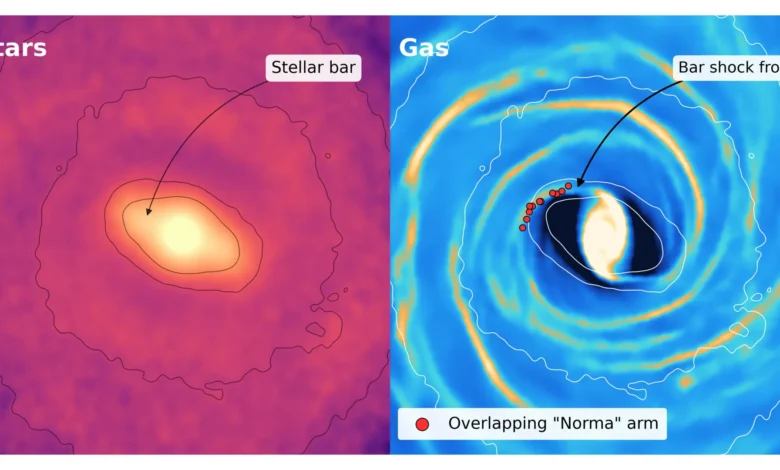
At the core of the discovery is the Milky Way’s Galactic bar—a massive, elongated rotating structure of stars stretching approximately 4.3 kiloparsecs (roughly 14,000 light-years) outward from the galactic center. As this colossal stellar bridge rotates through space, its immense gravitational field exerts profound influence on the surrounding interstellar medium, driving dense clouds of gas into powerful shock fronts.
In standard astrophysics, the physics governing star formation are relatively straightforward: matter is set into motion, gas is compressed, and that compression triggers the gravitational collapse necessary to ignite new stars. However, in most barred spiral galaxies observed throughout the universe, the shock fronts generated by central bars are violently turbulent. These extreme forces typically create an environment where gas is disrupted rather than settled, effectively suppressing star formation in the central regions despite the abundant presence of raw materials.
The Milky Way, it turns out, is playing by a different set of rules. Dr. Davis and her colleagues discovered that our galaxy’s central bar is actively fostering robust star formation directly along its shock fronts. While a tiny handful of other galaxies exhibit similar behavior, it remains an extreme rarity across the cosmos.
"At its heart, star formation is a process we understand from everyday physics," Dr. Davis explained. "Forces set matter in motion. In this case gas is compressed, and that compression can create the conditions for new stars to be born on a massive scale. In most similar galaxies, star formation very commonly occurs along spiral arms. What’s extraordinary is seeing this happen in a different region of our Galaxy, where shocks are usually so strong that star formation is often suppressed."
The Chronology of Discovery: From Interstellar Obstacles to Advanced Simulations
Unraveling the inner workings of the Milky Way has historically been one of astronomy’s most daunting challenges. Because humanity resides safely nestled within the galactic disk—roughly 26,000 light-years from the core—observing the galactic center directly is akin to trying to study a forest fire from deep inside a dense, smoke-choked woodland. Copious amounts of cosmic dust absorb and scatter optical light, obscuring our view and leaving the fundamental properties of the Galactic bar heavily debated for decades.
To bypass these observational bottlenecks, the research team adopted a multidisciplinary approach bridging theoretical modeling and high-precision radio astronomy. The chronology of the breakthrough hinged on several key milestones:
- The Observational Blind Spot: For generations, astronomers relied on infrared and radio wavelengths to peer through the galactic dust, mapping the distribution of gas and young stars. Yet, interpreting these signals accurately remained difficult without a reliable structural model.
- Simulation Development: The research team deployed a new generation of large-scale, high-resolution computer simulations. These models tracked the thermodynamic and gravitational evolution of barred galaxies over timescales spanning billions of years, mapping out where gas accumulates and where shock fronts inevitably develop.
- The Masers Breakthrough: A critical turning point occurred when the team analyzed masers—naturally occurring sources of microwave amplification by stimulated emission of radiation. Operating on the exact same physical principles as lasers but functioning at microwave wavelengths, cosmic masers serve as precise signposts for the birthplaces of massive, newborn stars.
- The Alignment: By plotting the exact spatial coordinates of these masers, the researchers noticed an undeniable, striking correlation. The real-world positions of the masers aligned almost perfectly with the theoretical shock fronts predicted by their computer models.
Challenging Dogma: Is the Norma Arm Actually a Bar Feature?
The alignment of the masers yielded an implication that sent ripples through the astronomical community: it directly implicated the Norma spiral arm, a well-known structural feature of the Milky Way named after the constellation Norma as observed from Earth.
For decades, astronomers mapped the masers in question as components of the Norma spiral arm, assuming they marked the outer boundaries of the galaxy’s spiral structure. However, the new simulations demonstrate that these stellar nurseries actually coincide precisely with the leading edge of the Galactic bar’s shock front.
"We found that masers previously associated with the Norma arm closely align with the shock front predicted by our simulations," Dr. Davis noted. "This suggests that at least part of the so-called Norma arm may not be a spiral arm at all, but a region of star formation along the leading edge of the Galactic bar."
This revelation forces a vital re-evaluation of galactic cartography. If portions of what has long been categorized as a spiral arm are actually products of the central bar’s dynamics, the established blueprint of the Milky Way’s inner architecture must be systematically redrawn. It suggests that the boundary lines between the galaxy’s central bar and its surrounding spiral arms are far more blurred than previously imagined.
Supporting Data and Quantitative Insights
The robustness of the new study relies heavily on the constraints it places on the physical dimensions and dynamics of the Milky Way. Due to our internal perspective, determining the exact length, orientation, and rotational velocity of the Galactic bar has historically yielded widely varying estimates across different scientific papers.
By cross-referencing their evolutionary models with observational data, the research team successfully narrowed these parameters:
- Bar Length: The analysis confirms that the Milky Way’s bar extends approximately 4.3 kiloparsecs (roughly 14,000 light-years) from the galactic center along its primary axis.
- Rotation Dynamics: The models support the characterization of the Milky Way as housing a relatively elongated bar that rotates at a measured, steady tempo, influencing gas dynamics across thousands of light-years.
- Computational Backing: The heavy lifting required to process billions of years of galactic evolution was made possible through advanced computing infrastructure, including resources provided by National Computing Infrastructure Australia—an NCRIS capability supported by the Australian Government—and LUNARC, the Centre for Scientific and Technical Computing at Lund University in Sweden.
Financial backing for the study was provided by a coalition of international scientific organizations, including the Australian Research Council, the Knut and Alice Wallenberg Foundation, the Swedish Research Council, the Swedish National Space Agency, the LMK Foundation, and eSSENCE. The authors of the study have formally reported no competing financial interests.
Official Responses and Scientific Context
While the paper primarily reflects the work conducted at the University of Sydney, its publication in Nature Astronomy has immediately drawn the attention of the broader astrophysics community. Experts note that the methodology—utilizing long-term cosmological and galactic simulations to interpret complex internal kinematics—represents the cutting edge of modern observational astronomy.
Astrophysicists external to the study have praised the clever use of masers as celestial tracers. Because masers shine brightly through obscuring dust clouds, they offer an unvarnished look at active star-forming regions that traditional optical telescopes can never capture. By tying these markers directly to bar-induced shock fronts rather than spiral density waves, the Sydney-led team has provided a compelling alternative framework for interpreting inner-galaxy emissions.
Furthermore, the study highlights how technological advancements in data processing are transforming astronomy. Where past decades relied on static snapshots and educated guesses, modern researchers can simulate the life cycles of galaxies from their primordial states to their present configurations, matching simulated physical outcomes directly against empirical telemetry.
Broader Impact and Implications for Galactic Evolution
The implications of Dr. Davis and her colleagues’ research extend well beyond the immediate geography of our solar system’s cosmic neighborhood. Understanding the Milky Way serves as a vital anchor for galactic astronomy as a whole; because we can study our own galaxy in vastly more detail than any external system, it acts as the primary laboratory for testing theories of stellar evolution and galactic mechanics.
If the Milky Way is indeed an outlier—a barred spiral galaxy that actively manufactures stars along its central shock fronts rather than suppressing them—astronomers must ask what makes our galaxy unique. Does the specific mass, age, or composition of the Galactic bar create an optimal environment for star birth? How do these internal shocks impact the long-term lifecycle of the interstellar gas supply, and will this centralized star factory eventually starve the outer spiral arms of the materials they need to maintain their own stellar output?
Moreover, the potential reclassification of the Norma arm serves as a cautionary tale regarding our understanding of large-scale cosmic structures. It demonstrates that even within our own galactic backyard, fundamental misconceptions can persist simply due to the extreme difficulty of observing objects from an internal vantage point.
As observational technology continues to advance—bolstered by next-generation space telescopes, improved infrared sensors, and ever-more-powerful supercomputers—astronomers will undoubtedly subject the Milky Way’s heart to further scrutiny. For now, this new research stands as a milestone achievement, proving that our home galaxy still holds profound surprises hidden deep within its dusty, dynamic core.