BepiColombo Has Officially Entered Orbit Around Mercury After an Eight-Year Interplanetary Journey

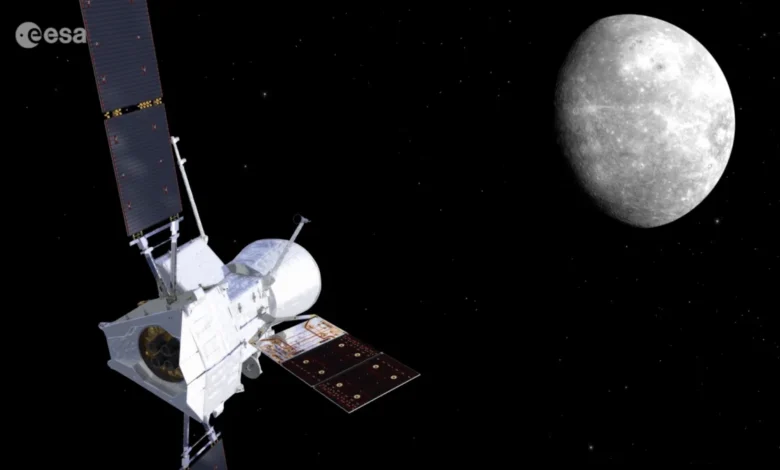
The joint European-Japanese spacecraft BepiColombo has officially reached its destination, successfully entering orbit around Mercury on Saturday, November 21. This milestone marks the conclusion of an exhaustive eight-year transit through the inner solar system, during which the probe navigated complex gravitational maneuvers to overcome the intense pull of the Sun. By settling into a stable orbit around the solar system’s innermost planet, BepiColombo becomes only the second mission in human history to achieve this feat, following NASA’s MESSENGER mission, which orbited Mercury from 2011 to 2015.
The mission, a collaborative endeavor between the European Space Agency (ESA) and the Japan Aerospace Exploration Agency (JAXA), confirmed the successful insertion via a series of telemetry packets transmitted back to ground control teams. This achievement represents a significant triumph for orbital mechanics and aerospace engineering, given the extreme difficulty of navigating to a planet so close to the Sun’s massive gravitational well.
A Decade-Long Trajectory: The Chronology of the Mission
The BepiColombo mission began its long trek into deep space on October 20, 2018, when it launched from the Guiana Space Centre in Kourou, French Guiana. Unlike missions to the outer planets that utilize gravity assists to gain speed, BepiColombo’s trajectory required a series of complex "braking" maneuvers to shed the immense orbital velocity it inherited from Earth’s motion around the Sun.
The chronology of the journey is marked by a series of precise planetary flybys designed to adjust the spacecraft’s speed and path:
- 2018: Successful launch and initial checkout of the spacecraft’s complex dual-module design, which consists of the Mercury Planetary Orbiter (MPO) and the Mercury Magnetospheric Orbiter (MMO).
- 2020: The mission conducted its first Earth flyby, followed by two gravity-assist flybys of Venus to further slow its momentum.
- 2021–2023: The spacecraft executed six consecutive flybys of Mercury itself. These passes were critical, as they allowed the probe to gradually reduce its speed relative to the planet, aligning its trajectory for the final capture.
- November 2024: The spacecraft performed the final engine burns necessary to be captured by Mercury’s gravity, officially marking the start of its primary science phase.
Technical Complexity and Scientific Objectives
Mercury is famously one of the most challenging targets in the solar system. The extreme proximity to the Sun creates a hostile thermal environment, with surface temperatures fluctuating between 800 degrees Fahrenheit (430 degrees Celsius) during the day and minus 290 degrees Fahrenheit (minus 180 degrees Celsius) at night. Furthermore, the immense solar gravity makes it harder to reach Mercury than it is to reach Mars or even the outer gas giants.
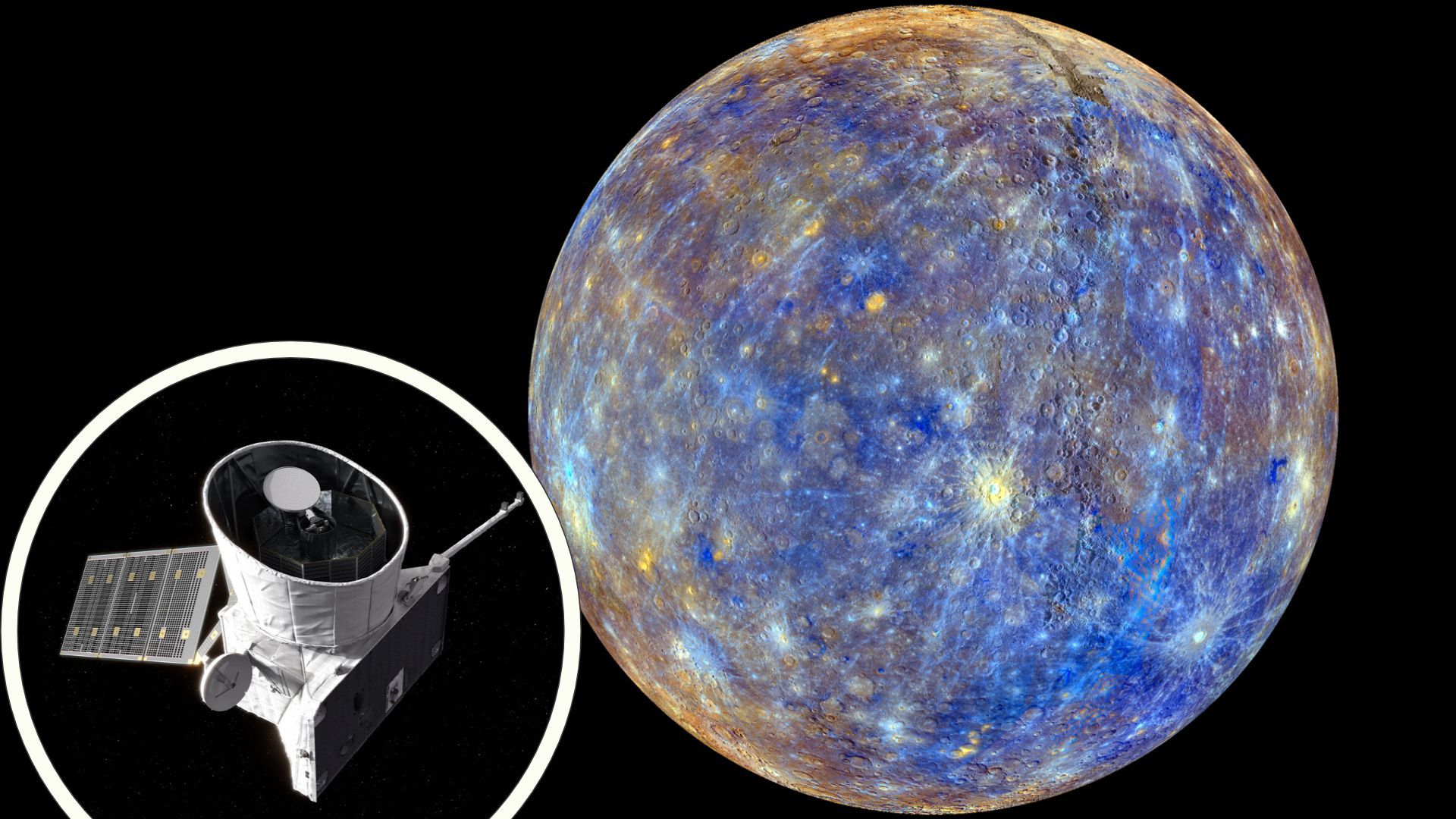
To survive this, the BepiColombo spacecraft utilizes a sophisticated thermal protection system. The MPO is equipped with high-tech radiators to dissipate the heat absorbed from the Sun, while the entire craft is protected by multi-layered insulation blankets capable of withstanding extreme solar radiation.
The mission is scientifically diverse, split between the two main modules:
- The Mercury Planetary Orbiter (MPO): Led by the ESA, this module is equipped with an array of instruments designed to map the surface, study the composition of the planet’s crust, and investigate its internal structure, including its oversized iron core.
- The Mercury Magnetospheric Orbiter (MMO): Developed by JAXA, this module focuses on studying the planet’s magnetic field, the interaction between the solar wind and the magnetosphere, and the exosphere—a tenuous layer of gases surrounding the planet.
Official Responses and Mission Significance
Mission controllers at the European Space Operations Centre (ESOC) in Darmstadt, Germany, expressed relief and pride as the confirmation signal arrived. "The successful insertion into Mercury’s orbit is a testament to the decades of work put in by thousands of engineers and scientists across Europe and Japan," stated an ESA spokesperson following the confirmation.
JAXA officials echoed these sentiments, emphasizing the value of international cooperation in planetary exploration. The mission is viewed not just as an exploration of a single world, but as a window into the formation of the inner solar system. Because Mercury is thought to be a remnant of the early terrestrial planets, understanding its formation provides crucial context for the history of Earth, Venus, and Mars.
Broader Impact and Future Implications
The data returned by BepiColombo is expected to resolve several long-standing mysteries regarding Mercury. Among these is the "volatiles" paradox: despite the intense solar heat, previous observations have suggested the presence of water ice in permanently shadowed craters near the planet’s poles. Scientists hope that BepiColombo’s high-resolution sensors will provide a definitive map of these regions, clarifying how ice can persist in such an extreme environment.
Additionally, the mission will provide unprecedented insight into the planet’s magnetic field. Mercury is the only terrestrial planet other than Earth to possess a global magnetic field. However, Mercury’s field is significantly weaker and displays unique characteristics that have puzzled researchers since the Mariner 10 flybys in the 1970s. By measuring the interaction between the solar wind and the magnetosphere in real-time, the mission expects to explain how this magnetic field influences the erosion of the planet’s surface.
The Challenges Ahead
While the orbit insertion is a massive victory, the mission is far from over. The next phase involves a gradual adjustment of the orbital path to reach the final, mission-specific orbit. This process requires continuous use of the spacecraft’s electric propulsion system, which has been in operation throughout the journey.
The primary scientific observation phase is slated to last for at least one year, with a potential extension depending on the health of the hardware. The mission faces the constant challenge of "solar glare"—the overwhelming light from the Sun that can blind sensors—requiring the mission team to exercise extreme caution in how the spacecraft is oriented toward the planet.
As BepiColombo begins its comprehensive survey, the global scientific community is watching closely. The findings will likely reshape models of planetary formation, influence future exploration strategies for other rocky bodies, and provide a masterclass in how to conduct long-duration, high-precision deep space missions under the most difficult conditions imaginable.
With its status as the second orbiter in history, BepiColombo is set to become the definitive authority on Mercury, providing a legacy of data that will be studied for generations to come. The success of this mission underscores the maturing capabilities of international space agencies in orchestrating complex, multi-modular platforms that push the boundaries of what is possible in the harsh, radiation-drenched environment of the inner solar system.