Unlocking the Century-Old Secret of the Four-Color Theorem: Mathematicians Uncover New Structural Insights Into Planar Graphs


For generations, the four-color theorem has served as both a foundational pillar and a persistent thorn in the side of the global mathematical community. Stated simply, the theorem posits that any contiguous map on a flat surface can be colored using a maximum of four distinct colors in such a way that no two adjacent regions share the same hue. While the concept can be easily understood by a child, proving it rigorously has consumed the lives of mathematicians, mapmakers, and amateur puzzle solvers for over 170 years.
Recently, an international collaboration of six mathematicians and computer scientists announced a major breakthrough by producing a fresh computer-assisted proof of the theorem. Unveiled online and slated for presentation at the prestigious Foundations of Computer Science conference, this new work does more than just re-verify a settled mathematical truth. By exploring uncharted regions of planar graphs and utilizing a novel parallel reduction strategy, the research team has unlocked unprecedented efficiency in map coloring and yielded profound structural insights that could finally unlock other stubborn problems in graph theory.
The Genesis of an Obsession: From 1852 to the Kempe Error

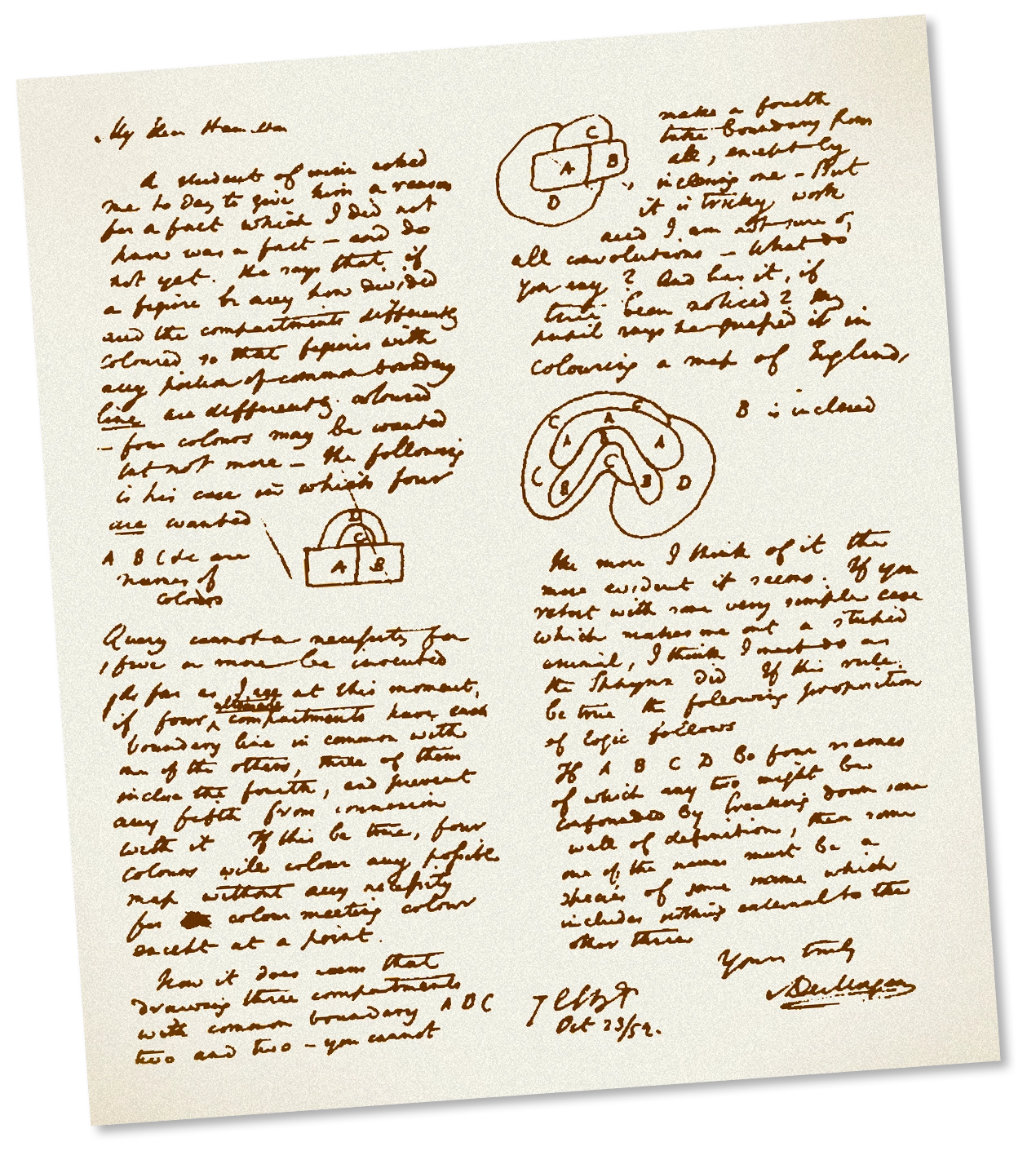
The history of the four-color theorem is rooted in nineteenth-century curiosity. In 1852, while attempting to color a map of English counties, Francis Guthrie observed that only four colors were necessary to ensure that no bordering regions clashed. Guthrie queried his brother Frederick, who brought the dilemma to his mentor, the prominent logician and mathematician Augustus De Morgan. De Morgan quickly popularized the question within British academic circles, transforming a casual cartographic observation into a mathematical puzzle.
By 1879, the scientific community believed the problem had been solved. Alfred Bray Kempe published a proof in the journal Nature that relied on a brilliant, elegant strategy. Kempe utilized a proof by contradiction, assuming a "minimal" counterexample—a map requiring five colors that, if any single country were removed, would become four-colorable. He demonstrated that any such graph must contain at least one configuration from an unavoidable set, and that each configuration was "reducible," meaning it could be successfully manipulated and recolored without invoking a fifth color.
However, the triumph was short-lived. Eleven years later, in 1890, mathematician Percy John Heawood discovered a subtle flaw in Kempe’s color-swapping procedure for vertices with five neighbors. Although Kempe’s overarching logical framework—including his color-swapping technique known today as the "Kempe chain"—remained invaluable, the final configuration in his unavoidable set could not be proven reducible by hand. It became evident that a valid proof would require evaluating thousands of distinct configurations, a task far beyond the computational capabilities of nineteenth-century mathematics.
The 1976 Computer Revolution and Ongoing Skepticism

Nearly a century after Guthrie’s initial observation, the four-color theorem finally yielded to brute-force computation. In 1976, mathematicians Kenneth Appel and Wolfgang Haken of the University of Illinois successfully reduced the problem down to 1,482 distinct configurations and employed university supercomputers to check every single one.
The announcement sent shockwaves through the mathematical world, sparking a fierce philosophical debate. Traditionalists viewed computer-assisted proofs with deep suspicion, arguing that a proof requiring thousands of hours of machine computation on hand-woven magnetic core memory could not be truly understood or verified by human intuition. Critics questioned whether an undetected hardware glitch, a sudden electrical surge, or a software bug could invalidate the entire enterprise.
Despite initial resistance, the mathematical community gradually warmed to computational methodologies. In 1997, a simplified computer proof reduced the required configurations to just 633, earning widespread acceptance. Yet, a lingering sense of dissatisfaction remained among graph theorists. The Appel-Haken approach and its successors provided a recipe for coloring maps, but the algorithm was notoriously inefficient, requiring a quadratic number of steps ($n^2$ for a graph with $n$ vertices) because configurations had to be identified, removed, and processed sequentially.
A Beachside Brainstorm and the 2026 Breakthrough

The latest chapter in this mathematical saga began in 2015 during a casual conversation on a Danish beach in Nyborg. Ken-ichi Kawarabayashi of Japan’s National Institute of Informatics and Mikkel Thorup of the University of Copenhagen—longtime collaborators who had previously won the prestigious Fulkerson Prize—were pondering their next major research endeavor. Deeply inspired by the historical impact of the four-color theorem, they sought a more efficient algorithmic approach to map coloring.
Joined later by Carsten Thomassen of the Technical University of Denmark and Bojan Mohar of Simon Fraser University, alongside graduate students Yuta Inoue and Atsuyuki Miyashita, the team set out to design a method capable of reducing multiple configurations in parallel rather than one by one. Achieving this required guaranteeing that simultaneous reductions would not interfere with one another’s colorings.
To find these non-interfering components, the researchers took an unconventional path. While historical proofs focused exclusively on sparse clusters of vertices with few connections, the team directed their attention to the "flat" areas of graphs—regions where every vertex is connected to six others in a dense triangular arrangement. Traditionally avoided by graph theorists due to a lack of obvious structural hooks, these flat zones represented a mathematical no-man’s-land. However, because flat regions are vastly more abundant, the researchers hypothesized they could provide the diverse array of configurations necessary for parallel reduction.
Following months of intensive computational analysis, the team identified a massive new unavoidable set consisting of 8,202 configurations. As predicted, these configurations could be reduced simultaneously, transforming a sequential process into a highly streamlined operation. The resulting algorithm drastically improves computational efficiency, requiring only $n(log n)$ steps to color an $n$-vertex graph—a massive leap forward from previous iterations.
Broader Implications for Graph Theory and Beyond
While the headline achievement of the 2026 study is yet another successful proof of the four-color theorem, mainstream mathematicians and computer scientists emphasize that the true value lies in the newly discovered structural properties of planar graphs. By pioneering alternative concepts of reducibility and harnessing previously ignored domains within graph structures, the team has provided researchers with powerful new diagnostic tools.
These methodological innovations extend far beyond standard planar maps. Graph theorists frequently study structures mapped onto more complex topological surfaces, such as doughnut-shaped tori. The structural insights unveiled by Kawarabayashi, Thorup, Thomassen, Mohar, and their students share deep mathematical parallels with toroidal graphs, opening promising pathways for proving coloring theorems in higher-dimensional topologies.
Looking Ahead: The Quest for the Mythical One-Pager

Despite these monumental technological and theoretical advances, the human element of mathematical curiosity remains unfulfilled. The "four-color disease"—as computer scientists affectionately term the compulsive urge to simplify the problem—continues to afflict leading researchers.
Carsten Thomassen and his colleagues acknowledge that while their algorithmic machinery is robust and deeply insightful, the ultimate holy grail of four-color research remains elusive. Generations of mathematicians have dreamed of discovering a concise, elegant, purely conceptual proof that requires no computational assistance—the mythical "one-page paper" that explains intuitively why four colors are universally sufficient for planar maps.
As the mathematical community prepares to examine the team’s findings in greater depth at upcoming academic conferences, the consensus is clear: while the computational debate of the 1970s is long settled, the journey to fully understand the architecture of graphs is far from over. For researchers like Thomassen, the pursuit of mathematical elegance will continue unabated, driven by the enduring belief that deep simplicity underlies the complex machinery of modern graph theory.