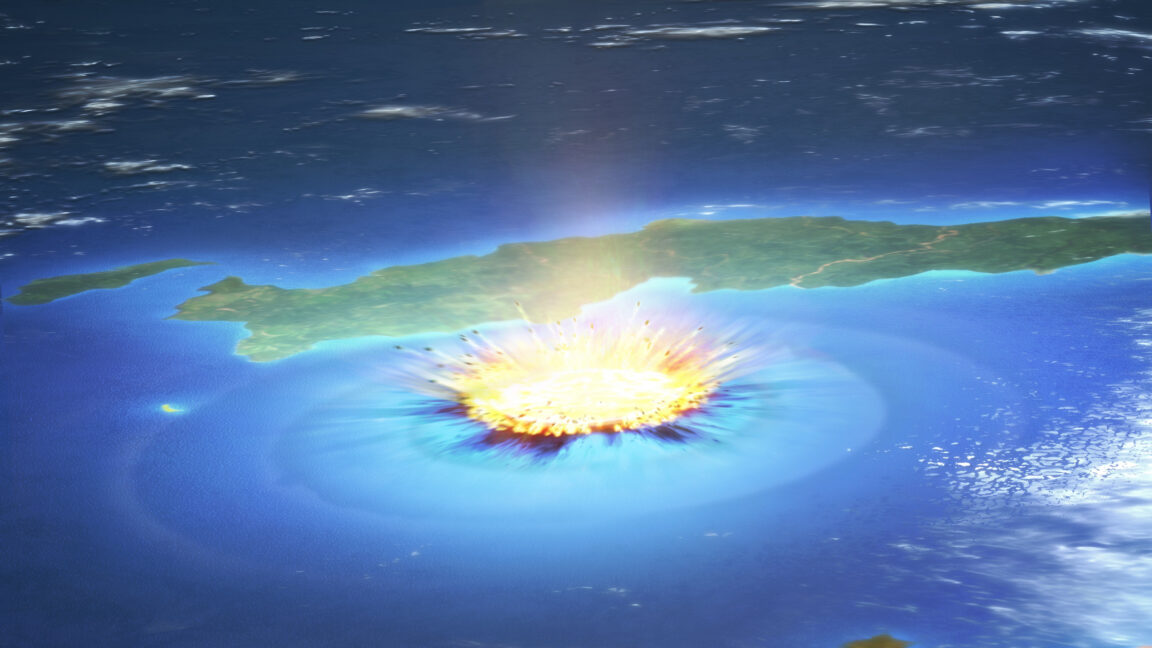
Sixty-six million years ago, a massive asteroid, roughly 10 to 15 kilometers in diameter, struck the Yucatan Peninsula in what is now Mexico. This event, known as the Chicxulub impact, triggered a global cataclysm that resulted in the extinction of non-avian dinosaurs and nearly three-quarters of all plant and animal species on Earth. While the immediate aftermath is defined by the devastation caused by tsunamis, wildfires, and a long-lasting "impact winter" caused by debris blocking the sun, recent geological analysis suggests that the crater itself may have served as a long-lived oasis for microbial life. A study published in Communications Earth & Environment reveals that the massive heat generated by the impact birthed a sprawling hydrothermal system that persisted for at least 8 million years, far longer than previous models had estimated.
The Mechanics of a Subterranean Oasis
The Chicxulub impact was an event of incomprehensible energy, estimated to be equivalent to billions of atomic bombs. This energy did not merely vaporize surface material; it deformed the Earth’s crust to a depth of approximately 35 kilometers. This intense tectonic disturbance shattered the bedrock, creating a porous, fractured landscape. As the Earth’s crust settled, seawater from the surrounding Gulf of Mexico flooded these subterranean fractures.
Deep within the Earth, the residual heat from the impact—combined with the naturally occurring thermal gradient of the planet—warmed this trapped seawater. As the water heated, it circulated through the porous, impact-shattered rock, leaching minerals and nutrients. This process created a vast hydrothermal system, effectively a massive, underground plumbing network of hot, mineral-rich fluid. For early microbial life, these conditions were ideal. Hydrothermal systems provide a steady source of heat and chemical energy independent of solar light, offering a stable environment that can withstand surface-level catastrophes.
Reassessing the Timeline of Thermal Activity
For years, the scientific consensus regarding the longevity of the Chicxulub hydrothermal system was that it remained active for approximately 2 million years. However, new research led by Dr. Annemarie Pickersgill of the SUERC Center for Isotope Sciences at the University of Glasgow has challenged this timeline. By analyzing core samples drilled from 1 kilometer beneath the surface of the crater in 2016, the research team utilized high-precision radioisotopic dating to track the cooling of the crust.
The team focused on feldspar, a common mineral found in the impact melt rocks. Potassium within the feldspar decays into argon over time at a known, constant rate. Because argon gas escapes from rock while it is in a molten or semi-molten state, the presence of trapped argon allows geologists to pinpoint the exact moment the rock cooled and solidified. The data indicated that the hydrothermal system did not cease activity after 2 million years; instead, the thermal energy persisted until approximately 58 million years ago—roughly 8 million years after the initial impact.
Computer simulations conducted alongside the isotope analysis corroborated these findings. The models showed that at a depth of one kilometer, the temperature would have remained above 90°C for over 2 million years, cooling to a more temperate 50°C—a "Goldilocks" zone for many thermophilic microbes—over the subsequent 3 million years. By the 8-million-year mark, the thermal flux had dissipated sufficiently to halt the hydrothermal circulation.
Implications for Prebiotic Chemistry and Evolution
The significance of an 8-million-year window of habitable conditions cannot be overstated. According to Dr. Pickersgill, extended periods of hydrothermal activity provide a stable environment for prebiotic chemical reactions to occur. In the immediate aftermath of a global extinction event, surface conditions were likely hostile for long periods. The subterranean hydrothermal system, however, was shielded from the atmospheric toxicity and climate volatility that plagued the planet’s surface.
This protected environment would have allowed microbial colonies to thrive, propagate, and potentially diversify. In the field of astrobiology, such systems are considered prime candidates for the origins of life. If a system as robust as the Chicxulub crater could sustain life for millions of years, it stands to reason that other, even larger impact sites on early Earth—and perhaps on other planetary bodies like Mars—could have functioned as incubators for life.
Comparative Planetology and Future Research
While this study provides compelling evidence for a long-lived, habitable environment, it is important to distinguish between "habitable conditions" and "inhabited environments." The current data confirms that the physical and chemical requirements for life were present; however, finding direct, fossilized evidence of the specific microorganisms that may have inhabited the Chicxulub crater remains a significant challenge.
The Chicxulub crater is just one of roughly 70 known underwater impact craters worldwide. Of these, only eight have been confirmed to host evidence of past hydrothermal activity. The difficulty in locating these signatures lies in the geological volatility of the Earth’s crust; tectonic movement, erosion, and sedimentation often obscure or destroy the evidence of ancient hydrothermal activity.
Dr. Pickersgill notes that the Chicxulub crater is relatively small compared to the massive impact basins that scarred the Earth during the Hadean and Archean eons. During those periods, the planet was subjected to a "Late Heavy Bombardment," a period where numerous massive asteroids struck the surface. If the Chicxulub impact sustained life for 8 million years, the larger, more energetic impacts of the early Earth could have maintained such environments for tens of millions of years. This suggests that the history of life on Earth may be more intimately tied to impact events than previously theorized.

A New Perspective on Extinction and Creation
The narrative of the Chicxulub impact has traditionally been one of singular destruction. It is the story of the end of an era, the sudden termination of the reign of the dinosaurs, and the collapse of complex ecosystems. The discovery of an 8-million-year-long hydrothermal system introduces a nuance to this history: the asteroid that caused the "Great Dying" also created a localized, enduring cradle for the evolution of new life forms.
This duality is a central theme in modern planetary science. Impacts are not merely destructive; they are also transformative. They alter the crust, introduce new mineralogy, and create environments that are fundamentally different from the pre-impact state. The study of the Chicxulub crater provides a blueprint for how scientists might evaluate the habitability of other craters, both on Earth and on other worlds.
As researchers continue to analyze the drill cores from the 2016 mission, they hope to further refine the timeline of the crater’s cooling and potentially identify chemical markers of organic activity. The 8-million-year duration serves as a benchmark for future studies, forcing a revision of how we calculate the "thermal longevity" of impact-induced habitats.
Conclusion
The research conducted by the team at the University of Glasgow marks a turning point in our understanding of the Chicxulub impact’s aftermath. By shifting the focus from the immediate destruction to the long-term, subterranean thermal legacy, scientists have opened a new window into the resilience of life. The 8-million-year duration of the Chicxulub hydrothermal system suggests that even in the wake of the most catastrophic events, the Earth possesses a capacity for renewal and a persistent drive toward habitability.
This study underscores the necessity of interdisciplinary approaches to planetary science. By combining radioisotopic dating, geochemistry, and computational modeling, researchers have successfully reconstructed a localized environment from 66 million years ago. As we look toward future exploration of the solar system, the lessons learned from the Chicxulub crater will be instrumental in identifying and characterizing potentially habitable environments on other planets, proving that the search for life is as much about understanding the history of our own world as it is about looking toward the stars. The persistence of life, it seems, is not just a matter of luck, but a consequence of the complex, heat-driven processes that define our planet’s dynamic geological history.