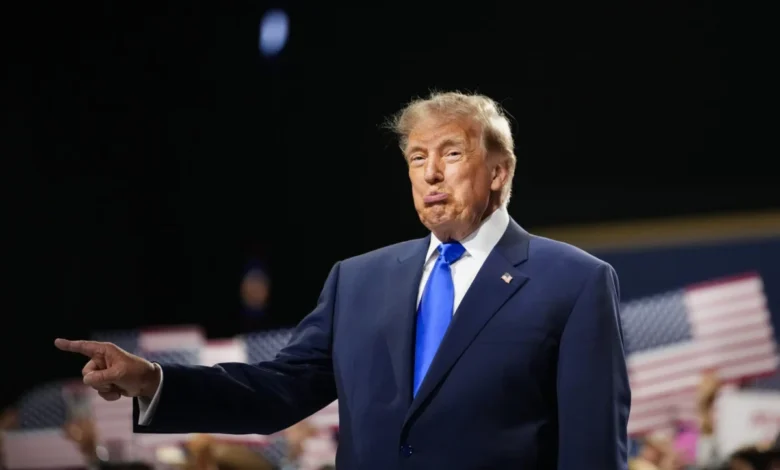
In a direct challenge to the burgeoning coalition of technology executives and national security experts calling for increased AI regulation, President Donald Trump has staked out a defiant position, framing the push for "guardrails" as a strategic liability that threatens American dominance. Through a series of declarations on Truth Social, the President dismissed concerns regarding the potential risks of frontier artificial intelligence models, arguing that the only oversight required is a "strong and smart" executive branch. By invoking the specter of Chinese geopolitical advancement, Trump has effectively recast a complex technological safety debate as a zero-sum game of national security, setting the stage for a confrontation between the White House and the leaders of the industry’s most powerful firms.
The President’s rhetoric arrives at a precarious moment for the administration. With midterm elections approaching and the Republican majority in Congress hanging by a thread, the White House finds itself increasingly misaligned with public sentiment on a suite of contentious issues, ranging from energy policy and surveillance to the role of AI in local communities. This friction is underscored by recent polling, which suggests that the "MAGA" platform is struggling to resonate with a public increasingly wary of rapid technological integration and government overreach.
The Geopolitics of AI Development
The crux of the President’s argument is that any artificial slowdown in AI development—whether mandated by law or adopted voluntarily by industry labs—acts as a direct gift to Beijing. "Whoever wins AI, wins," Trump stated, emphasizing that the race for computational superiority is the defining challenge of the 21st century. This perspective pits the administration directly against the leadership at firms like Anthropic and OpenAI.
Dario Amodei, CEO of Anthropic, has emerged as a leading voice for a more measured approach, advocating for a strategy to "pace the frontier." Amodei’s proposals, which include independent model auditing, industry-wide safety coordination, and enhanced transparency, are viewed by the White House as a potential "Trojan horse" for regulatory capture. Vice President JD Vance has echoed this sentiment, suggesting that the industry’s sudden pivot toward safety is a calculated maneuver by dominant incumbents to erect barriers to entry that smaller competitors cannot scale.
This disagreement is not merely theoretical; it has begun to influence capital markets. Wall Street analysts are currently navigating the volatility created by this regulatory uncertainty. On recent trading days, major chipmakers, including Nvidia, experienced notable pullbacks as investors weighed the possibility that government-mandated development pauses could disrupt the current pace of infrastructure capital expenditures. Conversely, firms specializing in cybersecurity, such as CrowdStrike, have seen their valuations surge, reflecting a market consensus that the demand for defensive AI infrastructure will remain robust regardless of how the regulatory climate shifts.
A Growing Disconnect: Data Centers and Public Opinion
While the President promotes AI as the "Golden Goose" of the modern economy, promising jobs and investment to communities that host data centers, local opposition is growing. According to recent data from the Annenberg Public Policy Center at the University of Pennsylvania, 61% of Americans now oppose the construction of new AI data centers in their immediate vicinity. Perhaps most striking is the erosion of support among the President’s own base, with 54% of Republicans expressing skepticism toward these massive infrastructure projects.
This skepticism is rooted in concerns over energy consumption, water usage, and the localized economic impact of facilities that are often highly automated and provide limited long-term employment for residents. The administration’s narrative—that communities resisting these servers risk becoming "backwards and poor"—appears to be missing the mark with a public that is increasingly prioritized quality-of-life concerns over the abstract promises of a national AI arms race.
The Broader Political Landscape
The friction surrounding AI policy is symptomatic of a broader political strategy that has placed the Republican party on the defensive as the midterm window closes. The administration is currently grappling with a "trifecta of unpopularity" regarding its stances on security and international policy.
Public support for the ongoing conflict in Iran remains suppressed at approximately 25%, a figure that has become increasingly politically radioactive as the war’s impact on domestic energy costs has become undeniable. Gas prices have risen by roughly 44% since the conflict’s escalation in February, a metric that has severely impacted consumer sentiment scores. Even within the Republican electorate, confidence in the economy has seen a marked decline, complicating the party’s attempts to frame the election as a referendum on Democratic fiscal management.
Furthermore, the administration’s support for the expansion of Flock-style automated license plate readers has drawn sharp criticism from privacy advocates and the general public. Despite the White House framing these tools as essential components of public safety, nearly 46% of Americans oppose their deployment in residential neighborhoods, compared to only 38% who support them. This trend toward centralization and constant surveillance, while aligned with the administration’s "law and order" messaging, appears to be alienating a significant portion of the suburban electorate.
Regulatory Evolution and State Intervention
The current administration’s approach to technology is characterized by a high degree of interventionism, a departure from traditional laissez-faire conservative economic policies. This has been most visible in the administration’s handling of the AI supply chain. In a June executive order, the White House directed national-security agencies to establish rigorous benchmarks for cyber capabilities, effectively creating a formal mechanism to classify "covered frontier models."
This move followed a series of tense negotiations between the White House and labs like Anthropic, specifically regarding the government’s desire for direct access to proprietary models. The administration has even floated the prospect of the federal government taking equity stakes in major AI firms—a policy that mirrors the interventionist playbook previously applied to the steel, semiconductor, and energy sectors.
This strategy of "co-investment" was most clearly demonstrated during the recent resolution of export disputes regarding advanced chips to China. The administration allowed Nvidia to continue certain sales on the condition that the federal government would receive a direct share of the revenue. This creates a unique precedent: the state is no longer merely a regulator of the AI industry but a direct beneficiary of its commercial success, a dynamic that complicates the "safety vs. speed" debate.
Analysis of Implications
The risk for the administration is that by tying its political capital to the unchecked growth of AI, it may be ignoring the practical concerns of the electorate. Gil Luria, head of technology research at D.A. Davidson, notes that the push for regulation is inherently skewed. "The companies at the frontier—OpenAI, Anthropic, Google—have the resources to build the moat," Luria explains. "They can afford the safety teams and the army of lawyers required to comply with these rules. For the rest of the industry, these regulations act as a barrier that prevents competition."
By labeling the safety debate as a "sick conspiracy," the President is attempting to bypass these complex economic and safety arguments, appealing directly to a nationalist sentiment that views any domestic constraint as an international weakness. However, the data suggests that the voters are increasingly focused on the tangible costs of this technological pivot, including the environmental strain of data centers and the loss of local privacy.
As the November midterms approach, the administration’s ability to reconcile its pro-industry, interventionist AI policy with the growing public demand for transparency and caution will be a defining factor in the election. With Democrats requiring only three seats in the House and four in the Senate to shift the balance of power, the President’s "AI-at-all-costs" stance may prove to be a liability that extends beyond the digital frontier and into the polling booth. The coming months will likely see the White House double down on its rhetoric, but whether this will energize the base or alienate the crucial independent voters remains the central question of the cycle.