Tesla Shifts Referral Program Strategy to Focus Entirely on Full Self-Driving Subscriptions Rather Than Vehicle Sales

Tesla has quietly restructured its popular referral program in the United States, marking a historic departure from a decade-long strategy centered on incentivizing vehicle sales. Under the newly implemented guidelines, the automaker has eliminated all buyer and referrer rewards tied to the purchase of new electric vehicles. Instead, the updated program redirects focus toward expanding the user base for Tesla’s driver-assistance software, Full Self-Driving (Supervised).
This strategic pivot replaces traditional hardware-focused discounts with software-centric incentives. Existing owners who share their referral links can now earn rewards exclusively when friends or acquaintances convert from a trial period to a paid monthly subscription for Full Self-Driving (Supervised), or when customers invest in Tesla’s solar energy solutions. The quiet introduction of these terms reflects a broader corporate alignment with recurring software revenue and specific high-profile performance milestones tied to executive compensation.
Mechanics of the New Full Self-Driving Referral Framework
Under the updated parameters detailed in Tesla application version 4.62.0 and later, the referral mechanism operates through a structured system designed to encourage software adoption among current vehicle owners. To participate as a referrer, an individual must either own Full Self-Driving outright—having purchased the feature prior to Tesla altering its retail availability—or maintain an active monthly subscription to the service. Customers who acquired Full Self-Driving via a temporary one-year promotional grant are excluded from sharing referral links.
For a referral to be successfully validated, the recipient must meet specific eligibility criteria. The referred individual must own a registered Tesla vehicle equipped with compatible hardware, must not have paid for a Full Self-Driving subscription or outright purchase within the preceding 12 months, and cannot have previously bought the software package permanently. Furthermore, recent vehicle buyers who received a complementary Full Self-Driving trial bundled with their automobile purchase are subjected to a strict cooling-off period, remaining ineligible to use a referral link until one full year has elapsed following the conclusion of their trial.
When a referred customer transitions into a paying subscriber, the reward structure is applied based on the referrer’s status. Referrers who own the software outright receive a $99 Tesla credit—an amount equivalent to one month of the standard software subscription fee. Referrers who subscribe monthly receive a free month of the service. Meanwhile, the newly converted friend receives a complimentary one-month trial of Full Self-Driving (Supervised). Tesla has established a strict cap on the program, limiting participants to a maximum of 12 rewards per calendar year, which caps potential annual earnings at either one full year of software access or $1,188 in account credits. These credits carry a 12-month expiration date and cannot be redeemed for cash.
Complete Removal of Vehicle Purchases from Referral Rewards

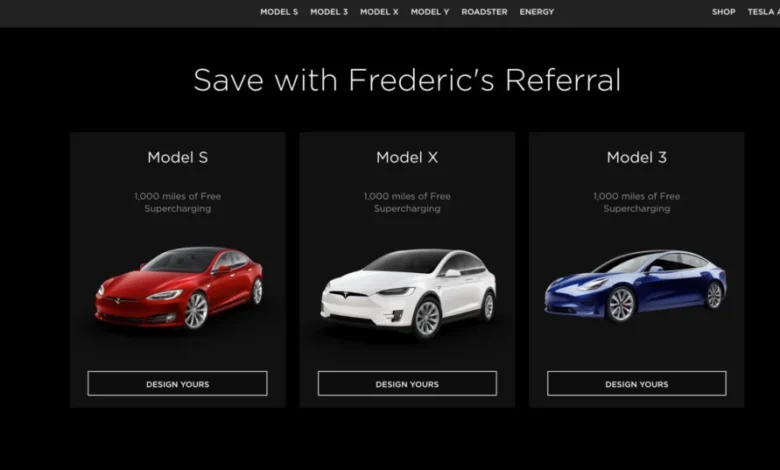
The most significant alteration within the revised "Refer and Earn" terms is the complete exclusion of automobile purchases from the incentive structure. For the first time in the modern history of Tesla’s marketing initiatives, purchasing a Model 3, Model Y, or Cybertruck yields no financial benefit or credit for either the buyer or the person who provided the referral code. Premium models such as the Model S and Model X are omitted from the program entirely.
The updated terms indicate that buyer incentives within the referral system are now exclusively restricted to solar panel installations. Referrer benefits are similarly limited to solar products, qualifying first-time demo drives—capped at 30 over the lifetime of a user account—and the newly introduced Full Self-Driving subscription conversions. While vehicle purchases continue to appear under loyalty categories for existing owners looking to expand or replace their garage inventory, they no longer carry referral value.
Tesla did not issue a formal press release or public notification regarding the modification. The updated support documentation carries an official revision date of February 24, 2026, leaving the precise transition timeline unpublicized. This quiet removal represents a sharp contrast to previous iterations of the program, which were heavily publicized and historically deployed as a tactical lever to stimulate quarterly vehicle deliveries and clear inventory bottlenecks.
Evolution of Tesla’s Referral Program Architecture
Tesla’s referral program has undergone numerous transformations since its inception, oscillating between aggressive customer-acquisition campaigns and complete operational suspensions. Originally launched during the early years of Model S production as a word-of-mouth marketing tool, the program frequently offered prizes ranging from free vehicles and Roadster allocations to solar roof systems and factory tour invitations.
Over subsequent years, the program was repeatedly scaled back, paused, and resurrected to align with production capacities and demand cycles. When Tesla reintroduced the initiative in August 2024, the structure heavily favored hardware sales, offering direct cash or credit discounts of $1,000 to buyers of new Model S, Model X, Model Y, and Model 3 vehicles, alongside a $500 credit for the referring owner.
The latest iteration represents a fundamental philosophical shift. Rather than deploying capital to subsidize the acquisition of multi-ton capital assets, Tesla is leveraging its existing digital ecosystem and software capabilities to generate continuous, predictable cash flow.
Strategic Importance of Full Self-Driving Subscription Metrics

The timing of the referral overhaul closely coincides with fundamental changes to Tesla’s commercial strategy regarding Full Self-Driving (Supervised). On February 14, 2026, Tesla officially discontinued the outright purchase option for Full Self-Driving in the United States, transitioning all new customers to a purely subscription-based model priced at $99 per month.
This transition places heightened strategic importance on active subscription metrics. In its Q3 shareholder report, Tesla disclosed a milestone of 1.74 million active Full Self-Driving subscriptions, representing a 67% increase compared to the same period in the previous year. This metric explicitly encompasses historical upfront buyers converted to the active ecosystem alongside monthly subscribers, while excluding temporary complimentary trials.
The tracking of this specific metric carries direct financial implications for corporate leadership. The milestone figures are integral to CEO Elon Musk’s 2025 Performance Award, which outlines a long-term corporate target of achieving 10 million active Full Self-Driving subscriptions. Tesla initiated public disclosure of these subscriber counts in January 2026 to provide transparency regarding progress toward this overarching corporate objective.
Industry Implications and Financial Analysis
Market analysts note that the restructured referral program is exceptionally cost-effective for the automaker. By pivoting away from direct cash discounts on vehicle purchases—which traditionally cost the company thousands of dollars per transaction—Tesla is utilizing an internal digital asset with near-zero marginal reproduction cost.
Providing a one-month software trial to a vehicle that already possesses the requisite hardware requires minimal incremental capital expenditure for the company. In exchange, the program incentivizes dedicated vehicle owners to convert hesitant users into recurring revenue generators who contribute $99 monthly to the corporate balance sheet.
With a global cumulative fleet surpassing 8.9 million vehicles by the conclusion of 2025, and an active Full Self-Driving subscription base standing at 1.74 million, analysts observe that a substantial portion of the existing fleet remains untapped. While scaling from the current subscription baseline to the targeted 10 million milestone represents a multi-year trajectory based on current growth rates, the elimination of hardware-linked rewards signals that executive priorities have firmly pivoted from sheer fleet expansion to software monetization and recurring service revenue.