Tesla Deploys Mobile Superchargers and Accelerates Permanent Stalls to Ease Thanksgiving Travel Crunch

As millions of Americans take to the highways for the Thanksgiving holiday, electric vehicle infrastructure is facing one of its most rigorous annual stress tests. In response to predictable holiday traffic spikes, Tesla has deployed a targeted fleet of mobile Supercharger stalls across strategic travel corridors in California and Arizona. This deployment is paired with an aggressive expansion of permanent infrastructure, reflecting a concerted effort by the automaker to mitigate the bottleneck issues that have historically plagued holiday EV travel.
The holiday travel period represents a critical juncture for electric vehicle adoption. While the convenience of daily home charging makes EVs exceptionally efficient for everyday commuting, long-distance holiday road trips concentrate thousands of drivers onto specific interstate corridors simultaneously. For years, major travel arteries—most notably California’s Central Valley—have experienced severe congestion at fast-charging stations, leading to prolonged wait times and traveler frustration. Tesla’s latest operational push indicates a shift toward proactive infrastructure management, utilizing both temporary relief measures and rapid permanent expansion to maintain network reliability during peak demand windows.
Strategic Deployment of Mobile Supercharger Units
To address immediate pressure points, Tesla has brought 29 temporary mobile Supercharger stalls live across four high-traffic locations. While modest in scale compared to the national network, these mobile units are strategically positioned at historical bottlenecks where demand vastly outstrips permanent capacity during major holidays.

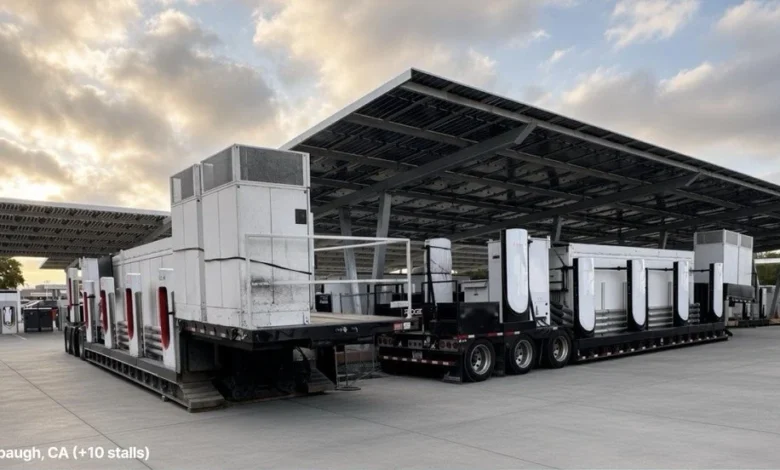
The deployment focuses heavily on California’s Central Valley, a primary geographic conduit for motorists traveling between Los Angeles and the San Francisco Bay Area. Among the designated sites is Firebaugh, California, which received the largest single temporary boost with two flatbed trailers loaded with Supercharger posts and tall power cabinets, cleverly parked beneath the station’s existing solar canopy. Additional mobile hardware was established at two Bakersfield locations: the Olive Drive station, which received eight temporary stalls, and the Copus Road station, which added four stalls directly onto the pavement.
Outside of California, Tesla identified Holbrook, Arizona, as a vital regional outlier. Situated along Interstate 40, Holbrook serves as a critical desert corridor connecting Southern California to Albuquerque, New Mexico. Because alternative fast-charging options are sparse in this remote stretch, the addition of seven temporary stalls provides an essential safety net for motorists navigating long distances through challenging terrain.
While Tesla has utilized trailer-mounted battery energy storage systems, such as Megapacks, for previous holiday interventions, the company has experienced varying operational hurdles with temporary off-grid setups. Notably, a mobile Supercharger Megapack unit caught fire at a station in Baker, California, on New Year’s Day in 2023, underscoring the technical complexities of deploying rapid, high-capacity temporary energy solutions. The latest installations demonstrate a refined approach to temporary surge capacity, combining trailer-based units and direct pavement deployments to ensure grid stability and rapid energy delivery.
Accelerating Permanent Infrastructure Growth
While temporary mobile units provide crucial localized relief, industry analysts emphasize that long-term network expansion remains the definitive metric for addressing EV charging demand. Recent operational data highlights a significant acceleration in Tesla’s permanent station deployment rate ahead of the holiday season.

According to company figures, Tesla opened 1,027 permanent Supercharger stalls across 91 United States sites within a 56-day window leading up to the holiday rush. This equates to an average deployment rate of roughly 18 new stalls per day, with individual sites averaging more than 11 stalls each. This pace represents a notable acceleration compared to earlier in the year. Industry tracking data from entities like Paren indicated that Tesla added approximately 1,287 fast-charging ports in the United States during the third quarter, averaging about 14 ports per day. The recent pre-holiday surge demonstrates an approximate 30% increase in deployment velocity, outpacing other domestic charging network developers such as IONNA and Walmart during comparable periods.
This rapid buildout follows a turbulent organizational period for the company. Following strategic restructuring decisions that temporarily impacted the dedicated charging development division, industry stakeholders closely monitored whether infrastructure growth would stall. The recent acceleration suggests that deployment velocity has recovered, reinforcing Tesla’s position as the leading operator of high-speed charging infrastructure in North America.
Operational Enhancements: Attendants, Virtual Queues, and Uptime
Beyond physical hardware expansion, Tesla has implemented a comprehensive suite of operational protocols designed to streamline the charging experience during peak travel days. These measures encompass on-site personnel, software-driven queue management, and enhanced network maintenance.
To manage congestion at high-volume stations, Tesla has stationed on-site attendants at its busiest locations. These personnel assist with queue organization, direct motorists to available stalls, and ensure efficient vehicle turnover, minimizing friction during peak hours.

Concurrently, the company has expanded the deployment of its virtual queue pilot program. Initially launched as a limited pilot at just five Supercharger locations in May, following heightened public discussion regarding station etiquette and lines, the virtual waitlist system has now been scaled to approximately 300 sites nationwide. The feature allows drivers to secure their place in line digitally without blocking physical access lanes, transforming the management of high-demand charging hubs.
Network reliability has also been a focal point. Tesla reports heightened service dispatch readiness and improved uptime monitoring throughout the travel window. Maintaining high equipment availability is paramount during holiday periods, as a single out-of-service stall at a high-traffic location can disproportionately compound wait times for travelers.
Historical Context and Evolution of Holiday EV Travel
The current landscape of holiday EV travel stands in stark contrast to conditions experienced by early adopters a decade ago. During the formative years of mass-market electric mobility, long-distance holiday travel frequently involved significant uncertainty.
By 2018 and 2019, as the adoption of Model 3 and subsequent high-volume vehicles accelerated, major travel corridors such as the Interstate 5 corridor in California routinely experienced multi-hour queues at Supercharger stations. In response, Tesla began experimenting with various mitigation strategies. In November 2021, the company introduced financial incentives, offering free off-peak Supercharging at specific Central Valley locations during Thanksgiving week to encourage motorists to travel during non-traditional hours.

Over subsequent years, the network operator evolved its strategy from passive incentives to active congestion management. The integration of advanced analytics allows Tesla to pinpoint precise geographical pain points well in advance of holiday migrations, deploying targeted assets precisely where historical data predicts the highest volume of traffic.
Broader Industry Implications and Future Outlook
The rapid scaling of EV infrastructure ahead of high-demand travel periods carries significant implications for the broader automotive and energy sectors. As vehicle adoption continues to rise, the burden on national electrical grids and charging networks will intensify, requiring continuous capital investment and engineering innovation.
Tesla’s ability to rapidly deploy over a thousand permanent stalls in under two months highlights the structural advantage of a vertically integrated charging network. However, maintaining this pace requires navigating complex permitting processes, utility interconnection agreements, and supply chain logistics. Analysts note that as other major charging networks expand under federal initiatives like the National Electric Vehicle Infrastructure (NEVI) formula program, the entire industry is moving toward standardized reliability and capacity benchmarks.
Furthermore, the integration of virtual queue management systems and on-site attendants points to a maturing service model. As electric vehicles transition from early-adopter status to mainstream consumer adoption, the charging experience is increasingly expected to mirror the convenience and reliability of traditional fueling infrastructure.

Data from previous holiday cycles underscores the massive volume handled by modern fast-charging networks. During the Thanksgiving travel window in 2025, Tesla’s United States network recorded more than 2 million charging sessions, delivering over 70 gigawatt-hours (GWh) of energy. Notably, despite the immense volume, the vast majority of sessions experienced minimal friction, with only a fraction of a percent involving reported wait times.
As the automotive market moves forward, the success of infrastructure management during peak holiday windows will continue to serve as a vital benchmark for consumer confidence in electric mobility. Through a combination of rapid permanent station construction, targeted temporary mobile deployments, and software-driven queue solutions, network operators are demonstrating an enhanced capacity to absorb unprecedented travel demand without compromising network integrity.
Related posts: