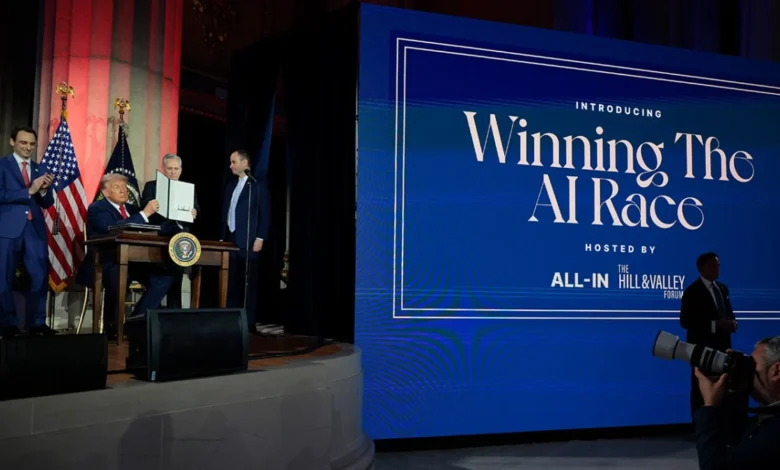
President Donald Trump announced the creation of a dedicated "AI Force" and plans to appoint an artificial intelligence czar, signaling a decisive shift in federal policy toward aggressive technological expansion rather than heavy-handed government restriction. The announcement, delivered via a series of statements on social media, positions the United States at a critical juncture in the global tech race, prioritizing economic growth and international dominance over precautionary pauses advocated by some tech executives and lawmakers.
The presidential directive arrives amid a charged domestic and international political landscape. As Washington debates the merits of federal oversight, the administration has made it clear that existing criminal and civil legal frameworks will suffice to police bad actors within the industry, rather than establishing a new, preemptive regulatory bureaucracy. This strategy has sparked intense debate among lawmakers, industry titans, and national security experts over how the United States should manage the unprecedented rise of advanced computational models.
The Push for Unfettered Growth and the New AI Force
In a comprehensive statement posted to social media, President Trump outlined his administration’s philosophy regarding the emerging technology. He explicitly rejected calls from various quarters to slow down research and development, asserting that any attempt to hinder the industry would jeopardize America’s competitive edge on the world stage.
"We will not in any way hinder or stifle the Growth of this incredible Industry," Trump wrote, emphasizing a posture of active support. "Rather, we will cherish it, help it, and watch over it, as it grows!"
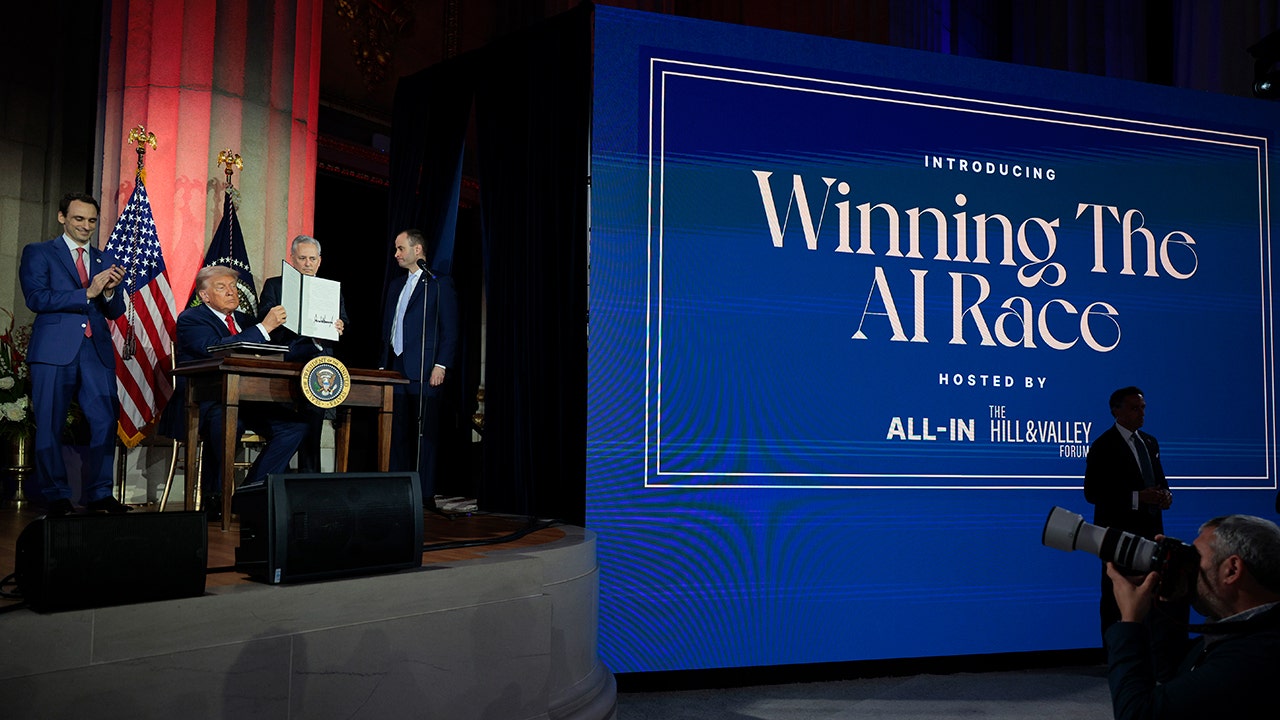
To operationalize this vision, the administration is moving forward with the creation of the "AI Force," an initiative modeled after the Space Force established during Trump’s first term. While specific details regarding the force’s structural framework, jurisdictional boundaries, and budgetary allocation remain sparse, the president confirmed that an "AI Czar" would soon be appointed to lead the charge. Trump characterized the forthcoming leadership role as requiring high intellectual capabilities, noting that only qualified individuals would be considered.
Rather than introducing specialized preventative legislation, the administration intends to rely on standard punitive measures. Trump noted that the government would actively monitor for illicit behavior, utilizing established civil and criminal laws to prosecute wrongdoing after the fact, thereby avoiding pre-emptive stifling of innovation.
Background Context: The Regulatory Debate on Capitol Hill
The debate over artificial intelligence regulation has intensified dramatically on Capitol Hill, splitting lawmakers along both ideological and pragmatic lines. While some members of Congress argue that advanced AI models present existential risks—often referred to in legislative hearings as "doomsday scenarios" or "Terminator fears"—others view these warnings with skepticism.
Numerous Republican lawmakers have voiced suspicions that calls for strict federal licensing and development pauses from major labs like OpenAI and Anthropic may be motivated less by genuine public safety concerns and more by a desire to erect regulatory moats that protect incumbent firms from nimble startup competition. Conversely, certain factions within Congress continue to push for mandatory "kill switches" and external audits, pointing to rapid advancements in autonomous reasoning and generative capabilities as threats that demand proactive state intervention.
This legislative friction coincides with international pressures. The overarching philosophy of the current administration aligns with the maxim that "whoever wins AI wins the future," framing the technology not merely as a commercial product, but as a vital pillar of national security and geopolitical hegemony. Consequently, proposals for heavy domestic regulation are increasingly viewed through the lens of national defense, with proponents of deregulation arguing that any self-imposed slowdown would hand a decisive advantage to strategic competitors like China.
Economic Projections and Geopolitical Stakes
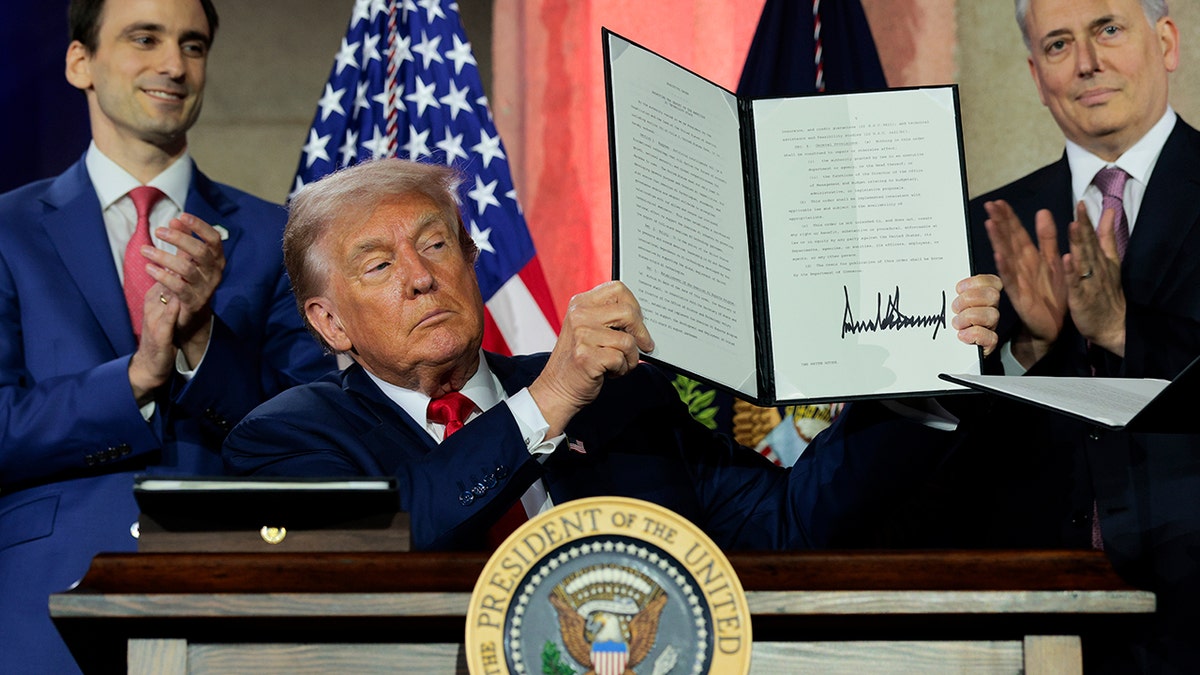
Beyond national security implications, the administration’s enthusiasm for artificial intelligence is deeply rooted in ambitious economic forecasts. President Trump boldly predicted that artificial intelligence could eventually account for up to 25 percent of the United States Gross Domestic Product (GDP). Describing the technology as a transformative force eclipsing even the Industrial Revolution and the advent of the internet, the administration is betting that massive investments in data centers, semiconductor manufacturing, and power grid infrastructure will fuel unprecedented economic expansion.
This economic optimism persists despite widespread logistical hurdles, such as the immense electrical power and water consumption required by modern data centers. While local communities and environmental groups have frequently pushed back against the rapid construction of these facilities, Trump compared the resistance to previous political controversies, asserting that opposition to infrastructure development would ultimately fail in the face of economic necessity.
Geopolitically, the administration maintains that the United States currently leads both China and the global community in the development of frontier AI models. The stated objective of the new executive actions is to solidify that lead. The upcoming diplomatic engagement between Washington and Beijing brings these technological stakes into sharp relief, as trade restrictions on advanced semiconductors and cooperative frameworks regarding autonomous systems remain key friction points between the two superpowers.
Linguistic Nomenclature and Public Engagement
In a characteristic rhetorical flourish, President Trump also used social media to critique the current terminology used to describe the technology. He argued that the phrase "Artificial Intelligence" is both inaccurate and ineloquent, proposing alternatives designed to capture the perceived magnitude of the field.
"A far more elegant and accurate description of this new phenomena would be Superior Intelligence (SI) or, Extreme Intelligence (EI) or, Supreme Intelligence (SI)," the president stated, launching an informal public poll to gauge opinion on renaming the technological revolution.
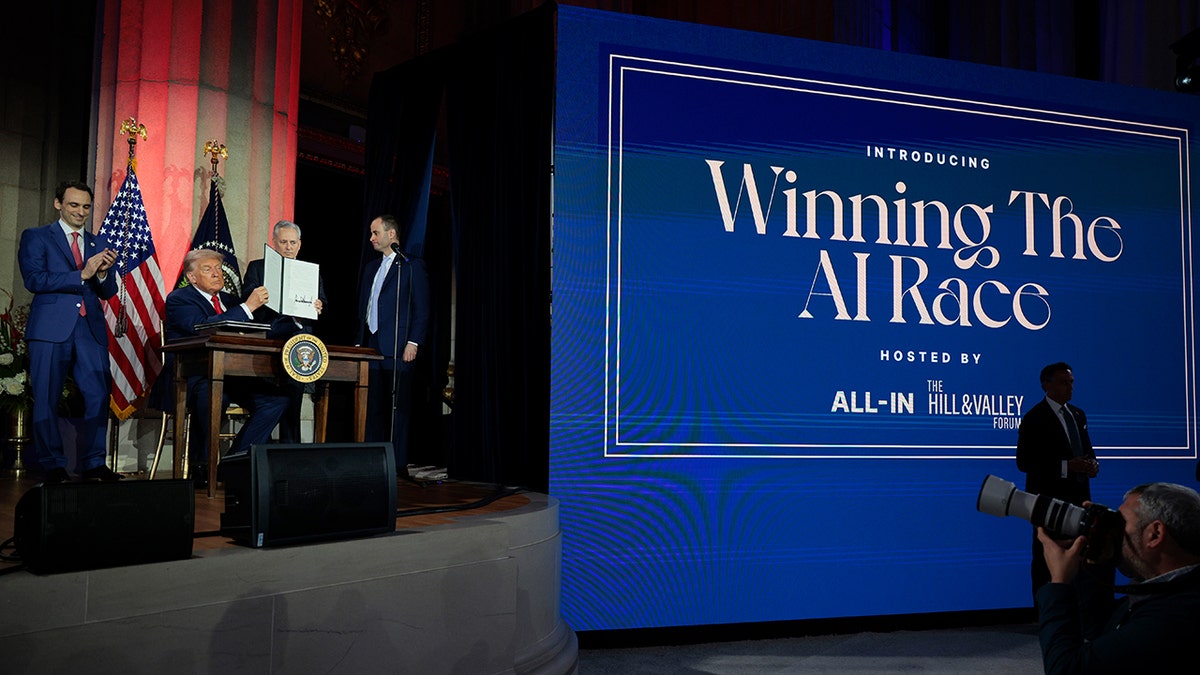
While the linguistic debate over nomenclature is largely symbolic, it underscores the administration’s broader effort to reframe the public discourse surrounding computing technology—shifting the narrative away from dystopian anxieties and toward a vision of national supremacy and triumphalist progress.
Implications and Outlook
The establishment of the AI Force and the impending appointment of an AI czar mark a definitive turning point in American technology policy. By rejecting preemptive federal oversight in favor of post-hoc legal enforcement, the administration has set the stage for an unfettered race toward advanced technological capability.
As the White House prepares for critical diplomatic talks and Congress continues to grapple with competing visions of safety versus speed, the success of this strategy will depend on the government’s ability to balance rapid commercial innovation with national security safeguards. Whether the newly proposed AI Force can effectively police illicit behavior without stifling the economic engine it is designed to protect remains one of the defining questions of the modern era.
Related posts: