The Hidden Danger on the Dinner Plate: Understanding the Rising Prevalence of Alpha-gal Syndrome

What began as a routine breakfast for Sandra Tiguila in August 2025 quickly spiraled into a harrowing medical mystery that highlights a growing public health concern in the United States. Tiguila, a resident of Carbondale, Illinois, experienced a severe allergic reaction after consuming a bison sausage sandwich, a meal that served as the catalyst for an arduous journey through the medical system. Her experience, characterized by a persistent, burning rash and eventual anaphylactic symptoms, has brought renewed attention to Alpha-gal syndrome (AGS), a rare but increasingly documented condition triggered by the bite of the lone star tick.
A Chronology of a Medical Crisis
The sequence of events leading to Tiguila’s diagnosis began months before her symptoms manifested. In June 2025, Tiguila reported being bitten by ticks twice while spending time outdoors in Southern Illinois. At the time, these encounters appeared to be nothing more than a minor nuisance, a common occurrence for residents in regions where tick populations are dense.
It was not until two months later, in August, that the physiological consequences of those bites became apparent. After enjoying a bison sausage breakfast sandwich, Tiguila noticed a rash developing on her wrist during her drive home. What initially seemed like a localized skin irritation rapidly escalated. Within hours, a debilitating burning sensation spread across her arms and legs, rendering sleep nearly impossible. Despite her immediate efforts to mitigate the symptoms through a regimen of over-the-counter creams, oral antihistamines, and professional medical injections, the condition proved resistant to standard treatments.
The situation reached a breaking point ten days later. During a subsequent meal out, Tiguila ordered a steak. Shortly after consumption, she experienced acute facial swelling—a hallmark symptom of a severe systemic allergic reaction. Her partner immediately transported her to the emergency department. It was there, through a detailed clinical evaluation, that physicians began to connect the dots. By analyzing her history of tick bites from the previous June and comparing them against her recent reactions to red meat, doctors identified the likely culprit: Alpha-gal syndrome.
Understanding Alpha-gal Syndrome: The Science of the Bite
Alpha-gal syndrome is a unique type of food allergy that is distinct from traditional food allergies, which typically involve an immediate reaction to proteins. Instead, AGS is triggered by a sugar molecule known as galactose-alpha-1,3-galactose, or "alpha-gal." This carbohydrate is found in the tissues of most mammals, including cows, pigs, sheep, and deer, but it is not naturally present in humans.
When a lone star tick (Amblyomma americanum) bites a human, it can introduce these alpha-gal molecules into the person’s bloodstream. The human immune system, identifying the molecule as a foreign invader, produces specific antibodies—immunoglobulin E (IgE)—to fight it. Once sensitized, the individual’s immune system remains on high alert. When the person subsequently consumes red meat or other products containing alpha-gal, the immune system launches a massive inflammatory response.
Unlike other allergies that trigger symptoms within minutes, Alpha-gal reactions are often delayed. Patients frequently report that symptoms—which can range from hives and digestive distress to full-blown anaphylaxis—do not appear until three to six hours after eating, making the causal link between the meal and the reaction difficult for both patients and clinicians to identify initially.
Data and Prevalence: A Growing Public Health Threat
The Centers for Disease Control and Prevention (CDC) has increasingly classified Alpha-gal syndrome as an emerging public health concern. While precise national incidence rates remain difficult to calculate due to underreporting and misdiagnosis, recent studies suggest that the number of cases is rising in tandem with the geographic expansion of the lone star tick.
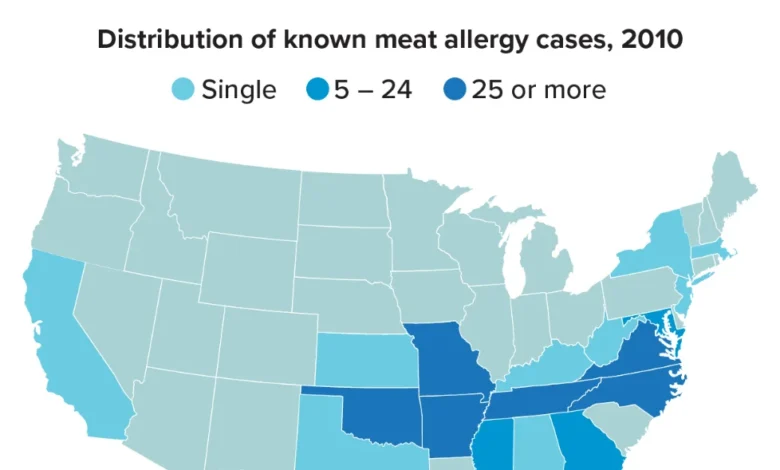
Historically, the lone star tick was primarily concentrated in the Southeastern and Eastern United States. However, changing climate patterns, including milder winters and longer growing seasons, have facilitated the northward and westward migration of the species. Today, populations are firmly established in the Midwest, including Illinois, and as far north as New England.
A 2023 report published by the CDC estimated that as many as 450,000 Americans may have been affected by Alpha-gal syndrome. Furthermore, medical researchers have noted that many primary care physicians remain unfamiliar with the condition, leading to lengthy diagnostic delays. On average, patients often visit multiple specialists—ranging from dermatologists to gastroenterologists—before receiving a correct diagnosis, during which time they continue to unknowingly expose themselves to the allergen.
Clinical Challenges and Diagnostic Hurdles
The case of Sandra Tiguila underscores the diagnostic challenges inherent in managing Alpha-gal syndrome. Because the symptoms are diverse—ranging from skin rashes and joint pain to severe gastrointestinal distress—patients are frequently misdiagnosed with chronic idiopathic urticaria (hives) or irritable bowel syndrome.
"The delay in symptom onset is the primary obstacle to early detection," notes Dr. Marcus Thorne, an immunologist not involved in Tiguila’s case but familiar with the syndrome’s protocols. "When a patient presents with a severe allergic reaction hours after dinner, they rarely associate it with the meal they consumed earlier in the evening. They are looking for something they ate five minutes ago, not five hours ago."
Diagnostic testing involves a specific blood test to measure the level of alpha-gal-specific IgE antibodies. However, clinicians often have to suspect the condition first to order the test. For patients living in endemic areas, public health officials recommend that any unexplained, recurring allergic reaction be evaluated specifically for tick-borne triggers.
Broader Implications and Preventive Strategies
The implications of the rising prevalence of Alpha-gal syndrome extend beyond the individual. There are significant lifestyle adjustments required for those diagnosed, including the necessity of adhering to a strict diet that eliminates not only red meat but often dairy products and certain medications that may contain mammalian byproducts, such as gelatin or heparin.
For the general public, the primary strategy remains prevention. Avoiding tick bites is the only way to prevent the development of the syndrome. Health experts recommend the following precautions:
- Use EPA-registered repellents: Products containing DEET, picaridin, or IR3535 are effective against ticks.
- Wear protective clothing: Long sleeves and pants tucked into socks can create a barrier against tick attachment.
- Perform thorough tick checks: After spending time in wooded or grassy areas, individuals should inspect their bodies, paying particular attention to the scalp, underarms, and groin area.
- Manage landscapes: Keeping lawns mowed and removing leaf litter can reduce the hospitable environment for tick populations.
Future Research and Public Awareness
The medical community is currently focusing on long-term management and the potential for recovery. While some patients report that their sensitivity to alpha-gal decreases over time—provided they avoid further tick bites—the timeline for this recovery is highly variable and not guaranteed.
Public health campaigns are now being scaled up to educate not only the public but also healthcare providers. The objective is to standardize screening protocols so that patients like Tiguila, who present with symptoms in an emergency room, are flagged for tick-borne sensitivities as part of their initial triage.
As the lone star tick continues to move into new territories, the intersection of entomology and immunology will become increasingly critical. The story of Tiguila’s encounter with Alpha-gal syndrome serves as a stark reminder of the complex relationship between human activity, changing ecosystems, and the emergence of novel food-related health risks. For those living in areas where these ticks are prevalent, vigilance is no longer just a recommendation—it is a necessity for maintaining long-term health and safety in an environment that is rapidly changing.
Related posts: