NYU Langone Privately Bought the Site of a Landmark AMC Theater — New Yorkers Are Now Fighting to Save It

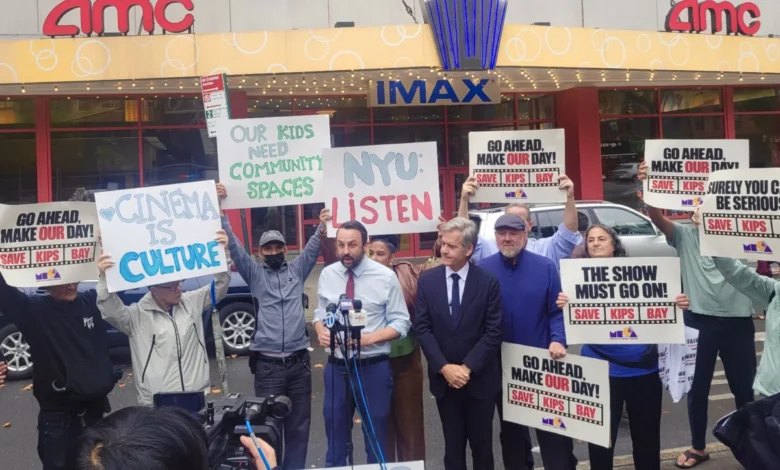
On a rainy Sunday afternoon, the sidewalk outside the AMC Kips Bay 15 was transformed from a routine thoroughfare into a staging ground for civic advocacy. More than 100 residents, local activists, and elected officials gathered under umbrellas to protest the scheduled closure of the Kips Bay multiplex, a cultural anchor for the neighborhood that is slated to shut its doors permanently at the end of this year. Manhattan Borough President Brad Hoylman-Sigal led the demonstration, delivering a poignant, if theatrical, recitation of the Nicole Kidman-led AMC advertising campaign—a nod to the “magic” of the big screen that the community now fears will vanish from their daily lives.
The protest, organized by the Eleanor Roosevelt Independent Democrats, serves as the most visible manifestation of a localized crisis: the tension between the unchecked expansion of medical and educational institutions and the maintenance of essential community spaces. As the Kips Bay theater prepares to shutter, the event has prompted a wider discussion regarding urban planning, corporate transparency, and the shrinking footprint of public entertainment venues in New York City.
A Chronology of the Acquisition
The fate of the Kips Bay 15 was effectively sealed over a year ago, though the surrounding community remained largely unaware of the transaction until recently. Records indicate that the site, which houses the second-largest AMC multiplex in Manhattan, was acquired in a private sale by NYU Langone Health.
The timeline of this transition highlights a significant communication gap between the medical institution and the community it occupies. While the sale was finalized months ago, local representatives, including New York State Senator Kristen Gonzalez, have stated that they were not informed of the deal until after the legal transfer of property was complete. This lack of transparency has fueled the current wave of public outcry, as residents argue that the conversion of a public-facing cultural hub into private medical facilities should require a more rigorous public vetting process.
The Economic and Cultural Stakes
The closure of the Kips Bay theater is particularly jarring given the current health of the film industry. The theater industry recently celebrated a record-breaking summer at the box office, proving that, contrary to post-pandemic skepticism, there remains a robust appetite for the collective, in-theater experience. By removing one of the most accessible venues in the neighborhood, stakeholders argue that the city is actively undermining the cultural vitality that makes New York a global hub for the arts.
From an economic perspective, the loss extends beyond the theater itself. Local businesses have already begun to feel the chilling effect of the impending closure. Paddy Reilly’s Music Bar, a 40-year-old local institution located just around the corner, has become a vocal ally in the "Save the Kips Bay AMC" campaign. Desi Murray, the proprietor of the pub, noted that the theater acts as a reliable anchor for foot traffic. For businesses in the immediate vicinity, the theater is not merely a venue for films; it is a primary driver of the evening economy. By encouraging patrons to share photos from the rally in exchange for a drink, Paddy Reilly’s has bridged the gap between the neighborhood’s historic nightlife and its modern recreational needs.
Institutional Responses and Community Frustration
The frustration expressed by the local community is rooted in a perceived pattern of encroachment. Judith Gross, president of the Eleanor Roosevelt Independent Democrats, emphasized that the neighborhood is rapidly becoming a de facto campus for NYU Langone, often at the expense of residential infrastructure and public amenities.
"This neighborhood is not a campus for NYU and its medical offices," Gross stated during the rally. Her sentiment reflects a broader anxiety among Manhattan residents who feel that the city’s zoning and development policies prioritize large institutions over the day-to-day requirements of long-term inhabitants.
When reached for comment on the lack of communication, representatives for the local political coalition noted that they have attempted to open a dialogue with both AMC Theatres and NYU Langone. However, the responses—or lack thereof—have been insufficient to halt the transition. The core of the complaint is not necessarily a prohibition against development, but a demand for "proactive engagement." Senator Gonzalez noted that while NYU is a vital neighbor and partner in many capacities, the unilateral nature of this acquisition undermines the social contract between the institution and the surrounding Kips Bay community.
Broader Implications: The "Hollywood" Parallels
The struggle in Kips Bay is increasingly being viewed through the lens of a much larger trend of consolidation and centralization. The controversy mirrors the ongoing industry-wide debates regarding the proposed Paramount-Warner Bros. merger. In that instance, prominent Hollywood voices have argued that the consolidation of major studios will inevitably diminish the diversity of content and the opportunities available to independent creatives.
The parallels, while seemingly disparate, are being drawn by local officials to highlight a systemic issue. Whether it is the closing of a local cinema or the corporate consolidation of film distribution, the result is the same: fewer choices for the consumer and the erosion of the local cultural ecosystem.
"We’re getting a big new partner coming in, potentially kicking this out, limiting options to see the movies in our neighborhood," Senator Gonzalez observed. "And all we’re asking for, whether it’s in Hollywood or right here in New York, is for everyday people to be included and have our voices heard."
The Future of Community Space
As 2026 draws to a close, the Kips Bay AMC remains in a state of limbo. While the physical structure is slated for transition, the political pressure continues to mount. The rally demonstrated that Gen-Z residents and long-term patrons—some of whom have frequented the site since the 1970s—are finding common ground in their defense of the theater.
For many, the theater is more than just a place to watch movies; it is an essential piece of urban architecture that fosters social interaction. As residents like "Cesar," a long-time local, noted while at the nearby pub, the presence of a theater in that specific location has been a constant in the neighborhood’s history for decades. The potential loss of this space raises fundamental questions about what constitutes a "community."
If institutions like NYU Langone continue to prioritize private expansion without addressing the loss of public amenities, the social fabric of neighborhoods like Kips Bay may be permanently altered. The protest was not merely about a cinema; it was a demand for accountability. As the activists look toward the end-of-year deadline, the question remains whether the combined pressure of local businesses, elected officials, and a dedicated constituency will be enough to force a reconsideration of the site’s future. For now, the theater stays open, but the clock is ticking on a landmark that has served as a center for neighborhood "magic" for generations.
The incident underscores a crucial reality for modern urban centers: growth, while necessary, must be balanced against the preservation of the spaces that provide character and connectivity to the public. Without such a balance, the city risks replacing the very community features that attract residents and visitors alike with sterile, private infrastructure. The Kips Bay situation stands as a case study for future developments in Manhattan and beyond.