MTV Video Music Awards Achieve Historic Decade-High Ratings in Massive Sunday Night Broadcast

The MTV Video Music Awards achieved a landmark cultural milestone this past Sunday, securing its highest viewership numbers in over a decade. According to preliminary Nielsen data, the ceremony averaged 8.43 million viewers across its simulcast on CBS and MTV, marking a significant 51 percent increase over the 2025 broadcast. This surge in popularity signals a robust revitalization for the long-running awards show, which has been aggressively pivoting to capitalize on multi-platform engagement and strategic network scheduling.
The 2026 telecast, which featured a high-octane opening and a star-studded roster of honorees, outperformed the 2025 show—itself a multi-year high at 5.6 million viewers—by a substantial margin. To find a comparable audience reach, one must look back to 2015, when the VMAs drew more than 12 million viewers across an expansive network footprint. While the current figures remain subject to final adjustments as Nielsen incorporates out-of-home and streaming data, the immediate metrics solidify the 2026 VMAs as the most significant event in the franchise’s recent history.
A Demographic Resurgence
The success of the evening was not limited to aggregate numbers; the VMAs demonstrated a profound ability to capture key demographic cohorts that are increasingly difficult to retain in the era of fragmented digital media. Among adults aged 18-49, the show drew 2.66 million viewers, marking its strongest performance in that critical advertising demographic since 2018.
The reach extended into older and younger brackets as well: adults aged 25-54 accounted for 3.11 million viewers, the highest total since 2019, while the 18-34 demographic brought in 1.09 million viewers, representing the best turnout for the awards in that age group since 2020. This broad-based appeal suggests that the production’s mix of legacy stars and contemporary chart-toppers successfully bridged the gap between different generations of music fans.
The NFL Lead-In Strategy
A pivotal factor in the evening’s success was the aggressive programming strategy employed by CBS, which utilized a high-profile NFL matchup as a lead-in for the awards ceremony. The game between the Baltimore Ravens and the Dallas Cowboys—two of the league’s most consistent television draws—delivered a massive audience directly into the VMA broadcast.
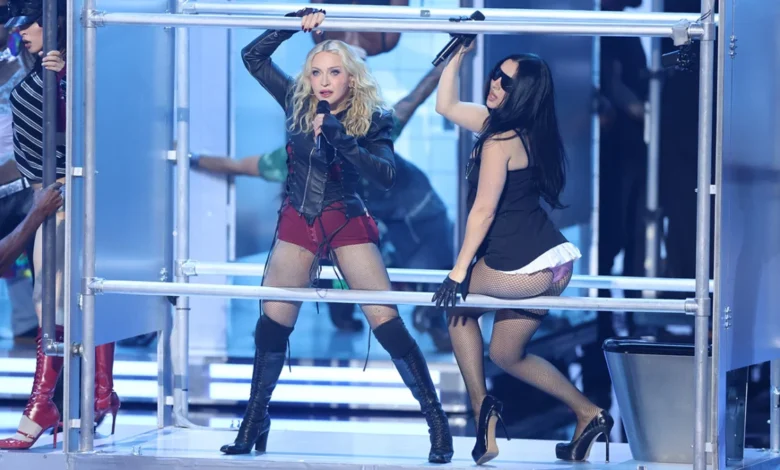
The effect was immediate and measurable: the VMAs reached a peak of 15 million viewers during the opening performance, which featured a collaboration between music icon Madonna, Charli XCX, and Sabrina Carpenter. This peak occurred moments after the conclusion of the NFL game, confirming that the sports-to-entertainment pipeline remains one of the most effective strategies for network television. While the 2025 VMA broadcast also benefited from a strong NFL lead-in, which garnered 23.9 million viewers, industry analysts anticipate that the final tally for the Ravens-Cowboys game may ultimately exceed that of the previous year, further bolstering the VMA’s performance.
Breakdown of Viewership Distribution
The logistical distribution of the audience highlighted the dominance of the CBS network in reaching a mass market. Of the 8.43 million total viewers, CBS accounted for 7.61 million, or roughly 90 percent of the total audience. The simulcast on MTV contributed 686,000 viewers, while a scheduled encore presentation added another 142,000 to the total count. This heavy skew toward the CBS broadcast underscores the continued power of linear network television when paired with premium live events, even as MTV remains the spiritual home and brand-driver for the ceremony.
Highlights and Honorees
The 2026 ceremony was defined by both contemporary recognition and career-spanning tributes. Madonna dominated the trophy count, walking away with seven awards, a testament to her enduring influence and the success of her latest creative endeavors. Taylor Swift, a perennial force in the music industry, secured the award for Video of the Year for her work on "The Fate of Ophelia." Furthermore, Swift was the inaugural recipient of the Artist Director award, a new category established to recognize musical artists who exert significant creative control over their own music videos.
The production also prioritized historical resonance. Tributes were held in honor of Dolly Parton and George Michael, acknowledging their profound contributions to the industry. Additionally, the legendary rock band Nirvana was bestowed with the Video Vanguard honor, an award that acknowledges a career of groundbreaking visual work. The show was hosted by Snoop Dogg, whose presence provided a sense of continuity and prestige to the proceedings.
Digital Integration and Social Media Impact
In an era where linear ratings are only one piece of the puzzle, the VMAs also saw a measurable uptick in social media engagement. The awards generated 159 million video views across various digital platforms, an 8 percent increase over the previous year. This metric is increasingly vital for the VMAs, as the show’s brand relies heavily on the "viral moment"—the clips and segments that are shared, critiqued, and meme-ified in the hours and days following the broadcast. By focusing on high-energy performances that are designed for social sharing, MTV has successfully aligned its broadcast goals with the behavior of its core younger audience.
Implications for Future Awards Programming
The 2026 VMAs offer a compelling case study for the future of awards-based television. As major networks struggle to maintain relevance in a landscape dominated by on-demand streaming services, the VMA’s reliance on live spectacle and strategic integration with live sports provides a blueprint for survival.
The data suggests that audiences are still willing to tune in to live events if the content is curated to provide a sense of "event television" that cannot be replicated through delayed viewing. By leveraging the massive, captive audience of the NFL, CBS and MTV have managed to overcome the general downward trend in awards show viewership that has plagued the Emmys, the Grammys, and the Oscars over the past several years.
However, the challenge for future iterations will be maintaining this momentum without relying exclusively on the strength of a sports lead-in. While the 2026 success is undeniably positive, the industry will be watching to see if the VMAs can continue to drive engagement through their own creative output and brand identity.
Broader Cultural Context
The 2026 VMAs arrive at a time when the music industry is undergoing a significant transition. The emergence of the Artist Director award, for instance, reflects the growing trend of musicians acting as their own creative architects. By shifting focus toward the artist’s vision rather than just the commercial success of the track, the VMA organizers are aligning themselves with the current zeitgeist of creative independence.
Furthermore, the inclusion of tributes to icons like Dolly Parton and George Michael demonstrates a concerted effort to broaden the show’s appeal to older demographics, ensuring that the broadcast is seen as a celebration of music history rather than just a showcase for the latest TikTok trends. This balance between legacy and innovation appears to have struck a chord with the public.
As the industry prepares for the 2027 awards cycle, the success of the 2026 show will likely serve as the new benchmark. Network executives will be under pressure to replicate this model, focusing on high-production-value performances, strategic scheduling, and a mix of honors that satisfy both the critical establishment and the massive, digitally native fanbase that powers the show’s social media reach. For now, the MTV Video Music Awards have proven that they are not just a relic of the past, but a functioning, relevant, and highly potent engine for mass-market entertainment.