Living with the Ferrari Purosangue: A Study in V12 Grand Touring Luxury and Human-Machine Interface Evolution

The Ferrari Purosangue represents a singular moment in the history of the Maranello-based manufacturer, marking its official entry into the high-performance utility vehicle segment while simultaneously challenging the ergonomic conventions that have defined the brand for decades. Priced at a base MSRP of $393,350—though quickly escalating with customization—the vehicle serves as a bridge between the traditional, high-revving internal combustion legacy of Ferrari and the pragmatic demands of modern, multi-passenger touring.
The Evolution of the Ferrari Cabin Experience
At the heart of the Purosangue’s interior design is a departure from the contentious capacitive touch controls seen in earlier models like the 296 GTB. Unlike the 296, which drew criticism for its reliance on near-unusable touch-sensitive surfaces, the Purosangue utilizes tactile, physical buttons on the multifunction steering wheel. This design choice is significant, as it acknowledges the necessity of "eyes-on-the-road" operation for critical vehicle functions.
When the driver engages with Apple CarPlay, the interface integrates directly into the primary digital instrument cluster. This placement replaces the traditional, central tachometer-focused layout with a more functional, information-rich display. While this shift facilitates safer navigation and media control while in motion, the cabin’s complexity remains high. Climate control, seating adjustments, and massage functions are managed through a unique, motorized rotating controller that emerges from the dashboard. While elegant in execution, the interface requires the user to interact with small, high-density touchscreen targets. For a driver navigating a winding road, these small inputs present a measurable ergonomic hurdle compared to static physical switches. A secondary, identical controller is positioned between the rear seats, ensuring that passengers possess the same level of granular control over their environment, though the learning curve for these digital menus remains steep.
Design Philosophy and Aesthetic Customization
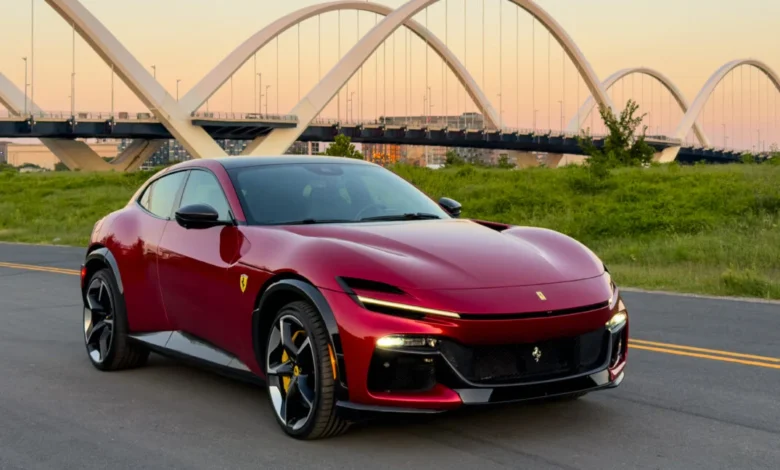
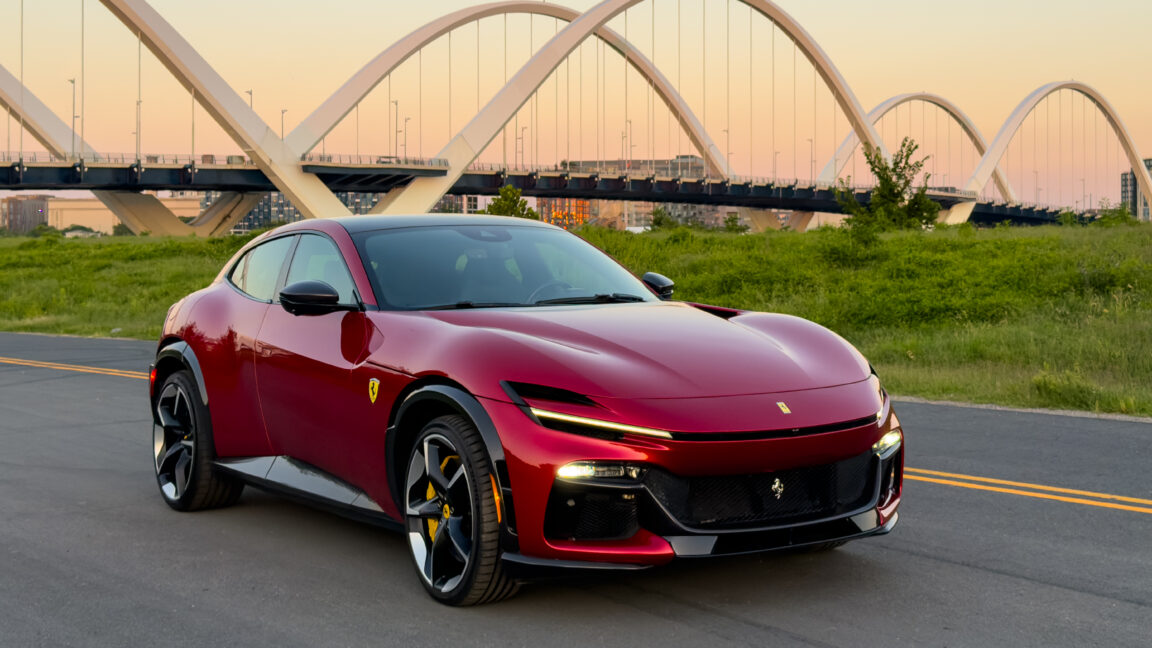
The vehicle evaluated for this report, finished in the striking "Rosso Portofino," demonstrated the brand’s mastery of exterior presentation. In the harsh glare of August sunlight, the paint finish underscored the sculptural lines of the chassis, offering a more aggressive and visually cohesive aesthetic than the muted yellow-green metallic variants seen in earlier test cycles in Rome.
The Purosangue is not merely a vehicle but a canvas for the "Atelier" and "Tailor Made" customization programs. Ferrari’s business model has shifted significantly toward hyper-personalization, allowing the base price of roughly $393,000 to balloon to $576,544 in this specific configuration. This pricing strategy places the Purosangue in a rarefied echelon, significantly above the competitive price points of the Aston Martin DBX and the Lamborghini Urus SE. While the Urus and DBX are established players in the high-performance SUV market, the Purosangue relies on its naturally aspirated V12 engine and its status as a Ferrari-badged "four-door" to justify its premium.
Performance Data and Daily Usability
The Purosangue is powered by an engine that remains the brand’s crowning achievement: a naturally aspirated 6.5-liter V12. Unlike its competitors, which have largely transitioned to turbocharged or hybrid-assisted powertrains to meet emissions and performance targets, the Purosangue remains a bastion of traditional engine architecture.
However, this performance comes with a notable impact on fuel economy. Rated at 12 mpg combined (19.6 L/100 km), the vehicle is intended for a specific demographic of enthusiast drivers rather than those seeking daily commuter efficiency. For the latter, the impending launch of the battery-electric "Luce" indicates that Ferrari is bifurcating its lineup to cater to both the traditionalist V12 enthusiast and the modern, eco-conscious luxury buyer. Despite the low fuel efficiency, the Purosangue’s chassis dynamics, supported by sophisticated suspension technology, suggest that it is arguably the most versatile vehicle ever produced in Maranello. With appropriate winter tires, the all-wheel-drive capability transforms the Purosangue into a year-round grand tourer, capable of handling alpine conditions that would leave a standard mid-engine Ferrari confined to a climate-controlled garage.
Passenger Experience and Infotainment Architecture
A distinctive aspect of the Purosangue interior is the absence of a traditional central infotainment display. Instead, Ferrari has opted for a dedicated screen for the front-seat passenger, which is heavily polarized to prevent the driver from being distracted by the content displayed. This separation of user experiences ensures that the passenger can interact with native media applications without interfering with the driver’s instrument cluster.
One limitation of this design is the lack of CarPlay projection on the passenger screen. While this maintains a clean, driver-centric interface, it limits the collaborative utility that modern passengers have come to expect. Furthermore, the rear seats of the Purosangue are not an afterthought; they offer a level of lateral support and comfort comparable to the front seats, a necessary design choice given the high levels of lateral G-force the vehicle can generate through corners.
Industry Context and Strategic Implications
The introduction of the Purosangue follows a long, deliberate period of speculation regarding whether Ferrari would ever produce an SUV. For years, former management and the founder’s ethos suggested that Ferrari would remain a producer of two-door sports cars. However, the changing market dynamics of the early 2020s necessitated a pivot.
The timeline of the Purosangue’s development reflects a broader industry trend where legacy luxury brands must balance "brand purity" with "market survival." By entering the segment, Ferrari has effectively neutralized the threat posed by the Lamborghini Urus, which had previously captured the high-net-worth segment of the SUV market without a direct challenge from Maranello.
The financial implications of this move are profound. By positioning the Purosangue as a "four-door, four-seater" rather than a traditional SUV, Ferrari has protected its brand identity while increasing its total addressable market. Analysts note that the profit margins on the Purosangue, particularly when considering the vast array of options, are significantly higher than the brand’s entry-level models, providing the capital necessary to fund the massive R&D costs associated with the transition to electric powertrains.
Future-Proofing the Maranello Legacy
Looking ahead, the Purosangue serves as a bridge. The integration of advanced human-machine interfaces (HMI), while still in its experimental phase with the rotating dashboard controllers, signals that Ferrari is investing heavily in the digital cabin experience. The transition from the 296 GTB’s problematic touch interface to the more balanced, button-heavy approach of the Purosangue suggests a company that is listening to its customer base and refining its technological approach through iterative updates.
The Purosangue is not just a commercial success for the company; it is a technical statement. It proves that a V12, four-door, four-wheel-drive vehicle can still retain the "Ferrari feel"—that ephemeral quality of precision, sound, and engagement—despite the increased weight and dimensions. Whether the market will continue to accept such a high price point in the face of increasing electrification remains the primary question for the next five years. However, for the current iteration, the Purosangue succeeds in its goal: to provide a space where the driver can enjoy a high-performance, twelve-cylinder experience while including family or friends in the journey. It is a bold, expensive, and technically complex machine that defines the current era of Ferrari—a company balancing the weight of its history with the demands of an evolving, digital-first automotive landscape.