Kia Makes History at the 2026 Golden Steering Wheel Awards with an Unprecedented Triple Victory

In a landmark achievement for the global automotive industry, South Korean manufacturer Kia has secured a historic triple crown at Germany’s prestigious 2026 Golden Steering Wheel Awards. For the first time in the fifty-year history of the awards—jointly organized by prominent German automotive publications AUTO BILD and BILD am SONNTAG—a non-European brand has claimed three first-place class victories in a single year.
The achievement underscores Kia’s accelerating evolution from a budget-friendly alternative to a dominant force in both the internal combustion engine and electric vehicle segments. Across fiercely contested categories featuring some of Europe’s most revered automotive institutions, Kia’s EV2, EV5, and K4 Sportswagon outperformed rival models to capture the top honors.
A Half-Century Legacy of the Golden Steering Wheel
Established in 1976, the Golden Steering Wheel (Das Goldene Lenkrad) is widely regarded as Germany’s most significant and influential automotive accolade. The competition’s rigorous evaluation process sets it apart from standard industry awards. This year, the journey began with an initial pool of 90 newly launched models nominated across the European market.
From this broad selection, readers of AUTO BILD and BILD am SONNTAG cast their votes to narrow the field down to 27 finalists, with exactly three contenders advancing in each of the nine distinct vehicle classes. The ultimate test, however, took place at the DEKRA-Lausitzring racetrack. There, a diverse panel of automotive experts, racing professionals, and celebrity judges subjected the finalists to comprehensive track evaluations.
Vehicles were scrutinized across a multitude of practical parameters, including dynamic handling, ride comfort, ergonomics, material quality, and everyday usability. Furthermore, the modern judging criteria placed a heavy emphasis on lifecycle sustainability, overall market value, and economic accessibility. Kia’s ability to sweep three distinct classes demonstrates a rare manufacturing versatility, proving that the brand can engineer class-leading vehicles regardless of the underlying propulsion technology.
The Winning Lineup: EV2, EV5, and K4 Sportswagon
The centerpiece of Kia’s unprecedented victory was its diverse portfolio, which highlighted the automaker’s localized design strategy for the European market.
Leading the charge in the entry-level electric segment was the Kia EV2, which captured the coveted title of "Best Car Under €30,000." Tailored specifically for European urban environments, the compact electric SUV measures a manageable 4.06 meters in length. Despite its diminutive exterior footprint, engineers managed to maximize interior packaging, providing up to 403 liters of designated cargo capacity. More importantly, the EV2 addresses range anxiety head-on in the affordable segment, offering a WLTP-certified driving range of up to 453 kilometers (approximately 281 miles), positioning it comfortably at the apex of its class.

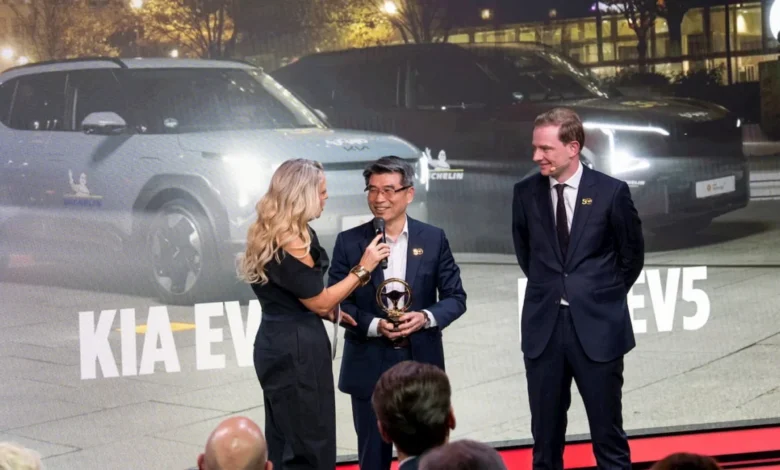
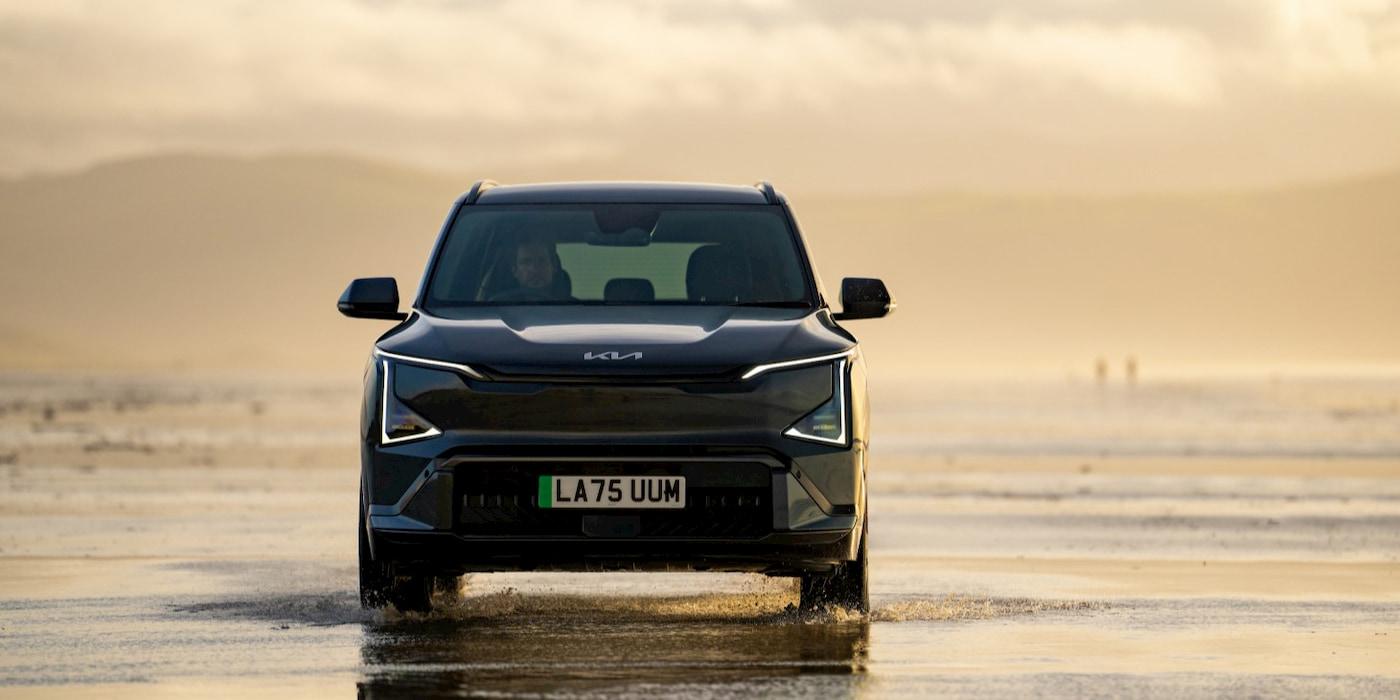
In the highly competitive compact SUV category, the Kia EV5 triumphed over formidable regional rivals such as the Audi Q3 and the Cupra Formentor VZ5. Roughly comparable in physical footprint to the familiar Kia Sportage, the EV5 brings robust utility to the electric landscape. It is offered in both front-wheel-drive and dual-motor all-wheel-drive configurations, pushing driving ranges beyond 550 kilometers (341 miles) on a single charge. Demonstrating that EVs can match the utility of traditional internal combustion vehicles, select configurations of the EV5 boast a towing capacity of up to 1,800 kilograms (roughly 4,000 pounds).
Rounding out the historic treble was the gas-powered Kia K4 Sportswagon. Launched earlier in May, the wagon outperformed modern electric competitors in the broader compact class, including the Volkswagen ID.3 Neo and the Cupra Born. The victory of the K4 Sportswagon serves as a reminder that Kia remains committed to refining traditional powertrains even as it aggressively expands its electric footprint.
Leadership Reactions and Corporate Significance
Accepting the awards at the official ceremony in Germany, Ho Sung Song, President and CEO of Kia Corporation, emphasized the profound importance of the milestone. Standing alongside prominent German television presenter Barbara Schöneberger and BILD Group CEO Christoph Eck-Schmidt, Song remarked that the triple victory validates Kia’s long-term strategy of localized product development, technological innovation, and aggressive electrification.
Industry analysts note that capturing three Golden Steering Wheel awards in a single year represents a significant psychological barrier broken for Asian automakers in the European heartland. Germany, home to automotive giants like Volkswagen, BMW, and Mercedes-Benz, has historically favored domestic or broader European nameplates. Kia’s triumph indicates that European consumers and critics alike now view the South Korean brand not merely as a competitive alternative, but as an industry benchmark for quality and value.

This success builds upon previous milestones for the brand. In 2024, the Kia EV3 secured the Golden Steering Wheel award for "Best Car Under €40,000," proving that the brand’s formula for affordable, high-range electric vehicles is consistently repeatable.
Geographic Discrepancies and North American Market Realities
While the European automotive landscape celebrates Kia’s latest generation of localized offerings, the brand’s regional product strategy highlights stark differences between global markets.
Currently, Kia has no plans to introduce either the award-winning EV2 or the compact EV5 to the North American market. Automakers frequently tailor their portfolios to regulatory requirements, consumer size preferences, and charging infrastructure availability across different continents. Consequently, American consumers will not have direct access to the specific models that dominated the German podium.
However, North American buyers are not entirely excluded from the brand’s recent wave of award-winning design and engineering. The Kia EV3—spiritual sibling to the European EV2 and EV5—has officially landed in North America. Following its European predecessor’s award-winning trajectory, the 2027 Kia EV3 has established itself as one of the most competitively priced electric vehicles available in the United States, carrying a starting MSRP of $29,890.

The North American EV3 lineup is structured to offer substantial consumer choice across five distinct trim levels and two battery capacities. The entry-level EV3 Light utilizes a 58.3 kWh battery pack, delivering an EPA-estimated range of 221 miles. Meanwhile, higher trims—including the Wind, Land, GT-Line, and performance-oriented GT—upgrade to a larger 81.4 kWh battery pack, extending the driving range to an impressive 321 miles per charge.
Broader Industry Implications and Future Outlook
Kia’s unprecedented success at the 2026 Golden Steering Wheel Awards serves as a bellwether for the ongoing transformation of the global automotive sector. As legacy automakers grapple with the complexities of transitioning to electric mobility while managing fluctuating consumer demand, companies with flexible manufacturing platforms and rapid development cycles are pulling ahead.
By engineering vehicles that successfully bridge the gap between affordability, high-range capability, and everyday utility, Kia has demonstrated how traditional automakers can capture market share from both legacy competitors and emerging EV startups. As the brand continues to expand its comprehensive lineup—which in Europe spans from the entry-level EV2 through the EV3, EV4, EV5, EV6, the flagship three-row EV9, and the commercial-focused PV5 van—the pressure on European and domestic manufacturers to innovate will only intensify.
The 2026 awards ceremony will likely be remembered in automotive history books not just as a night of celebration for Kia, but as the moment the traditional hierarchy of the European car market was definitively redrawn.
Related posts: