The global technology market is currently navigating a period of significant price volatility driven by a prolonged memory and semiconductor supply chain crunch. As inflation and production costs continue to impact the retail landscape, consumers are increasingly cautious about their discretionary spending. However, the maturation of consumer electronics has created a robust secondary tier of high-performance devices that maintain accessibility without compromising on utility. For many, the goal is to balance professional requirements and personal entertainment needs while adhering to a strict budget of $50 or less per unit.
The Economic Context of Budget Tech
As of September 2026, the consumer electronics industry is balancing high-end innovation with a necessity to provide value-oriented hardware. Major manufacturers have increasingly adopted a strategy of “tiered feature sets,” where core technology—such as high-fidelity audio drivers or efficient wireless charging protocols—trickles down from flagship models into more affordable entry-level devices. This shift has allowed companies like Anker, JBL, and 8BitDo to capture a significant market share among price-sensitive demographics, providing functional, durable, and highly rated equipment that addresses common pain points in the digital lifestyle.
Audio Solutions: Balancing Fidelity and Portability
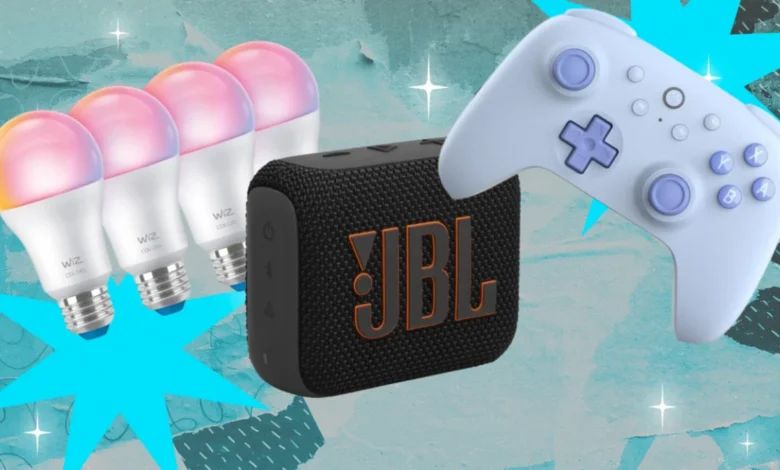
Audio equipment represents one of the most competitive segments under the $50 threshold. The JBL Go 4 has emerged as a leader in the ultra-portable category. Engineered for rugged environments, it carries an IP67 rating, ensuring resistance against both dust and water ingress. From a technical standpoint, the device leverages proprietary pairing technology that allows users to synchronize multiple units, effectively creating a decentralized, wide-area audio network.
Alternatively, the Anker Soundcore 2 serves as a viable competitor for users prioritizing longevity. With a 24-hour battery life—a significant increase over the Go 4’s seven-hour capacity—it serves a different use case: long-term, static audio playback. While the Soundcore 2 lacks the high-level dust protection found in the JBL model, its power efficiency makes it a preferred choice for stationary outdoor events or office settings.
For personal listening, the market has seen a surge in value-oriented earbuds. The Anker Soundcore P31i offers a compelling value proposition by integrating Active Noise Cancellation (ANC), a feature historically reserved for premium audio devices costing upwards of $200. With 50 hours of total playback time supported by the charging case and a rapid-charge function—providing 3.5 hours of audio from a 10-minute charge—these buds demonstrate how quickly R&D costs have been amortized across mass-market production.
For users within the Apple ecosystem, the Beats Flex Wireless remain a notable entry. Despite a retail price that occasionally fluctuates above $50, the inclusion of Apple’s W1 chip allows for seamless ecosystem integration, enabling rapid device switching and audio sharing. The persistence of wired solutions, such as the Sennheiser CX 80U, also highlights a segment of the market that remains loyal to analog or direct-digital connections to avoid the latency and battery degradation associated with Bluetooth.
Tracking and Connectivity Tools
Location tracking has become a fundamental aspect of consumer safety and asset management. Apple’s AirTag, retailing at approximately $30, utilizes the Find My network—a massive, crowdsourced infrastructure of millions of active Apple devices—to provide precise location data. This technology represents a significant advancement in consumer-grade geolocation.

For non-Apple users, the Life360 Tile ecosystem offers a versatile alternative. Unlike the AirTag, the Tile system operates independently of a specific smartphone manufacturer’s ecosystem, making it the preferred choice for households with mixed-device environments. These trackers provide a range of form factors, including the slim, wallet-friendly design, which maintains a low profile while offering long-range Bluetooth connectivity.
Smart Home and Streaming Infrastructure
The smart home market has undergone a transition from luxury to utility. WiZ smart light bulbs, for instance, have lowered the barrier to entry for home automation. By offering individual bulbs for approximately $10 and multi-pack options that further reduce the cost-per-unit, WiZ allows users to implement complex scheduling and color-temperature automation without the need for a dedicated, expensive central hub.
In the streaming hardware sector, the Amazon Fire TV Stick 4K Plus has become the industry standard for budget-conscious 4K content delivery. Supporting HDR10, HDR10+, and Dolby Vision, it offers technical parity with much more expensive streaming boxes. Its integration with cloud gaming services, such as NVIDIA GeForce NOW and Xbox Game Pass, reflects a broader trend: the convergence of media consumption and interactive gaming in a single, affordable form factor.
Ergonomics and Power Management
Gaming peripherals often demand a premium price; however, companies like 8BitDo have successfully challenged the industry standard by focusing on functionality over brand-name premiums. The 8BitDo Ultimate 2C controller provides a professional-grade experience for Nintendo Switch users, featuring a layout consistent with high-end controllers while maintaining a price point that makes it accessible to casual gamers.
Finally, power management remains the most critical utility for mobile professionals. The Iniu 10,000mAh portable charger represents the current state of battery technology. By supporting 45W charging, it is capable of providing rapid power delivery to modern smartphones, including the iPhone 17 Pro and Samsung Galaxy S26 Ultra. This ability to deliver high wattage in a compact frame is a testament to recent improvements in lithium-polymer energy density and power management circuitry. Similarly, the Anker 65W 3-port USB-C charger block illustrates the efficiency of GaN (Gallium Nitride) technology, which allows for high-wattage output across three simultaneous connections in a form factor that fits in the palm of one’s hand.
Strategic Implications for Consumers
The existence of high-quality tech under $50 is not merely a matter of convenience; it is a signal of a more mature, efficient, and competitive manufacturing sector. By opting for these budget-friendly alternatives, consumers can maintain a high level of connectivity and productivity without the financial burden associated with "pro-level" branding. As the technology industry continues to evolve through the remainder of 2026, the focus on high-performance, low-cost hardware is expected to grow, further democratizing access to essential digital tools.
Whether it is the resurgence of over-the-air television via budget-friendly antennae—which allow users to bypass expensive cable subscriptions—or the adoption of universal charging standards, the message to the consumer is clear: meaningful technology does not always require a high-end price tag. By focusing on specific utility needs rather than premium ecosystems, the average consumer can build a highly effective, modern technology suite for a fraction of the traditional cost.