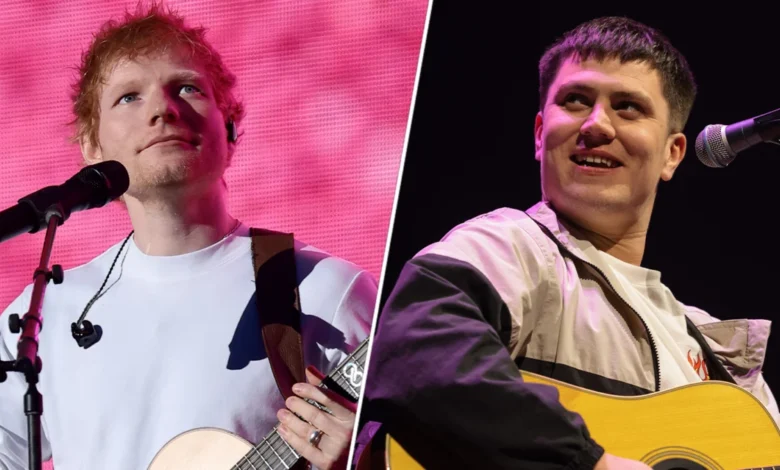
The international music community finds itself at the intersection of live entertainment, corporate influence, and intense geopolitical discourse following a series of rapid developments surrounding global pop superstar Ed Sheeran’s Loop Tour. The controversy, which began with the abrupt removal of hip-hop artist Macklemore over his public remarks concerning the Israel-Hamas conflict, has triggered a domino effect of artist boycotts, venue ultimatums, and fierce debates over free expression in the arts. Despite departing from the tour himself in protest, opening act Aaron Rowe has stepped forward to publicly defend Sheeran, shifting the narrative away from the British singer-songwriter and directing public scrutiny toward billionaire sports mogul and Gillette Stadium owner Robert Kraft.
The unfolding crisis highlights the fragile balance modern touring artists maintain when navigating complex political landscapes, corporate sponsorships, and venue ownership demands. As the Loop Tour now proceeds without any opening acts, industry analysts are closely examining the broader implications of corporate pressure on artistic freedom and the responsibilities of headlining performers when political flashpoints intersect with major concert series.
Chronology of Events: From Stage Remarks to Mass Departures
The sequence of events leading to the dismantling of the Loop Tour’s supporting lineup unfolded over a high-stakes, multi-day span, creating a logistical and public relations crisis for tour organizers.
The friction originated when Macklemore, serving as a prominent support act on the tour, utilized his platform during a live performance to voice support for Palestinian sovereignty, explicitly delivering "Free Palestine" remarks. The statements instantly drew heavy media attention and polarized reactions from concertgoers, local politicians, and venue stakeholders.
By Monday, the situation escalated when pressure mounted from powerful venue operators. Reports confirmed that Robert Kraft, owner of Gillette Stadium and a prominent figure in venue management, organized a collective push involving representatives from several key tour stops. Kraft and associated stakeholders reportedly delivered an ultimatum to tour management, demanding Macklemore’s immediate removal from the remaining itinerary to preempt further political polarization or stadium disruptions.
Faced with mounting pressure, tour organizers—with subsequent statements pointing toward promoter-level decisions—dropped Macklemore from the lineup. Ed Sheeran later addressed the public, explaining that the decision stemmed from promoter and venue-level ultimatums following the coordinated push by venue owners.
The fallout was immediate and severe. In solidarity with the suppressed expression and discontent over how the situation was handled, multiple supporting acts and musicians announced their immediate resignation from the tour. Aaron Rowe, alongside fellow high-profile openers Finneas and Lukas Graham, officially pulled out of their respective supporting slots. Furthermore, Sheeran’s long-standing traditional backing band, Beoga, also elected to withdraw, leaving the Loop Tour entirely devoid of opening acts and supporting ensembles.
Aaron Rowe’s Defense and Shift of Focus
On Friday, Aaron Rowe took to Instagram to address his departure and clear the air regarding Ed Sheeran’s character, while simultaneously redirecting public anger toward Robert Kraft and corporate lobbying influences.
In his video statement, Rowe asserted that public criticism was being misdirected toward Sheeran rather than the figures orchestrating the censorship behind the scenes. "I’m gonna be honest, I think you are all focusing on the wrong person here," Rowe stated. "All I keep hearing is Ed Sheeran this, Ed Sheeran that, but you really should be focusing on the likes of Robert Kraft… on the zionist lobbies that are trying to silence the voices of people who are shouting about genocide, the genocide that is happening in Palestine right now, by Israel."
Rowe acknowledged that while Sheeran’s initial handling and public communication regarding Macklemore’s removal left room for improvement, the decision was born out of panic rather than ideological malice. He characterized the action as "human fucking error" driven by a frantic management team caught off-guard by external pressures. "I do think that Macklemore shouldn’t have been pulled off the tour," Rowe continued. "I fully believe it was panicked stations over there, and they rushed to a decision because they didn’t know what to do, because they were getting it from all angles."
Emphasizing his firsthand knowledge of Sheeran’s personal values, Rowe pointed out that the headliner’s selection of supporting acts consistently reflected pro-Palestine perspectives, arguing that Sheeran would not intentionally surround himself with such artists if his personal beliefs aligned with the censorship. "If Ed Sheeran was a fucking zionist, why would he have all these fucking people on the fucking tour? It was human fucking error," Rowe emphasized, noting that Sheeran had profoundly impacted his own career and possessed a core foundation of kindness.
Rather than maintaining sustained outrage at the headliner, Rowe urged the public and fellow artists to utilize their energy to challenge individuals with immense financial and institutional power. He called for concentrated pressure against figures who attempt to stifle free speech in the cultural and entertainment sectors, framing the moment as a broader fight against the suppression of dissenting opinions on global humanitarian crises.
Industry Implications and the Clash of Free Speech and Corporate Power
The rapid dissolution of the Loop Tour’s supporting acts serves as a profound case study in the modern vulnerabilities of the live music industry. Stadium-scale tours are complex financial ecosystems reliant on a delicate consensus between artists, promoters, booking agencies, multinational corporate sponsors, and venue conglomerates. When geopolitical controversies penetrate these spaces, the inherent friction between commercial interests and artistic free expression frequently results in swift, risk-averse corporate reactions.
Legal and entertainment industry analysts point out that major venue owners hold considerable leverage over touring productions. Venues such as Gillette Stadium operate under strict safety, community relations, and corporate governance guidelines, often positioning stadium executives to demand immediate remediation if an artist’s on-stage political declarations risk alienating major stakeholders, sponsors, or local municipal partners. However, this dynamic creates a dangerous precedent, where economic leverage can effectively dictate what political viewpoints are permissible on a publicly attended stage.
The departure of artists of the caliber of Finneas, Lukas Graham, Aaron Rowe, and the instrumental group Beoga signals a shifting ethos among contemporary musicians. Increasingly, artists are demonstrating a willingness to sacrifice lucrative touring slots and high-profile exposure to maintain ideological alignment and protect the principle of artistic freedom. For supporting acts, whose profit margins are significantly tighter than those of legacy headliners like Sheeran, such a withdrawal represents a major financial sacrifice, underscoring the depth of conviction behind the collective boycott.
Broader Public and Political Reactions
The controversy has transcended the boundaries of entertainment journalism, drawing commentary from political activists, cultural critics, and international observers. The Israel-Hamas conflict has consistently polarized public discourse across Western nations, and the music industry has proven to be no exception.
Supporters of Macklemore have hailed his willingness to speak out against civilian casualties as a courageous use of a public platform, arguing that artists have a moral obligation to address human rights atrocities regardless of commercial consequences. Conversely, critics and certain pro-Israel organizations have argued that concert venues should remain neutral spaces focused on entertainment rather than ideological battlegrounds, asserting that political slogans shouted from concert stages can foster division and alienating ticket holders from diverse backgrounds.
The involvement of Robert Kraft has further magnified the story within American media circles. As the billionaire owner of the New England Patriots and a prominent philanthropist with deep ties to both civic and Jewish community organizations, Kraft represents the intersection of corporate sports management, philanthropy, and political advocacy. The public targeting of Kraft by artists like Rowe introduces a new layer of friction between the entertainment industry and billionaire stadium proprietors, potentially altering how venue contracts handle political speech in the future.
Conclusion and Future Outlook for the Loop Tour
As Ed Sheeran prepares to complete the remaining dates of the Loop Tour entirely without opening acts or supporting bands, the long-term professional and personal fallout remains to be seen. The tour, which once stood as a collaborative celebration of diverse musical talent across multiple genres, now stands as a stark monument to the inescapable reach of global geopolitics into popular culture.
While Ed Sheeran has attempted to distance himself from the administrative decisions that forced Macklemore’s departure, the mass exodus of his supporting lineup suggests that repairing industry relationships and public perception will require sustained transparency and reflection. Whether this high-profile conflict will lead to standardized industry protocols regarding political speech on tour, or simply result in more cautious vetting of supporting acts by promoters, remains one of the most pressing questions facing the live entertainment sector today.