A Pilot Sponsored By Red Lion Gasoline Decided He Should Make A Real Lion His Co-Pilot

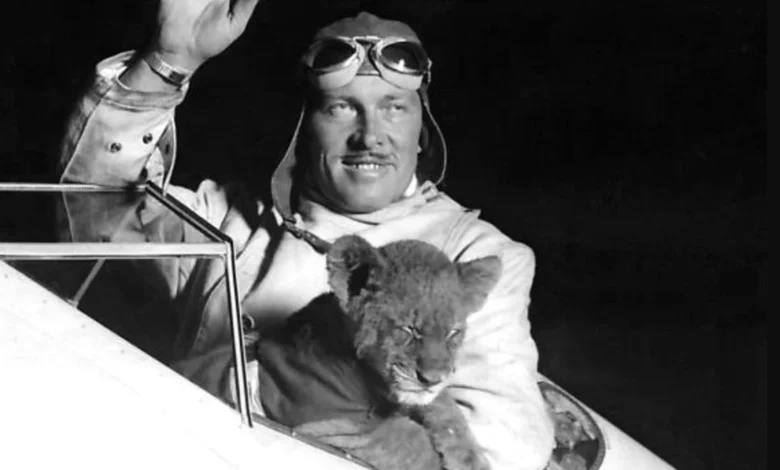
In the annals of early 20th-century aviation, few partnerships have been as bizarrely effective or as culturally enduring as the bond between Roscoe Turner, a flamboyant air racer, and his feline co-pilot, a lion cub named Gilmore. During the formative years of American flight, celebrity was defined by daring, speed, and the ability to capture the public imagination through unprecedented spectacles. In 1930, Turner, sponsored by the California-based Gilmore Oil Company, executed a marketing campaign that bridged the gap between industrial branding and the golden age of barnstorming. By placing a live lion cub into the cockpit of a Lockheed Express, Turner secured his place in history as both a pioneer of high-speed transit and a master of the unconventional promotional stunt.
The Rise of a Showman Pilot
Roscoe Turner’s path to the cockpit was paved with the rugged determination common to World War I veterans. After learning to fly for the U.S. Army, Turner transitioned into the world of barnstorming—a nomadic lifestyle defined by dangerous aerial displays, wing-walking, and parachute jumps. His career was punctuated by both professional achievement and legal turbulence, most notably a 1922 prison stint following the purchase of a Curtiss JN-4 aircraft that was discovered to be stolen government property.
Undeterred, Turner founded the Roscoe Turner Flying Circus, later moving into stunt work for the burgeoning Hollywood film industry. However, the onset of the Great Depression forced a pivot. With capital scarce and the aviation industry looking for new ways to prove the viability of commercial flight, Turner turned to the petroleum industry. He found a willing partner in Earl Gilmore, the proprietor of Gilmore Oil, who sought to market his "Red Lion" gasoline as a high-octane fuel that provided an engine with more "roar."
The Transcontinental Record and the Flying Cub
In early 1930, the partnership between Turner and Gilmore Oil reached its apex. The objective was to demonstrate the reliability and speed of the Lockheed Express by setting a new transcontinental flight record. The journey from New York to Los Angeles was completed in 18 hours and 42 minutes, a feat that drew national headlines. However, it was not merely the time that captured the public’s interest; it was the presence of a three-week-old lion cub in the cockpit.
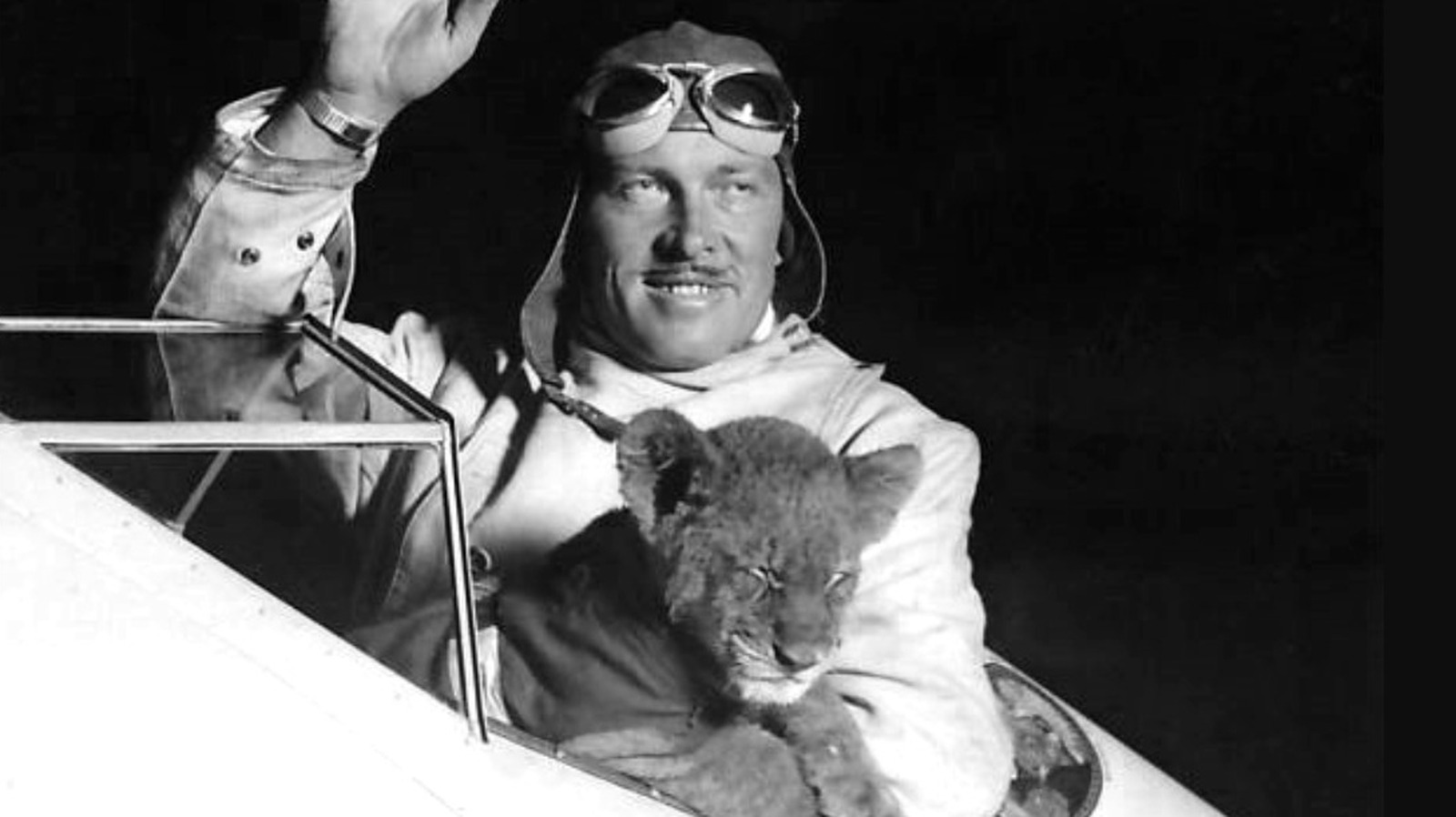
Turner, ever the showman, had convinced a local lion farm owner to donate the cub, which he promptly christened "Gilmore the Flying Lion." The cub became a fixture of the campaign, appearing in speed trials and at the prestigious Cleveland National Air Races. To the public of 1930, the sight of a pilot in a gold-and-crimson uniform with a lion cub by his side was the height of modern adventure.
Chronology of the Aviation Partnership (1930–1933)
The operational life of the "Flying Lion" was intense but brief, reflecting the rapid growth of the cub and the shifting priorities of the aviation industry.
- April 1930: Roscoe Turner and Gilmore the Lion begin a cross-country tour, acting as ambassadors for Gilmore Oil.
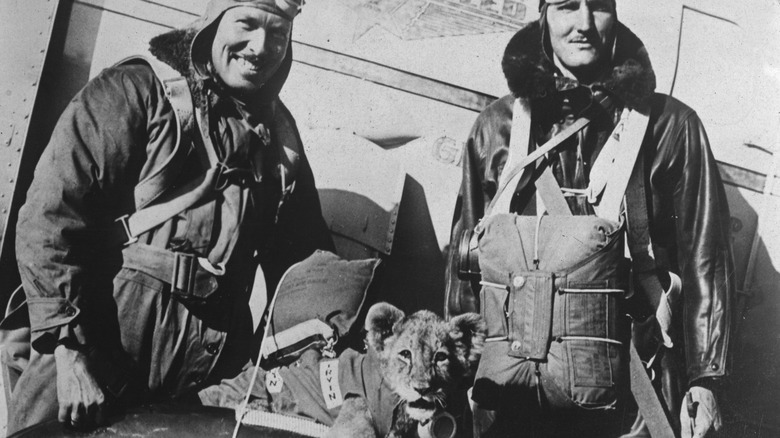
- Summer 1930: The pair performs at various air shows and movie premieres. Under pressure from the Humane Society, Turner outfits the 17-pound cub with a custom-made static-line parachute.
- Autumn 1930: Turner completes a record-setting flight from Vancouver to Aguascalientes, Mexico, with the lion on board.
- December 1930: By the end of the year, the lion reaches a weight of 150 pounds, making further flights in the cramped cockpit of the speed plane untenable.
- 1933: Having retired his lion companion from the air, Turner wins the Bendix Trophy, marking his emergence as one of the premier competitive pilots in the United States.
Professional Reputation and the Humane Society
The reaction to Turner’s stunt was a mix of awe and concern. Fellow aviator Jimmy Doolittle, a legend of World War II, later recalled Turner’s presence at airfields as a sensory experience. Doolittle described Turner’s attire—polished boots, diamond-studded wings, and a waxed mustache—as a theatrical display that masked a highly capable, albeit unconventional, pilot.
However, the Humane Society was less enamored with the spectacle. The organization raised significant concerns regarding the welfare of a lion cub subjected to high-altitude flights and the physiological stressors of aerobatic maneuvers. In response, Turner implemented safety measures, including the aforementioned parachute, to demonstrate that he was a responsible guardian. While these measures satisfied critics at the time, they also served as a clever, albeit macabre, marketing hook that further cemented the "Flying Lion" in the American consciousness.
The Technical Evolution of the Speed Plane
While the lion provided the publicity, the technical development of the aircraft provided the substance. Following the 1930 tour, Turner collaborated with engineers Jimmy Wedell and Harry Williams to refine his racing craft. The resulting low-wing monoplane was an exercise in minimalist engineering: a cockpit consisting of a seat and a tiller, powered by a massive Pratt & Whitney nine-cylinder radial engine. This machine allowed Turner to secure the 1933 Bendix Trophy and the 1934 Thompson Trophy, confirming his status as the fastest man in the air at the time.
The Legacy of the "Monarch of All"
The transition of Gilmore the Lion from the cockpit to the ground was a slow decline from high-altitude fame to regional curiosity. For nearly a decade, the lion was housed in a cage at the Burbank airport and later at a Gilmore gas station in Beverly Hills. The marketing slogan "Monarch of All," which adorned the fuel pumps, was a final nod to the lion’s former status as the face of the brand.
In 1940, the lion returned to the Louis Goebel Lion Farm in Agoura, California, where he lived until his death on December 17, 1950. He was 20 years old, a significant age for a lion in that era, owing largely to the sustained financial support provided by Turner, who continued to send funds for his care long after their flying days had ended.
Historical Significance and Preservation
The remains of Gilmore were eventually taxidermied and placed on display at the Roscoe Turner Museum in Indianapolis. Following the museum’s closure in 1972, the specimen was donated to the Smithsonian’s National Air and Space Museum. Today, the stuffed lion, weighing 328 pounds, serves as a testament to an era where the lines between corporate sponsorship, entertainment, and aviation progress were frequently blurred.
The implications of the Turner-Gilmore partnership are twofold. Firstly, it marked the beginning of modern corporate branding in aviation, proving that an exotic, high-visibility stunt could effectively capture the market share of a regional oil company. Secondly, it highlights the changing ethical standards of the 20th century. What was once viewed as an adventurous display of human-animal companionship would today be considered a violation of animal welfare standards, illustrating how society’s relationship with nature and the definition of "celebrity" have evolved over the last century.
Ultimately, the story of the Flying Lion is more than a footnote in aviation history; it is a case study in the power of narrative. Through careful orchestration, Roscoe Turner turned a fuel company’s branding campaign into a national obsession, ensuring that even as the technology of flight advanced and the Gilmore Oil brand faded, the image of a lion in a flight suit would remain a permanent part of the American cultural tapestry.
Related posts: