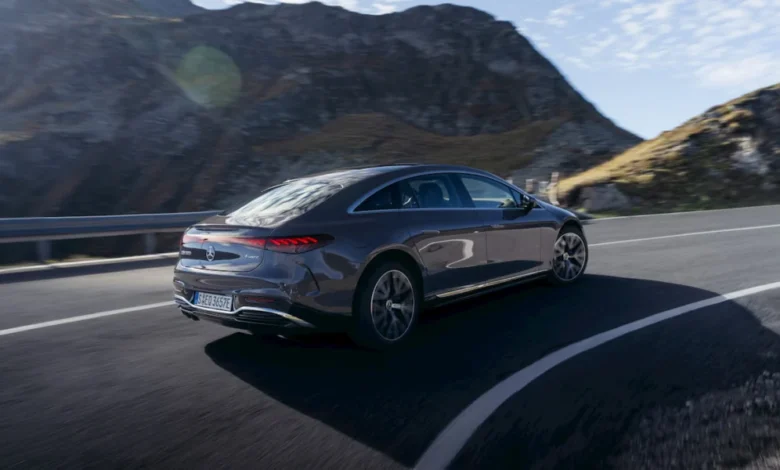
The landscape of electric mobility has reached another milestone as long-distance endurance testing redefines what is possible for luxury battery-electric vehicles. In a recent rigorous evaluation conducted by automotive testing authorities, the newly overhauled Mercedes-Benz EQS 450+ successfully covered an astonishing 539 miles on a single charge under mixed driving conditions. This remarkable feat not only shatters the vehicle’s official Environmental Protection Agency (EPA) estimates but also positions the flagship electric sedan near the absolute pinnacle of real-world energy efficiency and battery endurance in the contemporary automotive market.
The achievement effectively addresses longstanding consumer hesitations regarding long-distance travel in battery-powered vehicles. By clearing the 500-mile threshold by a comfortable margin, the latest iteration of the EQS demonstrates that automotive engineering has entered a mature phase where range anxiety is increasingly becoming a relic of the past, replaced by genuine cross-country touring capabilities that rival or exceed traditional internal combustion engine vehicles.
An Engineering Overhaul: The Evolution of the 2027 EQS
The impressive performance of the 2027 Mercedes-Benz EQS 450+ is not a matter of chance, but rather the direct result of a comprehensive engineering overhaul executed by Stuttgart’s design and powertrain teams. Recognizing the competitive pressures of the luxury EV segment, Mercedes-Benz undertook a systematic redesign of its premier electric sedan platform.
Central to this transformation is the integration of an advanced 800-volt electrical architecture, replacing the 400-volt system found in previous model years. This high-voltage transition yields multifaceted benefits, most notably in thermal management, energy transmission efficiency, and dramatic reductions in charging duration. Accompanying the architectural shift is a high-density, next-generation 122 kWh battery pack. This energy storage unit represents a significant leap forward in chemistry and packaging, packing more kilowatt-hours into a structurally optimized footprint without imposing undue weight penalties that could compromise vehicle dynamics or handling agility.

Prior to its real-world evaluation, the official EPA metrics for the 2027 Mercedes-Benz EQS 450+ were already establishing new benchmarks for the brand, rated at an estimated 467 miles of total driving range. However, controlled laboratory testing protocols rarely capture the nuanced variables of actual highway and urban traffic, making independent evaluations essential for verifying manufacturer claims.
Putting Theory to the Test: The Edmunds Evaluation
The vehicle’s true capabilities came to light during a standardized evaluation protocol administered by automotive researchers at Edmunds. Known for their rigorous, repeatable methodology, these real-world range tests are specifically designed to simulate everyday driving scenarios rather than optimized laboratory conditions.
The testing protocol strictly adheres to a balanced route comprising approximately 60 percent city driving and 40 percent highway transit. To ensure absolute consistency across different vehicle makes and models, test drivers maintain speeds within five miles per hour of posted limits, while the cabin climate control systems are standardized to an automatic setting of 72 degrees Fahrenheit. This prevents hypermiling tactics or artificial climate manipulation from skewing the results, providing consumers with an authentic representation of what they can expect during daily ownership.
When the 2027 EQS 450+ completed its run on the test loop, the odometer read 539 miles. This figure surpassed the vehicle’s own official EPA rating by an extraordinary 72 miles. Within the context of the testing organization’s historical database, the EQS 450+ instantly claimed the title of the longest-range electric sedan ever evaluated by the publication, eclipsing even the Lucid Air, which historically pioneered the commercial breakthrough past the 500-mile barrier for sedans.
To date, the only battery-electric vehicle across all body styles to outdistance the EQS in these specific evaluations is the Cadillac Escalade IQ, which managed 558 miles—a feat enabled by a vastly larger, truck-scale 205 kWh battery pack, highlighting the superior aerodynamic and mechanical efficiency of the Mercedes sedan.

Efficiency Gains and Energy Consumption Metrics
Beyond total distance traveled, the telemetry data gathered during the test revealed profound improvements in energy efficiency. The 2027 EQS 450+ recorded an energy consumption rate of 29.6 kWh per 100 miles, outperforming its own official EPA efficiency estimate of 28 kWh per 100 miles under the specific testing conditions.
To contextualize this progress, a direct comparison with its predecessor is illuminating. During evaluations of the 2025 model year EQS 450+, the vehicle covered a respectable, though comparatively modest, 464 miles while consuming 34 kWh per 100 miles over the exact same route. The combination of aerodynamic refinements, rolling-resistance optimizations, inverter efficiency, and advanced battery management has yielded a generational leap in how effectively the vehicle converts stored electrical energy into forward motion.
Furthermore, the transition to the 800-volt architecture manifested decisively during replenishment evaluations. Technicians observed a peak charging rate of 350 kW, matching manufacturer specifications, while the vehicle sustained an impressive average charging rate of 222 kW throughout the session. By comparison, the preceding generation EQS architecture peaked at 208 kW and sustained an average of just 175 kW.
These charging improvements translate directly to consumer convenience. The updated EQS demonstrated the ability to replenish approximately 825 miles of range in an hour of charging, or add 100 miles of driving capability in just over seven minutes—effectively cutting the replenishment time of the previous model generation nearly in half.
Shifting Consumer Sentiment and Market Context

The emergence of vehicles capable of exceeding 500 miles of real-world driving range arrives at a critical juncture for the global automotive industry. Recent comprehensive surveys concerning consumer adoption trends—including research published by the BMW Group and ongoing analyses by automotive analysts—indicate a fascinating psychological dichotomy among prospective buyers regarding electric vehicle capabilities.
Data suggests that while the vast majority of daily driving requirements are remarkably modest—with studies indicating that roughly 73 percent of motorists find that 25, 50, or 75 miles of daily range is entirely sufficient for their routine commuting and errands—psychological barriers persist. Approximately 42 percent of surveyed consumers state they demand an official driving range of at least 300 miles before they would seriously consider transitioning from an internal combustion vehicle to a battery-electric platform.
This discrepancy highlights the role of range as a psychological safety net rather than an absolute daily requirement. High-capacity flagships like the EQS 450+ effectively neutralize this hesitation, providing an abundance of capability that completely eliminates trip-planning anxiety for long-distance travel.
Simultaneously, consumer research underscores the growing importance of ultra-fast replenishment infrastructure. More than half of surveyed motorists indicate they would feel significantly more confident adopting an electric vehicle if it possessed the capability to recover roughly 150 miles of range in approximately 10 minutes. With the 2027 EQS achieving parity in both high-capacity endurance and rapid energy replenishment, luxury electric vehicles are rapidly converging on the operational convenience traditionally associated with liquid-fueled automobiles.
Broader Industry Implications
The performance benchmarks set by the Mercedes-Benz EQS 450+ are part of a broader, accelerating trend across the premium and mainstream automotive segments. Recent evaluations of competing models reveal a synchronized industry-wide push toward enhanced efficiency. For instance, contemporary luxury electric SUVs and crossovers evaluated under identical real-world protocols have demonstrated similarly dramatic over-deliveries against EPA estimates, signaling that modern propulsion systems are inherently more efficient on open roads than legacy testing cycles suggest.

As battery chemistries evolve, thermal management systems become more sophisticated, and software-defined power distribution matures, the baseline capabilities of electric vehicles are undergoing a permanent upward shift. Manufacturers are no longer forced to choose between ultra-luxury performance and long-distance utility; instead, aerodynamic optimization, silicon-carbide power electronics, and high-density cells are allowing engineers to deliver both in a single cohesive package.
Ultimately, the successful execution of the 539-mile real-world test by the Mercedes-Benz EQS 450+ serves as a watershed moment for the viability of long-range electric luxury transport. By outperforming its own certification metrics and establishing new efficiency standards, the vehicle underscores a future where electric mobility accommodates any lifestyle or travel requirement without compromise.