A Catastrophic End Awaits the Outer Solar System as the Sun Approaches Its Final Transformation

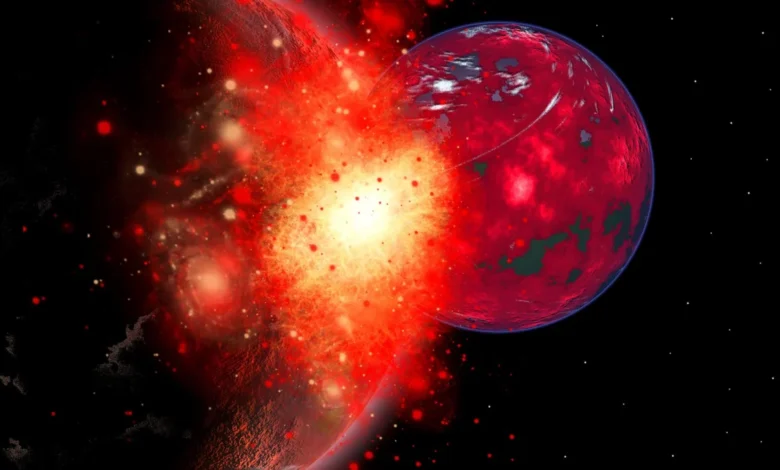
When the sun inevitably dies, not even the outer solar system will be safe from the resulting chaos, new research hints. For decades, the prevailing consensus among astrophysicists was that the outer solar system—comprising the four gas and ice giants Jupiter, Saturn, Uranus, and Neptune—would remain a relatively stable, albeit lonely, relic long after the sun exhausted its nuclear fuel. However, groundbreaking simulations detailed in a study published on September 21 in The Astrophysical Journal Letters suggest that the terminal phase of our star’s life will trigger a violent, gravitational upheaval, potentially leading to the wholesale destruction of the outer planets through catastrophic collisions within three billion years of the sun’s transition into a red giant.
The Dynamics of Solar Evolution
To understand the precarious future of the outer planets, one must first consider the life cycle of the sun. Currently, the sun is a main-sequence star, steadily fusing hydrogen into helium in its core. This process provides a consistent gravitational anchor, maintaining the delicate balance of the solar system. In approximately five billion years, the sun will deplete its hydrogen supply. At this juncture, the core will contract while the outer layers expand dramatically, cooling to become a red giant.
As the sun expands, it will consume the inner terrestrial planets—Mercury, Venus, and possibly Earth. This loss of mass is the primary driver of the instability predicted by the new research. As the sun sheds its outer layers, its gravitational pull on the remaining orbiting bodies will weaken. Scientists have traditionally modeled this as a slow, gradual "puffing out" of the planetary orbits, where the giant planets would simply migrate to wider, safer paths. The new study, however, challenges this optimistic assessment.
Unraveling the Stability of the Giants
The research team utilized advanced N-body simulations to model the gravitational interactions of the outer planets as the sun sheds roughly half of its total mass. These simulations revealed that the loss of stellar mass alters the resonance between the giant planets. In orbital mechanics, resonance occurs when two or more orbiting bodies exert a regular, periodic gravitational influence on each other.
The simulations suggest that as the sun loses mass, the orbits of Jupiter, Saturn, Uranus, and Neptune will become increasingly eccentric. This instability disrupts the "gravitational dance" that has kept these bodies in their respective lanes for over 4.5 billion years. Once the resonance is broken, the outer planets may begin to swing wildly through the solar system. In these scenarios, the paths of the giants begin to cross, leading to high-velocity close encounters. Because these planets possess immense mass, even a glancing gravitational interaction can eject a planet from the solar system entirely or, more violently, send it on a collision course with its neighbor.
Chronology of the Final Collapse
The timeline for this celestial demolition is condensed compared to the multi-billion-year lifespan of the sun. The process is predicted to unfold in three distinct stages:
- The Mass-Loss Phase: As the sun becomes a red giant and begins shedding its envelope, the orbits of the outer planets will begin to drift outward. This is a period of "soft" instability where the planets remain in their general zones but experience slight, cumulative perturbations.
- The Resonance Breakdown: Within a few hundred million years of the sun’s peak red giant phase, the mass loss becomes significant enough that the gravitational tether weakens critically. The outer planets enter a chaotic phase where their orbits become highly elliptical and non-aligned.
- The Terminal Collision Era: Within approximately three billion years post-red giant transition, the chaos reaches its crescendo. Simulations indicate that, in many scenarios, the planets collide, merge, or are ejected into interstellar space, leaving behind only a cold, white dwarf star orbited by the shattered remnants of what was once a majestic planetary system.
Supporting Data and Statistical Likelihood
The research team, led by astrophysicists specializing in planetary dynamics, ran hundreds of variations of these simulations to account for different mass-loss rates and initial orbital configurations. While the exact outcome is sensitive to initial conditions, the results are statistically consistent: the "stable" solar system model is increasingly viewed as an outlier.
According to the study, there is a significant probability—estimated by some researchers involved in similar models—that the outer solar system will not survive in its current form. The specific interactions between Jupiter and Saturn are the primary catalysts; as the two largest planets, their shifting mass and gravitational influence dictate the survival of the smaller ice giants, Uranus and Neptune. When Jupiter and Saturn lose their steady orbital resonance, the resulting gravitational "slingshot" effect becomes lethal for the other bodies in the system.
Scientific Implications for Exoplanetary Studies
The implications of this study extend far beyond our own solar system. For decades, astronomers have used the current structure of our solar system as a "template" for identifying potentially habitable systems around other stars. If our solar system is destined for such a violent end, it forces a re-evaluation of how we categorize exoplanets and the longevity of planetary systems orbiting aging stars.
If planetary systems generally undergo a period of "orbital suicide" at the end of their host star’s life, it suggests that the debris disks often observed around white dwarfs—the cooling, collapsed cores of dead stars—are not merely the remnants of asteroids or comets. Instead, these disks may be the pulverized remains of giant planets that met the same fate predicted for our own solar system. This insight could provide a "smoking gun" for astronomers observing white dwarfs, allowing them to better interpret the chemical signatures of the debris surrounding these stellar corpses.
Broader Context and Future Research
This research does not exist in a vacuum. It builds upon years of work regarding the "Nice Model," which explains how the giant planets reached their current positions through early migration and instability. The new findings essentially provide the final chapter to the story that the Nice Model began.
Experts in the field of planetary science note that while the study is robust, it remains a simulation-based projection. Future observations from deep-space telescopes and refined mathematical modeling will be required to confirm the precise mechanisms of this instability. However, the study provides a compelling, if sobering, narrative: the stability of the solar system is a temporary phenomenon, contingent upon the steady, reliable gravity of our sun.
As we look to the distant future, the research serves as a reminder of the dynamic, ever-changing nature of the universe. While humanity’s presence in the solar system will be long gone by the time these events occur, the discovery provides a deeper appreciation for the current epoch of stability. We are living in a rare, fleeting window of relative peace in the history of our solar system, a brief moment before the inevitable, chaotic dance that will eventually reshape the architecture of our local neighborhood.
Conclusion
The finding that our outer solar system is destined for a chaotic and potentially destructive end is a significant shift in astronomical theory. By challenging the long-held assumption that the gas giants would simply drift into a silent, stable retirement, this research provides a clearer, more violent, and ultimately more accurate picture of the life and death of planetary systems. As we continue to scan the cosmos for other worlds, this study serves as a critical lens through which we can view the past, present, and future of all planetary systems, including our own. The fate of the outer giants remains a testament to the fact that, in the cosmos, nothing remains static for eternity.