Hubble Space Telescope reveals stunning new imagery of the N44 nebula in the Large Magellanic Cloud

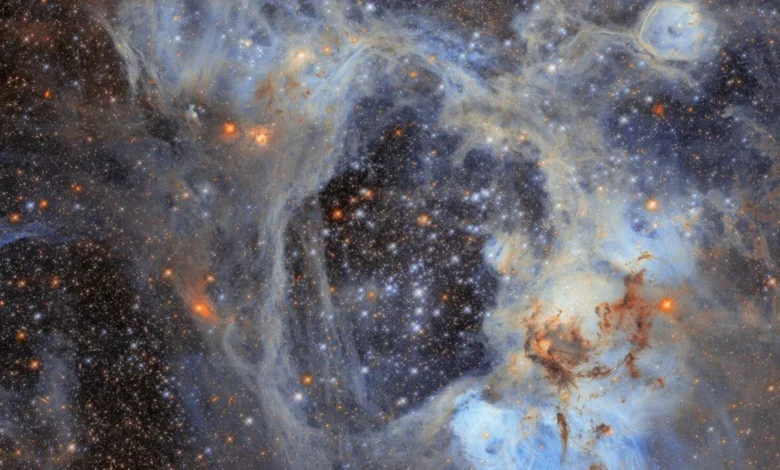
The Hubble Space Telescope has once again provided the scientific community and the general public with a breathtaking glimpse into the mechanics of star formation, releasing a high-resolution observation of the LHA 120-N44 nebula. Located approximately 160,000 light-years from Earth within the Large Magellanic Cloud—a satellite galaxy to our own Milky Way—the nebula remains a primary subject of study for astronomers seeking to understand the complex life cycles of massive stars and the interstellar medium. The imagery, unveiled on September 3, 2026, showcases a complex tapestry of swirling gases, ionizing radiation, and stellar winds that define this unique region of the constellation Dorado.
Unveiling the Structure of N44
The N44 nebula is not merely a singular cloud of gas; it is a complex of several distinct, interconnected regions of ionized hydrogen. The nebula is categorized as an H II region, a massive cloud of partially ionized gas where star formation is currently active. The most striking visual features captured by Hubble are the glowing filaments and cavities carved out by the intense energy emitted by young, massive stars.
The structural complexity of N44 is largely attributed to "feedback" processes. As massive stars are born, they emit powerful stellar winds and ultraviolet radiation that push away the surrounding dust and gas. This creates large, bubble-like voids within the nebula. Furthermore, the supernovae—explosions of massive stars that have reached the end of their lives—contribute to the expansion and shaping of these cavities. The resulting structure is a chaotic, beautiful, and highly energetic environment that serves as a laboratory for understanding how stellar feedback influences the evolution of galaxies.
Chronology of Observation and Research
While the 2026 release highlights the latest iteration of imaging technology, the scientific history of N44 spans decades of telescopic observation. The Large Magellanic Cloud has long been a preferred target for Southern Hemisphere astronomers due to its proximity and relative lack of foreground obscuration.
- Mid-20th Century: Early wide-field surveys identified N44 as a significant emission nebula, though the resolution of the era limited the understanding of its internal structure.
- 1990s: The deployment of the Hubble Space Telescope allowed for the first detailed looks at the "superbubble" structure of N44. Astronomers began to identify the OB associations—groups of massive, short-lived stars—that drive the nebula’s expansion.
- Early 2000s: Multi-wavelength studies, combining optical data with X-ray observations from the Chandra X-ray Observatory, revealed the presence of hot, X-ray-emitting gas within the bubbles, confirming the role of supernova remnants in the nebula’s evolution.
- 2026: The most recent imaging data utilizes advanced processing techniques to provide unprecedented clarity on the interaction between the stellar winds and the dense molecular clouds, refining models of star formation efficiency in high-radiation environments.
Supporting Data and Scientific Context
The significance of N44 lies in its classification as an "emission nebula." It is home to a massive star cluster, often referred to as an OB association. These stars are characterized by their high mass and short lifespans, typically burning through their nuclear fuel in only a few million years.
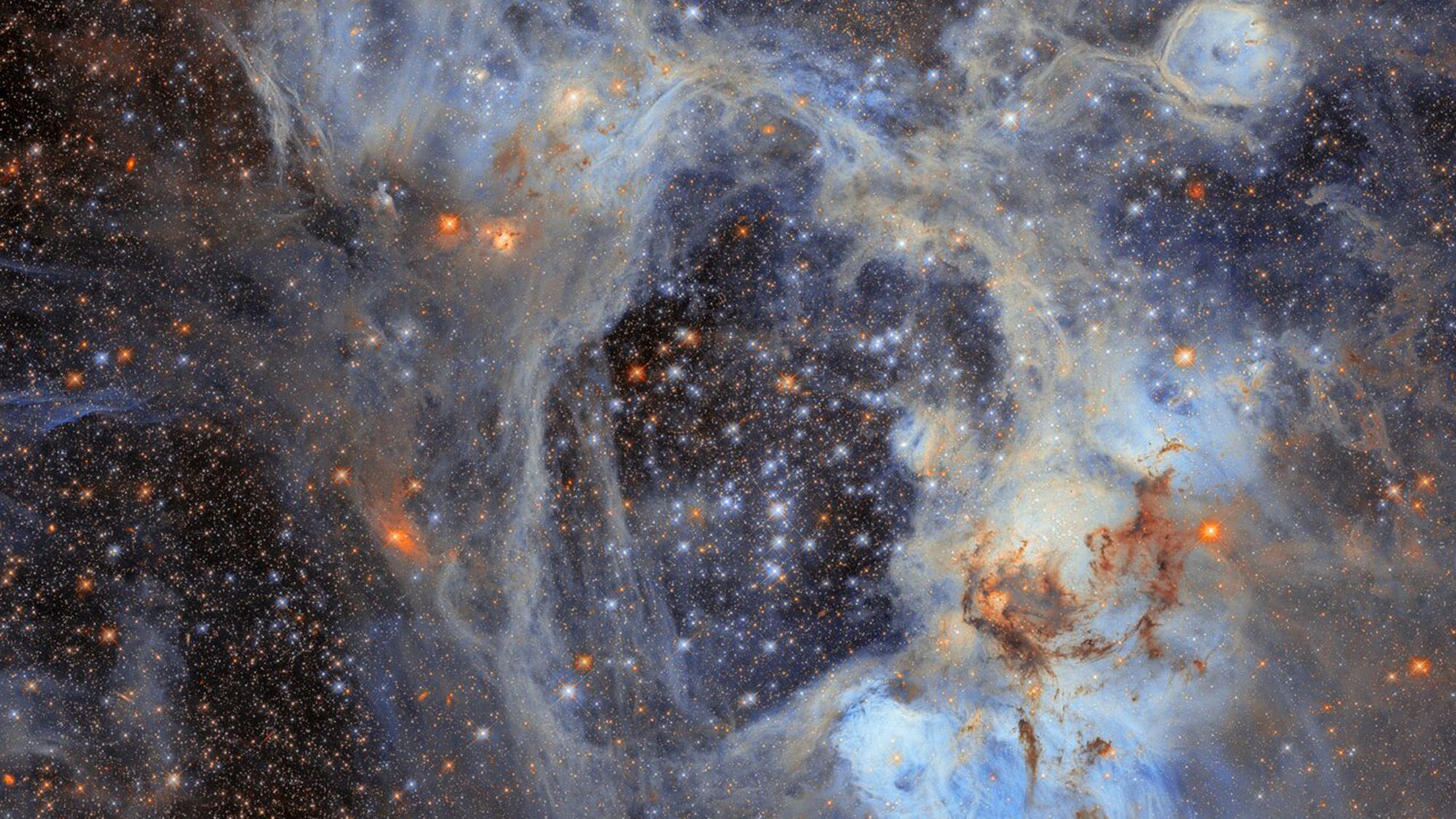
The gas within N44 is primarily hydrogen, which is ionized by the ultraviolet light from these young stars. When the electrons and protons recombine, they emit light at specific wavelengths, which is what allows the Hubble telescope to map the nebula in such vivid detail. The "swirls of brown and blue" observed are the result of dust particles scattering light and the specific emissions of ionized elements.
Quantitatively, the N44 complex spans roughly 1,000 light-years in diameter. The density of the gas in these regions is significantly higher than in the general interstellar medium, acting as a gravitational trigger that pulls together material to form the next generation of stars. This self-perpetuating cycle of star birth and death is essential to the chemical enrichment of galaxies, as the supernovae release heavy elements forged in the hearts of stars back into the surrounding medium.
Scientific Implications and Institutional Responses
The release of this imagery is not merely an aesthetic endeavor; it is part of an ongoing effort by the European Space Agency (ESA) and NASA to archive and analyze the dynamics of the local group of galaxies. By studying N44, researchers are gaining a better understanding of "starburst" regions—areas where stars form at an accelerated rate compared to the rest of the galaxy.
Astrophysicists analyzing the data suggest that N44 provides a proxy for understanding the early universe. In the early stages of cosmic history, star formation was far more violent and frequent than it is in the Milky Way today. Because N44 is relatively nearby, it offers a high-resolution view of processes that were common in the infant universe.
"Observations like those of N44 help us refine our models of how stellar feedback regulates galaxy growth," noted an analysis by researchers associated with the Hubble project. "By mapping the cavities and the distribution of ionized gas, we can calculate the energy balance between the radiation of the stars and the pressure of the interstellar medium. This data is critical for simulations that predict how galaxies evolve over billions of years."
The Broader Impact on Astronomy
The accessibility of this data to the global scientific community facilitates a collaborative approach to astrophysics. The imagery is being used by researchers to calibrate models of "photoevaporation," a process where high-energy radiation strips away the outer layers of gas from dense, newborn star clusters. This process can essentially "starve" a nascent star of the material it needs to grow, effectively capping the maximum mass a star can reach.
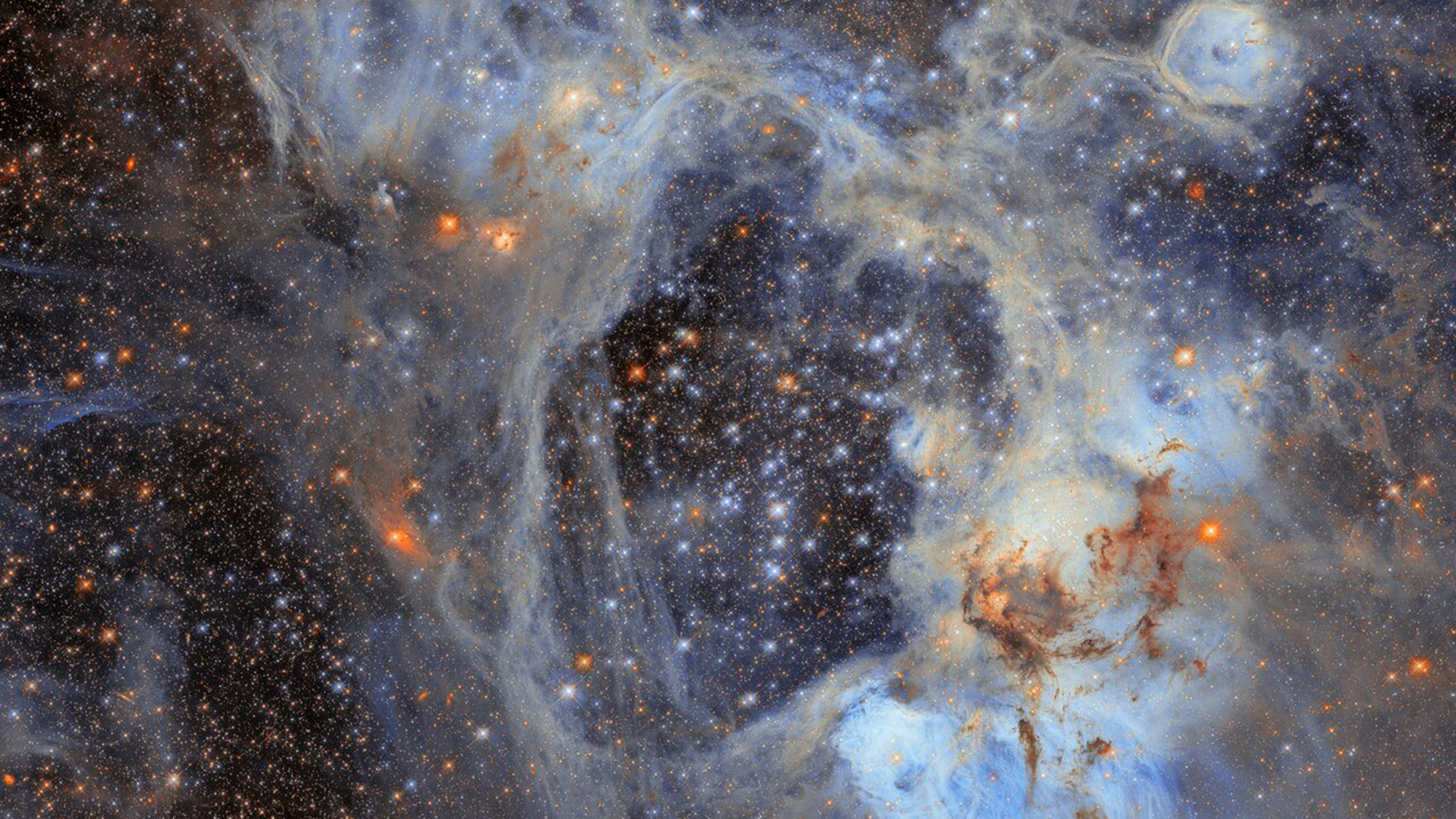
Furthermore, the public release of these images serves as a bridge between professional research and the public interest in space exploration. For the general audience, the N44 image serves as a reminder of the vast, dynamic nature of the cosmos. For the professional astronomer, it represents a data point in a much larger puzzle regarding the life cycles of stars and the chemical evolution of the universe.
Future Research Directions
As the James Webb Space Telescope (JWST) continues to operate alongside Hubble, researchers are increasingly combining data from both observatories. While Hubble excels in the optical and ultraviolet spectra—perfect for viewing the glowing gas of N44—Webb provides infrared capabilities that can peer through the thick, obscuring dust lanes. Future studies are expected to combine these datasets to create a "panchromatic" view of the nebula, allowing astronomers to see the stars hidden deep within the dark, brown filaments of dust that currently block out the light.
This synergy between different space-based assets ensures that the study of N44 will remain a cornerstone of galactic astronomy for years to come. The 2026 imagery, while definitive for now, is essentially a high-fidelity snapshot of an evolving system. As the stellar winds continue to blow and the older stars reach their explosive conclusions, the shape and chemical composition of N44 will shift, providing future generations of scientists with new data to analyze.
The work remains a testament to the longevity and continued utility of the Hubble Space Telescope, which, despite having been in orbit for decades, continues to produce science that challenges our understanding of the universe. The documentation of the N44 nebula stands as a highlight of this endeavor, capturing the raw, creative, and destructive forces that govern the life of a galaxy.
Related posts: